Healing from Church Hurt: A Narrative Journey Toward Spiritual Wholeness

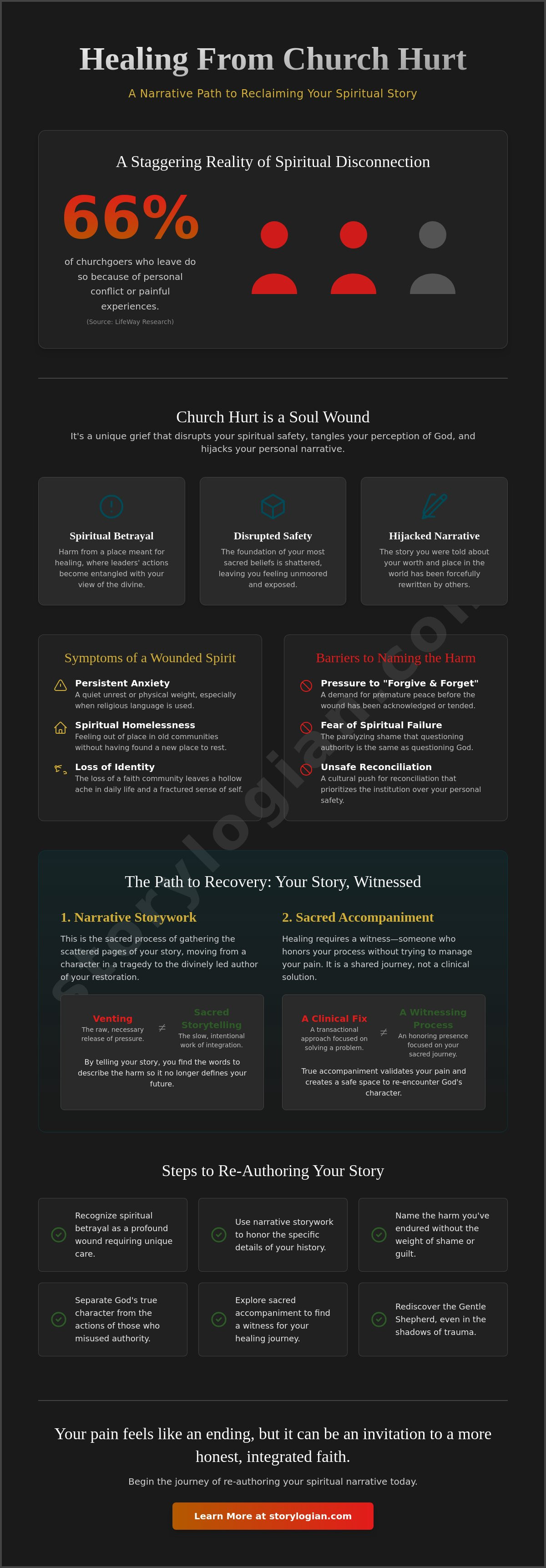
LifeWay Research found that 66% of churchgoers who stop attending regularly do so because of personal conflict or painful experiences. It's a staggering number. It represents a vast, quiet landscape of grief. You likely know the weight of this silence. You've felt the sharp dissonance between the God you love and the community that failed you. Finding true healing from church hurt requires a shift in perspective. What if the pain that feels like an ending is actually the invitation to a more honest, integrated faith?
It's exhausting to carry the shame of a story you didn't choose to write. You deserve a space where your pain is witnessed rather than managed. This article explores how the sacred art of storywork and accompaniment can help you move from being a character in a painful history to becoming the divinely led author of your own spiritual narrative. We'll look at how to name your harm without shame; moving toward a sense of spiritual peace that feels like a shared journey rather than a clinical solution.
Key Takeaways
Recognize why spiritual betrayal feels like a profound disruption of your internal safety. It's a wound that requires a different kind of tending.
Discover how narrative storywork allows you to honor the specific details of your history. This is a vital step toward healing from church hurt.
Learn to name the harm you've endured without the weight of shame. You'll find the language to re-author your story from one of betrayal to one of hope.
Separate the character of God from the actions of those who misused their authority. It's possible to rediscover the Gentle Shepherd even in the shadows of trauma.
Explore the path of sacred accompaniment. This approach focuses on witnessing your process rather than offering a transactional or clinical fix.
Table of Contents
Understanding the Weight of Church Hurt as a Soul Wound
To be wounded in the sanctuary is a singular grief. It's a disruption of the very ground you stand on; a tearing of the veil that once protected your most sacred beliefs. Unlike other relational traumas, spiritual betrayal involves the divine. It's as if the map you used to navigate the world has been set on fire by the very people who gave it to you. This is why the process of healing from church hurt feels so much like a reclamation of one's own life. It's a soul wound. It's a profound disruption of your spiritual and emotional safety that leaves you feeling exposed and unmoored.
When a leader or a community speaks in the name of God, their actions become entangled with your perception of the Creator. If they are cruel, God feels cruel. If they are manipulative, the heavens feel like a trap. This isn't just an event you can walk away from. It's a narrative interruption. The story you were told about your worth and your place in the world has been hijacked. Validation is the first step toward wholeness. You must acknowledge that being harmed in a place meant for healing is inherently soul-crushing. Your pain isn't a lack of faith. It's the natural response of a heart that's been betrayed at its deepest level.
The Symptoms of a Wounded Spirit
You might feel a quiet unrest that follows you into every room. It's a persistent hum of anxiety that makes sacred spaces feel like sites of danger. Some experience this as a physical weight in the chest or a sudden, sharp exhaustion when religious language is used. This often leads to a state of spiritual homelessness. You're no longer at home in your old pews, but you haven't found a new place to rest. Understanding the Weight of Church Hurt as a Soul Wound requires looking at how these symptoms mirror the cognitive and social impacts of religious trauma. It's a complex landscape where the loss of communal identity leaves a hollow ache in your daily life.
Why We Struggle to Name the Harm
Naming the harm is difficult because of the halo effect. We've been taught to view spiritual authority as synonymous with divine will. To question a leader feels like questioning God Himself. This creates a paralyzing shame that silences the wounded. You aren't "bitter" for feeling the sting of betrayal; you're injured. The path toward healing from church hurt doesn't demand that you rush toward a hollow peace. It asks you to sit with the reality of your history until the truth begins to set you free. Consider these common barriers to naming the harm:
The pressure to "forgive and forget" before the wound has even been cleaned.
The fear that acknowledging abuse is a sign of spiritual failure or rebellion.
The cultural demand within congregations for reconciliation at the expense of personal safety.
Recognizing spiritual abuse as a legitimate injury is an act of truth-telling. It's the moment you stop protecting the institution and start protecting your soul. This shift is quiet and slow, but it's the only way to move toward a sense of integrated wisdom.
Why Your Spiritual Story Needs to be Told and Witnessed
Your story is not a problem to be solved. It's a landscape to be honored. When you experience betrayal, your internal library is scattered. Narrative storywork is the process of gathering those pages. It's a tool for spiritual formation that moves beyond the clinical. It's an act of spiritual reclamation. You're taking back the pen. This process is the quiet, methodical labor of healing from church hurt. It's about moving from being a character in a tragedy to becoming the divinely led author of your own restoration.
God is the Great Author. He doesn't skip chapters. He dwells in the specific, often painful details of our history. This is why Reclaiming God’s Character from the Shadows of Trauma is so vital. When spiritual trauma occurs, the narrative of God's goodness is often the first thing to break. But God honors your specific history. He is not a distant editor; He is a witness. He invites you to look at the wreckage not with shame, but with a desire for integrated wisdom.
There's a significant difference between venting and sacred storytelling. Venting is the raw release of pressure. It's the necessary scream in the dark. Sacred storytelling, however, is the slow work of integration. It's finding the words to describe the harm so the harm no longer defines your future. It's the intentional path toward healing from church hurt that allows you to breathe again.
The Theology of Personal Narrative
The Apostle Paul describes believers as "living letters" written by the Spirit. Your life is a text. It deserves a careful, reverent reading. Silence is often the enemy of true spiritual restoration. When we hide our wounds, they fester in the dark. Reclaiming your agency means choosing who gets to read your story. It's a sacred choice that honors your dignity and your history.
The Power of the Witness
We were never meant to carry these stories alone. A witness acts as a sacred guide. They don't offer a fix-it mentality. They offer holy accompaniment. This is the heart of sacred accompaniment. It's the practice of deep listening. It’s a way to see the threads of grace that are often invisible to us when we're in the middle of the storm. A witness holds the space so you can find your way back to your own soul.
The Narrative Path to Recovery: Naming the Harm
The path of healing from church hurt is a rhythmic journey. It is unhurried. It is deliberate. It requires us to look at the sharp edges of our history without flinching. We call this naming the knife. To stop the internal bleeding of a soul wound, we must identify exactly what pierced us. This isn't a clinical exercise. It's a sacred inventory. It’s the difference between a vague sense of unease and the clarity required to move forward. When we name the harm, we begin to take the power back from the event itself. This naming is the first movement toward a story of hope.
This process is not a checklist to be crossed off in a weekend. It's a slow turning of the pages. You might spend weeks on a single chapter of your life, and that is okay. Healing has its own seasons. It follows the natural progression of time and the quiet movements of the Spirit. By allowing yourself the space to be thorough, you honor the weight of what you've endured. You aren't just "getting over it." You are integrating your history into a wiser, more resilient version of yourself.
Identifying the Themes of Spiritual Harm
Patterns often emerge when we look closely at our history. You might see a demand for compulsive availability, where your boundaries were treated as spiritual failures. Or perhaps you recognize toxic shame, a heavy shroud used by leaders to keep you small and compliant. These aren't just personality clashes; they are theological distortions. When a leader uses the concept of "submission" to justify manipulation, they are twisting the text to serve their own shadow. Distinguishing between the fallibility of man and the character of the Divine is a sacred task. It allows you to protect your relationship with the Holy while holding the human institution accountable. This distinction is vital for anyone healing from church hurt.
Reclaiming Your Agency
By naming the specific threads of your story, you reclaim the power to choose how those threads are woven into your future. You move from being a victim of a narrative written by others to becoming a co-author with Christ. This is the heart of storywork. It's a transition from silence to voice, from being acted upon to acting with intention. Practical steps can help facilitate this movement:
Try writing about a specific moment of hurt. Don't use the "church" as a whole. Use names. Use dates. Describe the air in the room.
Identify the "shadows" in your history. What were the unspoken rules you were forced to follow?
Reflect on where you felt the most alone. Bringing these details into the light is how you begin to re-author your life.
This work is quiet. It is steady. It is the methodical grace of taking back your own name.
Reclaiming God’s Character from the Shadows of Trauma
The most devastating casualty of spiritual betrayal is often your image of the Divine. It’s a common, painful objection: if the church is bad, then God must be bad too. This is a natural response to a shattered trust. When those who claim to speak for the Creator use their voice to manipulate or shame, the character of God becomes blurred by the shadows of their actions. Trauma acts as a thick, distorted lens. It magnifies the fear and obscures the love. True healing from church hurt requires a gentle, methodical cleaning of that lens so you can see the Gentle Shepherd apart from the toxic leaders who claimed His name.
This journey isn't about forced reconciliation with an institution. It’s about a slow rediscovery of a Presence that doesn't demand your destruction. Contemplative prayer offers a path through the noise. It’s not about finding the right words or performing for a distant deity. Instead, it’s a practice of quiet presence. In the silence, you might begin to hear a voice that sounds nothing like the one that hurt you. It’s a voice that honors your boundaries and invites you into rest. You're allowed to move at a pace that respects your internal landscape.
Deconstructing the False Images of God
Many carry images of God that were forged in the fires of religious trauma. You might see Him as an "Angry Auditor," perpetually checking your accounts for failure. Or perhaps He feels like a "Distant Taskmaster," impossible to please and quick to abandon. Narrative storywork helps you identify where these images came from. By looking at your history, you can see how a specific leader's cruelty became God’s character in your mind. Finding a safe harbor in the person of Jesus, who often stood against the religious authorities of His day, allows you to reclaim a God who is for you, not against you. This disentangling is essential for healing from church hurt.
Finding Sacredness in the Shadows
God is often found in the very places we were told He left. When you step away from a toxic community, you might feel a profound sense of absence. This is the "Via Negativa," the way of knowing God through what He is not and through the sacredness of the silence itself. You don't have to rush back into spiritual practices that feel like triggers. A slow, deliberate return to what feels safe is an act of holy autonomy. It is a process of reclamation. If you are ready to begin this process of disentangling the Divine from your trauma, consider exploring Storywork Sessions to help you re-author your spiritual path.
Sacred Accompaniment: Finding a Witness for Your Healing
Healing isn't a solo mountain climb. It’s a shared walk through a landscape that has been made unfamiliar by betrayal. When the structures of faith have crumbled, you don't need a blueprint or a checklist. You need a witness. This is the heart of sacred accompaniment. It’s a practice that refuses to rush your grief or manage your pain. In this space, the goal isn't to reach a clinical destination, but to honor the journey itself. Healing from church hurt requires a rhythmic, unhurried pace that respects the complexity of your soul. It’s about finding someone who can hold the weight of your story without flinching or trying to fix what is simply meant to be heard.
StoryLogian offers a unique approach that stands apart from clinical mental health counseling or church administration. We don't look for a diagnosis, nor do we seek to protect an institution. Instead, we look for the threads of your life that have been pulled taut by trauma. Our process is methodical and thorough. It allows ideas to settle before moving to the next thought. This organic flow creates a steady, guided movement that feels intentional. It matches the contemplative nature of the soul. You are invited to slow down and breathe. You are allowed to take up space.
The StoryLogian Approach to Church Hurt
The Sacred Accompaniment model is a shared journey of discovery. It’s a partnership where your autonomy remains central. Dr. Shonda Carter brings a deep expertise in theology and narrative healing to every interaction. She understands that your history is sacred. One-on-one sessions provide a safe container for the heavy stories you’ve been carrying in silence. Here, the internal landscape is explored with reverence. We aren't looking to solve a problem. We are looking to witness and interpret a process. This approach honors the dignity of your history while creating room for integrated wisdom to emerge.
Next Steps on Your Journey
As you consider the next chapter of your spiritual life, remember that you don't have to hurry. Take a moment to breathe and slow down. Your story is still being written, and the chapters of hurt don't have to be the final word. If you feel a pull toward a deeper immersion, a Spiritual Formation Retreat can provide the distance needed to see your life with new eyes. For those seeking a more personal exploration, our Storywork Sessions offer a dedicated path for narrative recovery. You deserve a guide who honors your pace. Begin your journey of sacred accompaniment with StoryLogian and discover the peace that comes from being truly seen.
Reauthoring Your Future with Grace
Your story is a sacred landscape. It deserves to be walked with reverence and care. We've explored how naming the specific threads of betrayal allows you to reclaim your internal agency. You've discovered that God remains the Great Author; even when human hands have smudged the ink of your history, the story isn't over. Healing from church hurt is not about returning to a painful past. It's about moving toward a future where your voice is finally heard and your wounds are honored as part of an integrated, wise whole.
You don't have to carry the weight of these chapters alone. Under the guidance of Dr. Shonda Carter, a theologian and spiritual director, StoryLogian provides contemplative, safe spaces for women to reclaim their narratives. We focus on narrative storywork to facilitate deep trauma healing through presence rather than clinical management. If you're ready to find a witness for your process, we invite you to Explore Sacred Accompaniment and Storywork Sessions. May you find the quiet strength to breathe, to wait, and to begin your next chapter with peace.
Frequently Asked Questions
What is the difference between church hurt and spiritual abuse?
Church hurt is a broad term for the pain experienced within a religious community, often stemming from unintentional slights or human fallibility. Spiritual abuse is more systemic, involving the misuse of sacred authority to control, manipulate, or exploit a person’s faith. While church hurt can be a single event, spiritual abuse is a pattern that weaponizes the Divine against the individual. Both require deep, intentional care to restore a sense of internal safety.
Can I heal from church hurt without leaving my current church?
Healing is possible within your current community if the environment is safe enough for your story to be told and heard. However, the path of healing from church hurt often requires a period of distance to distinguish your own voice from the demands of the institution. It depends on whether the leadership can honor your boundaries and your need for silence during the recovery process. Your soul's safety must always be the priority.
How is spiritual direction different from clinical mental health counseling?
Spiritual direction focuses on your relationship with the Divine and the movement of the Spirit in your life’s narrative. Unlike clinical mental health counseling, which focuses on diagnosing and treating psychological disorders, spiritual direction is a soulful companionship. It's a space for witnessing your spiritual evolution rather than fixing a pathology. It treats your history as a sacred text to be read with reverence rather than a problem to be solved.
What happens if I don’t feel ready to forgive the people who hurt me?
Forgiveness is a slow fruit of healing, not a prerequisite for the journey. If you aren't ready to forgive, it's often because the wound hasn't been fully named or witnessed yet. Forcing a premature peace is often a form of self-betrayal that bypasses the necessary work of truth-telling. Honor your current state. The story of your restoration requires honesty about your pain before it can reach the chapter of reconciliation.
How does narrative storywork actually help with trauma?
Narrative storywork helps you re-author the fragmented pieces of your history into a coherent, integrated whole. Trauma scatters the pages of your life, making you a passive character in a story written by your offenders. By naming the specific themes of harm, you reclaim your agency. You move from being a victim of a painful past to the divinely led author of your own spiritual future. It's a process of taking back the pen.
What is sacred accompaniment and how can it help me?
Sacred accompaniment is a shared journey where a guide walks beside you as a witness to your soul's unfolding. It's not a transactional service or a clinical intervention. Instead, it's a commitment to hold a safe container for your questions and your silence. This practice helps you find the threads of grace that are often hidden beneath the weight of betrayal. It provides the presence needed for healing from church hurt to take root.
Is it possible to trust a spiritual leader again after being betrayed?
Trust can be rebuilt, but it must be earned through a slow, rhythmic demonstration of consistency and humility. You don't have to rush back into vulnerability. It's possible to find leaders who honor your autonomy, but your primary trust should be restored to your own internal navigation first. Healing allows you to develop the discernment needed to know who is worthy of holding your story and who is not.
How long does the healing process from religious trauma typically take?
The timeline for recovery is as unique as your own history. There's no standardized schedule for the soul's restoration. Some find a sense of peace within months, while others spend years slowly untangling the knots of religious trauma. It's a circular process of reflection and discovery that follows the natural progression of time. Be patient with yourself. Healing is a methodical grace that settles into the heart at its own unhurried pace.


Comments