What to Talk About in Spiritual Direction: A Guide to the Sacred Narrative

What if the most "spiritual" part of your week wasn't the hour you spent in a pew, but the ten minutes you spent crying over a broken dish or the quiet frustration you felt during your morning commute? We often carry a heavy anxiety that we're doing this wrong. We worry that our messy, unpolished lives aren't holy enough for a sacred conversation. You might feel a deep disconnect from God amidst the noise of a busy schedule or the lingering ache of past spiritual trauma. It's a common burden to bear. You aren't alone in the silence.
You deserve to know that your whole life is a sacred text. This guide will help you discover how to bring your whole, unedited story into the sacred space of spiritual direction to find God’s presence in the details. We'll explore how your personal history intersects with your faith; providing you with practical prompts and clarity on what to talk about in spiritual direction. Your story is not a problem to be solved. It's a mystery to be honored. Let's begin the process of listening together.
Key Takeaways
Embrace the truth that your ordinary, unpolished moments are the very ground where sacred encounters begin.
Discover what to talk about in spiritual direction by exploring your soul's deep desires and the heavy weight of spiritual dryness.
Learn to view your personal history as a sacred text, identifying the threads of grace and the echoes of harm within your story.
Find gentle ways to process church hurt and the fatigue of religious performance in an atmosphere of total safety.
Establish a quiet pre-session ritual to transition from the noise of life into the presence of sacred accompaniment.
Table of Contents
The Sacredness of the Unedited: What is Appropriate for Direction?
We often arrive at the threshold of a session with an invisible filter. We sift through our week, discarding the grit and the gray, searching for the "holy" fragments we believe are worthy of a spiritual conversation. There's a lingering misconception that we must present a curated version of our souls. We think we need a highlight reel of answered prayers or a polished testimony of peace. But the truth is much simpler, and perhaps more daunting. Everything is material. Everything is sacred.
The practice of spiritual direction is the art of noticing God in the ordinary, unpolished rhythms of your existence. It's not a performance. It's a witnessing. When you wonder what to talk about in spiritual direction, remember that your emotions are the primary vocabulary of your soul. Your anger at a colleague, your boredom during a liturgy, or the sudden joy you felt watching the light shift across a room are not distractions from your faith. They are the very places where your narrative meets the Divine. We're not here to report on our faith; we're here to explore the story God is writing through our lives.
Moving Beyond the 'Prayer Report'
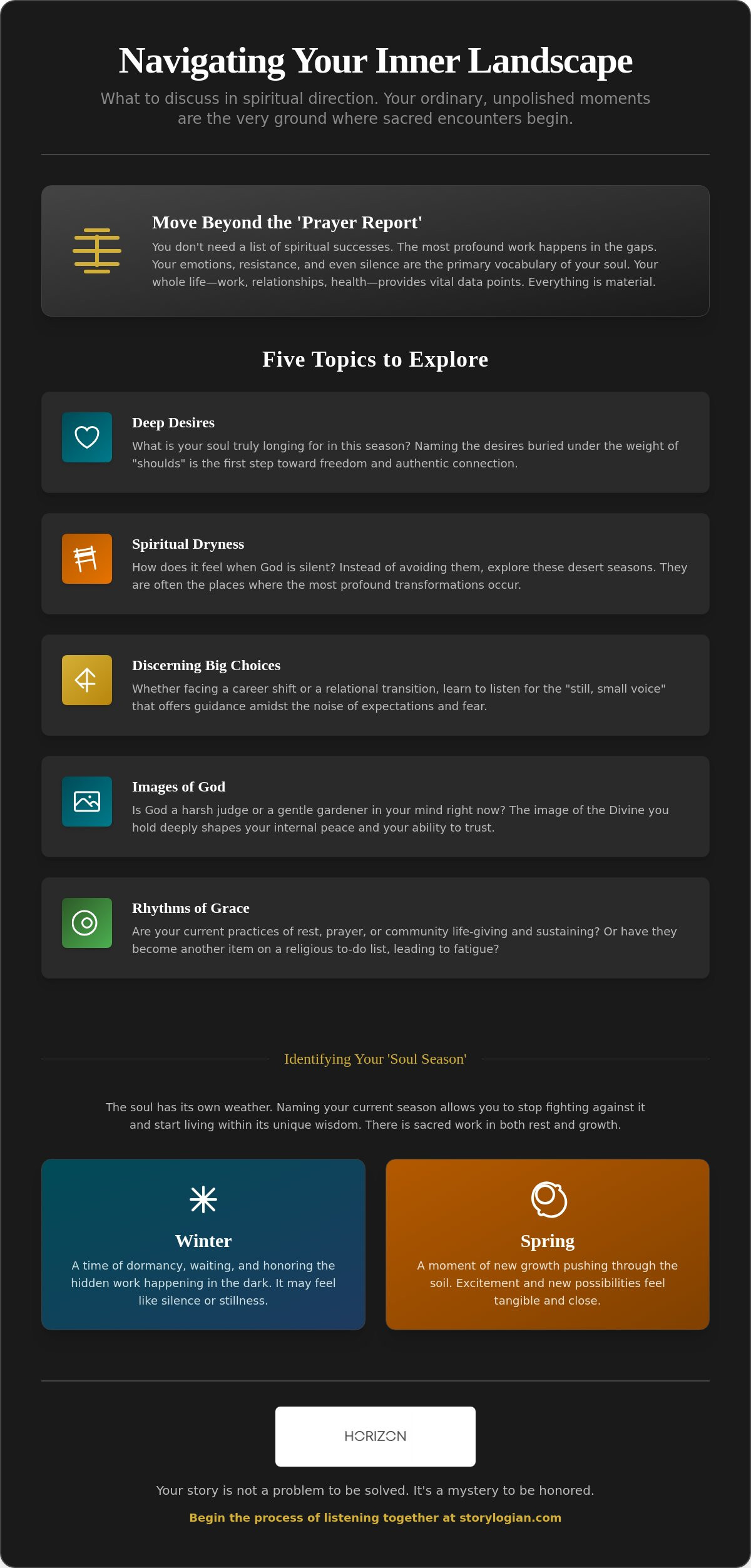
You don't need a list of spiritual successes to show up. Often, the most profound work happens in the gaps. If you've felt a heavy silence from God lately, bring that silence into the room. It isn't a sign of failure. It's a chapter of the journey. We also invite you to discuss your resistance. Why does the thought of silence feel like a threat? Why do you avoid the very practices that once gave you life? These questions hold more wisdom than a dozen "answered" prayers. They reveal the true state of your internal landscape.
The Intersections of Life and Spirit
Your spiritual life doesn't exist in a vacuum. It lives in your body, your bank account, and your kitchen. Work, relationships, and physical health are not secondary concerns. They are vital spiritual data points. When you're deciding what to talk about in spiritual direction, consider the mundane rhythms of your day. It's in the ordinary where the sacred is often hidden.
The physical exhaustion that makes quiet time feel impossible.
The recurring frustration with a neighbor that reveals a deeper longing for peace.
The way a specific project at work makes you feel fully alive or soul-crushingly drained.
There's a sacred thread woven through these daily frustrations. Our task is to slow down enough to see it. We're looking for the God who inhabits the spreadsheets and the sleepless nights just as much as the sanctuary. By bringing these unedited pieces of your life into the light, you allow them to be integrated into your larger story of faith.
Navigating Your Inner Landscape: Five Topics to Explore
The interior life is rarely a straight path. It is a topography of high peaks and shadowed valleys. When you sit down to consider what to talk about in spiritual direction, think of yourself as a cartographer of the soul. You aren't searching for a destination. You're simply naming the terrain. If you find yourself at a loss for where to begin, there are several questions to explore in spiritual direction that can help illuminate the path ahead.
Consider these five specific areas as you prepare for your next session:
Deep Desires: What is your soul truly longing for in this season? Sometimes our desires are buried under the weight of "shoulds," and naming them is the first step toward freedom.
Spiritual Dryness: How does it feel when God is silent? We often avoid the desert, yet the desert is where the most profound transformations occur.
Discerning Big Choices: Whether it's a career shift or a relational transition, we look for the "still, small voice" in the midst of the noise.
Images of God: Is the Divine a harsh judge or a gentle gardener in your mind right now? Your current view of the Divine deeply shapes your internal peace.
Rhythms of Grace: Are your current practices of rest sustaining you, or have they become another item on a religious to-do list?
Identifying Your Current 'Soul Season'
The soul has its own weather. You might find yourself in a season of "winter," where everything feels dormant and the ground is hard. This is a time for waiting and honoring the hidden work of the dark. Conversely, you might be in a "spring" moment, where new growth is pushing through the soil and excitement feels tangible. Naming your spiritual temperature allows you to stop fighting the season you're in and start living within it. It's about finding the grace that is available for today, not the grace you wish you had for a different season.
The Architecture of Your Prayer Life
Prayer is not a singular act. It's a dwelling place. We often limit ourselves to traditional liturgy, yet the soul often craves a different kind of resonance. You might explore the architecture of silence and how it settles in your body. How does stillness feel in your chest? Where does your mind wander when the words run out? Bringing these questions about contemplative prayer into your session can help you build a more sustainable rhythm of connection. If you're feeling the weight of a cluttered soul, perhaps it's time to seek Sacred Accompaniment to help you listen for what truly matters.
The Narrative Thread: Bringing Your Story to Direction
Your personal history is not a distraction from your spirituality. It is the primary text. Every chapter you've lived, including the ones you'd rather tear out, contains the fingerprints of the Divine. When you ponder what to talk about in spiritual direction, look to the narrative arc of your own life. We often think of our spiritual life as something that happens in the margins of our real life. But they are one and the same. They are the same story written with the same ink.
Identifying the threads of your story requires a specific kind of listening. This is where storywork sessions become invaluable. They help you zoom out to see the recurring themes of harm, grace, and resilience that have shaped your soul. By naming these threads, you move from being a passive observer of your past to an active participant in your healing. This clarity is the foundation of integrated wisdom. It allows you to see how God has been present even in the chapters where the plot felt most chaotic. Understanding your history gives you a map for what to talk about in spiritual direction next.
Exploring Family of Origin and Faith
The way we first learned to trust, or not trust, our caregivers deeply informs how we perceive the Divine. If your early narrative was defined by performance or fear, you might find yourself carrying that same weight into your prayer life. These unspoken family rules often become spiritual cages. Bringing these patterns into the light of sacred accompaniment is a profound act of courage. It allows you to identify inherited spiritual burdens that were never yours to carry. You can begin to distinguish between the God of your childhood and the God who is meeting you now.
Finding Sacredness in the Shadows
We all have shadows. We have moments of shame, regret, or deep pain that we try to keep hidden in the cellar of our souls. Yet, these are often the places where grace is most eager to take root. Using the sacred art of storytelling, you can begin to re-author these painful chapters. You aren't changing the facts. You're changing the meaning you assign to them.
When you bring these shadows into a space of mercy, the power of shame begins to dissolve. There is a specific kind of healing that only happens when someone else witnesses your story without judgment. A spiritual director acts as that witness, holding the space for you to see the sacredness in your own shadows. This is not about fixing the past. It's about honoring the divine thread that has always been there, even in the dark. It is about reclaiming the parts of yourself you thought were lost.
When the Path Feels Dark: Processing Pain and Burnout
The light eventually fades. For many, the spiritual journey leads into a thicket where the familiar markers of faith have vanished. This isn't the same as the spiritual dryness we discussed earlier. It's a deeper ache. It's the fatigue of religious performance. It's the exhaustion of trying to look holy while your soul feels like it's crumbling. If you've experienced "church hurt," you know the specific sting of being wounded in the place where you expected to find safety. The sanctuary becomes a source of stress. The liturgy feels like a hollow echo.
When you feel this weight, knowing what to talk about in spiritual direction can feel like trying to speak underwater. You might wonder if your anger at a religious institution is allowed in a sacred space. It is. You might struggle to distinguish between clinical depression and the "Dark Night of the Soul." While a spiritual director is not a clinical mental health counselor, they can help you discern the spiritual dimensions of your pain. They hold a lantern while you navigate the shadows, helping you find the presence of God even in the absence of feeling.
Healing from Spiritual Trauma
Religious systems can sometimes cause profound harm. It's vital to process spiritual trauma with a witness who understands that your voice and your boundaries are sacred. You can reclaim your autonomy. You can name the abuse of power or the manipulation of scripture that left you feeling hollow. A sacred guide helps you untangle the character of the Divine from the dysfunction of human systems. This is the work of reclaiming your story from the hands of those who misread it.
Soul Care for the Weary Leader
Ministry leaders carry a unique, often invisible burden. You hold the stories of others, but who holds yours? It's easy to lose the wonder of your vocation when it becomes a series of administrative tasks and pastoral crises. We must talk about the isolation. We must discuss the "hollowed out" feeling that comes from constant output. Creating a rhythm of soul care for ministry leaders is not about self-indulgence; it's about survival. It's about sustaining the daily work by tending to the internal fire. If you're ready to lay down the burden of performance, our Sacred Accompaniment offers a sanctuary where you can simply be a child of God again.
Preparing Your Heart for Sacred Accompaniment
The hour of accompaniment is a threshold. It is a thin place where the noise of the world begins to recede, allowing the quieter echoes of the soul to be heard. As you prepare, you might feel the familiar urge to tidy up your internal landscape. You might want to present a version of yourself that is more certain, more devout, or more "spiritual." We invite you to resist this performance. The most profound work happens when you show up as your true self. The version of you that is tired. The version that is questioning. The version that is simply here. This honesty is the bedrock of the sacred narrative.
Preparing your heart is not about finding the right words or constructing a perfect agenda. It's about creating a space for those words to emerge naturally. When you consider what to talk about in spiritual direction, look for the places where your life feels most alive or most heavy. Reviewing your journal or your Examen notes from the past month can reveal patterns you missed in the heat of daily life. These notes are not a report card. They are a map of where the Divine has been whispering in the margins of your schedule.
Practical Steps for Preparation
Preparation is a physical act as much as a mental one. Your body often knows the truth before your mind can name it. Before your session begins, try to carve out fifteen minutes of intentional silence. Sit with your breath. Listen to the tension in your shoulders or the fluttering in your chest. These are the physical markers of your story. They are data points for our time together. You might find it helpful to engage in these simple movements of the heart:
Listen to your body: Spend time in stillness, noticing where you are holding the month's stories or stresses.
Name your state: Find one word that describes your soul's current temperature. Is it "parched," "expectant," or perhaps "heavy"?
Choose one thread: Bring one specific story or event from the last month that felt significant, even if you don't yet know why it matters.
Beginning the Journey of Direction
The first few sessions are about building a sacred container. It is a slow, methodical process of establishing trust and safety. This is especially vital in spiritual direction for women, where the space for narrative exploration is often hard-won and deeply necessary. You are deciding what to talk about in spiritual direction while also learning that you are safe to say anything at all. No part of your story is too small or too messy for this space.
You may find that a standard session provides the gentle rhythm you need for ongoing growth. Or, you might feel called to a deeper, more focused dive through a storywork intensive. Both paths lead toward the same goal: integration, wisdom, and peace. If you are ready to begin this unhurried work of listening, we invite you to Book a Storywork Session or Sacred Accompaniment with Dr. Shonda Carter. Your story is waiting to be heard. Let us hold the space for it together.
Embracing the Wisdom of Your Narrative
Your life is a landscape. It is a sacred text written in the ink of your daily choices and quiet longings. We've explored how the ordinary moments and the painful shadows are not distractions, but the very substance of your spiritual walk. You now hold a map for what to talk about in spiritual direction, from the deep desires of your heart to the heavy fatigue of ministry burnout. It's a process of bringing your unedited self into the light of presence.
Led by Dr. Shonda Carter, a theologian and filmmaker, StoryLogian offers a unique integration of narrative storywork and traditional spiritual direction. This specialized focus on women's spiritual formation provides a sanctuary for deep soul care and narrative healing. Your story deserves a witness who can help you read the grace hidden between the lines of your history. Begin your journey of narrative healing and sacred accompaniment with StoryLogian today. Peace is not the absence of the struggle, but the presence of the Divine within it. You are ready to listen. You are ready to be known.
Frequently Asked Questions
What is the difference between spiritual direction and therapy?
Therapy typically focuses on clinical mental health and healing psychological wounds, while spiritual direction focuses on noticing God's presence within your life story. A director doesn't seek to fix a problem or provide a diagnosis. Instead, they act as a witness to the movements of the soul. While both paths offer deep healing, spiritual direction is specifically interested in your relationship with the Divine and the sacred narrative of your journey.
How often should I meet with a spiritual director?
Most individuals choose to meet once a month for a one hour session. This intentional rhythm provides enough space for your life to unfold and for the soul to settle between conversations. During seasons of intense transition or deep discernment, some may prefer to meet more frequently. The pace is designed to be slow and deliberate, matching the contemplative nature of the work we do together.
Is it okay to cry or be angry during my session?
Your tears and your fury are not only allowed; they are welcomed as honest expressions of your soul. We don't view these emotions as distractions or signs of weakness. They are often the most vibrant parts of your unedited story. By bringing your rawest feelings into the room, you create space for grace to meet you exactly where you are, without the need for a polished performance.
What if I don't have anything 'spiritual' to talk about this month?
If your month felt mundane or distant, we look at the ordinary details of your days as our primary text. Decisions about what to talk about in spiritual direction often begin with the most "unspiritual" moments, such as a frustration at work or a quiet evening at home. Every detail of your existence is a potential meeting place with the Divine. There is no such thing as a story that is too small.
Can I discuss my doubts about God and the Bible in direction?
Doubts are a vital part of a maturing faith and are honored with deep respect in this space. You are encouraged to bring your hardest questions and your deepest skepticism into the conversation. A director is not there to correct your theology or argue for a specific dogma. We are here to listen to how your questions are shaping your internal landscape and your search for truth.
How do I know if my spiritual director is the right fit for my story?
You'll know a director is the right fit when you feel a profound sense of safety and a resonance in their presence. Trust your intuition during your initial meeting. Notice if you feel invited into silence and if your autonomy is respected. It is a sacred partnership, and it's important that you feel the freedom to be your true self without fear of judgment or pressure.
What should I do if I feel stuck or bored in my spiritual life?
Feeling stuck or bored is a natural season of the spiritual life, often representing a necessary plateau or a desert experience. We don't try to manufacture an emotional high or force a breakthrough. Instead, we sit with the boredom to see what it might be revealing about your need for rest or hidden growth. Often, the most significant shifts happen when the soul appears to be at a standstill.
Is spiritual direction only for people in ministry or leadership?
Spiritual direction is for anyone who desires to live with more intention and awareness of the Divine. While it is a vital sanctuary for those in leadership, it is equally valuable for anyone wondering what to talk about in spiritual direction as they navigate the complexities of daily life. Whether you are in a boardroom, a classroom, or a quiet home, your story is a sacred narrative worthy of being heard.


Comments