Navigating Spiritual Dryness: Finding the Sacred in the Silence

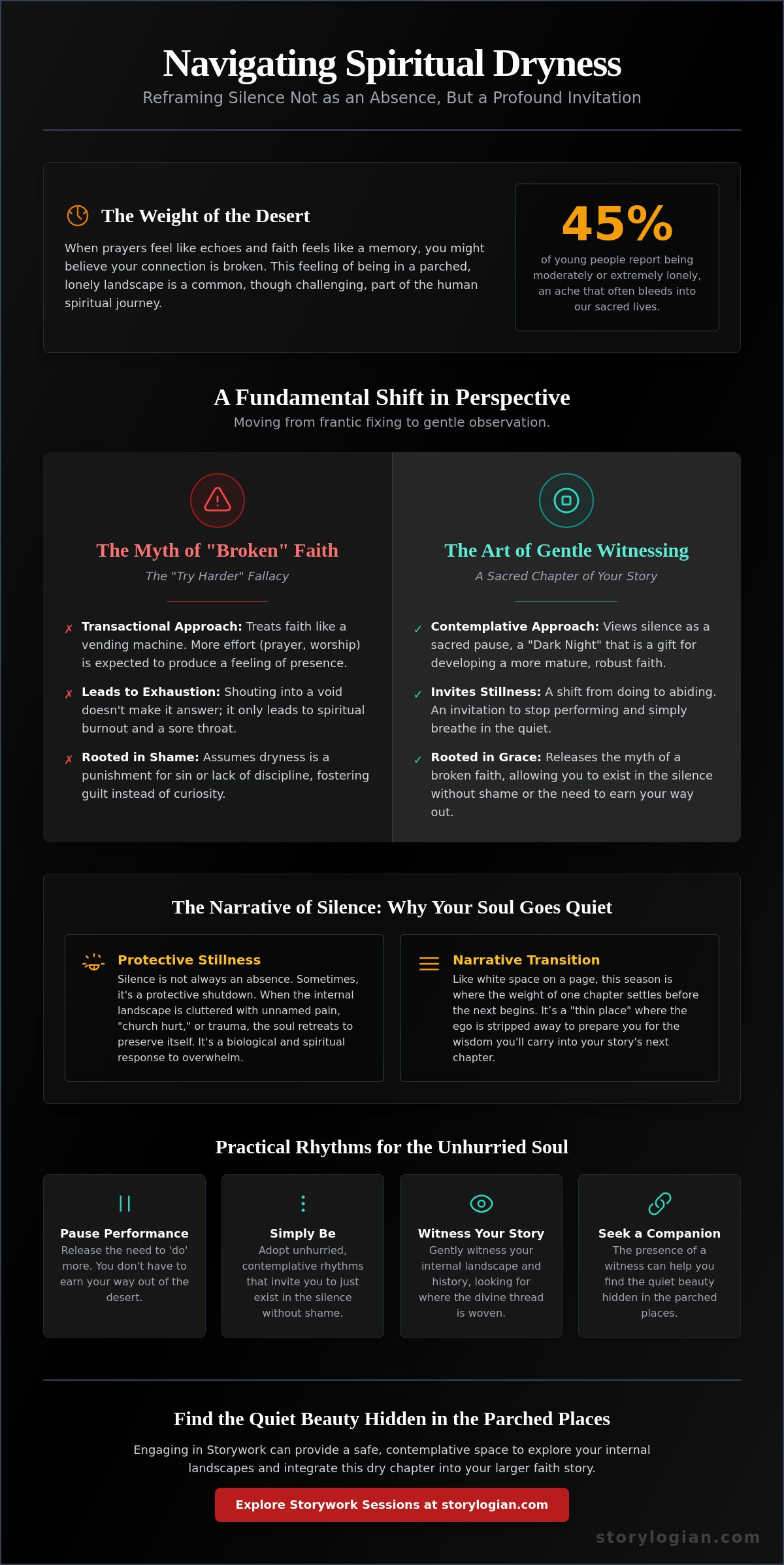
What if the silence you're currently enduring isn't a sign of divine absence, but a profound invitation into a different kind of presence? You feel the weight of the desert. The prayers feel like echoes. The rituals feel like inkless pens on a page. It's a lonely space, often crowded by the quiet, heavy guilt that you've somehow failed at your own faith. When you are navigating spiritual dryness, it's easy to mistake a pause for an ending. You aren't alone in this parched landscape. Research shows that 45% of young people report being moderately or extremely lonely, an ache that often bleeds into our internal, sacred lives.
We understand the fear that your soul has gone quiet because you've lost your way. We promise to help you reframe this season as a sacred chapter of your soul's narrative rather than a sign of failure. You deserve permission to exist in the silence without shame. This article explores how to integrate this dry chapter into your larger faith story. We will look at the distinction between spiritual desolation and mental health needs, offering gentle, non-transactional practices for soul care that honor your autonomy and your history.
Key Takeaways
Release the myth that your faith is broken; it's often just a sacred chapter in your soul's unfolding story.
Recognize the silence as a protective stillness, a pause where your soul gathers strength during profound life transitions.
Learn why navigating spiritual dryness calls for a shift from transactional self-correction to the gentle art of witnessing your internal landscape.
Adopt unhurried, contemplative rhythms that invite you to simply be, replacing the exhaustion of spiritual performance.
Understand how the presence of a witness through Storywork Sessions can help you find the quiet beauty hidden in the parched places.
Table of Contents
The Myth of the 'Broken' Faith: Reframing Spiritual Dryness
The silence is a heavy shroud. It feels like a verdict. When the vibrant colors of your spiritual life fade into a monochromatic gray, the first thing you lose isn't your faith, but your sense of safety. You've likely heard the whispers, either from your own inner critic or from well-meaning voices in your community, suggesting that this desert is a result of hidden sin or a lack of discipline. This is the myth of the broken faith. It's a narrative that suggests God only speaks to the "worthy" or the "active." In reality, the history of Spiritual dryness suggests something far more profound. It is not a sign of decay. It is often a sign of impending depth.
The "Dark Night of the Soul" was never described by the mystics as a punishment. It was described as a gift. It's a sacred stage of growth where the soul is stripped of its reliance on feelings and "spiritual sugar" to develop a more robust, mature love. When you are navigating spiritual dryness, you're participating in a long, hallowed tradition of being refined in the quiet. By engaging in the sacred art of storytelling, we begin to see that the gaps in our experience aren't empty. They are the spaces where the divine thread is woven most tightly, even if we can't see the pattern yet.
Busting the 'Try Harder' Fallacy
Our cultural instinct is to fix what feels broken. We double down on prayer journals. We add more worship music to our commute. We treat our relationship with the Divine like a vending machine; if we put in enough effort, we expect a sense of presence to drop out. This transactional approach only leads to exhaustion. Shouting into a void doesn't make the void answer; it just makes your throat sore. Navigating spiritual dryness requires a shift from doing to abiding. It's an invitation to stop performing and start breathing, acknowledging that you're tired and that it's okay to be still. You don't have to earn your way out of the desert.
Dryness as a Narrative Transition
In literature, the white space on a page is just as vital as the ink. It's where the reader breathes. It's where the weight of the previous chapter settles before the next one begins. Your soul needs this white space. We can view this season as a "thin place," a landscape where the ego is slowly stripped away to make room for something more authentic. Think of it as your own Kerith Ravine. It's a place of hiddenness and preparation. It's a necessary pause in your story, ensuring that when the next chapter opens, you have the capacity to carry the weight of the wisdom you've gained in the dark.
The Narrative of Silence: Why Your Soul Goes Quiet
The soul possesses a long memory. It remembers where it was nurtured, but it also remembers where it was bruised. Sometimes, the silence we encounter is not a divine withdrawal. It is a protective shutdown. When the internal landscape becomes too cluttered with unnamed pain or the echoes of "church hurt," the soul often retreats into a quiet room to preserve itself. While navigating spiritual dryness, we often hunt for theological errors or lapses in discipline. We treat the silence like a broken machine. Yet, the answer frequently lies within our own autobiography, hidden in the chapters we've skimmed or ignored.
Spiritual trauma or significant life transitions can create a perceived distance from the Divine that feels like a desert. This isn't a crisis of belief. It's a biological and spiritual response to overwhelm. A study in Pastoral Psychology on Overcoming Spiritual Dryness suggests that these seasons can be transformative when we stop viewing them as purely negative. If you feel the weight of this silence, engaging in storywork sessions can provide a safe space to explore these internal landscapes and identify where the soul has gone quiet to protect itself.
The Impact of Unnamed Harm on Spiritual Vitality
Unresolved stories of harm act like sediment in a well, clogging our spiritual receptors. We often attempt a "spiritual bypass," trying to pray our way over the pain rather than walking through it. This fails because the soul won't be hurried. It demands that we witness its history. Narrative storywork is a contemplative tool used to identify specific themes of harm and glory within your personal history to foster deep integration. Without this honest look at our past, navigating spiritual dryness becomes a repetitive cycle of performance and disappointment.
God as the Silent Witness
We often interpret silence as absence. In our human relationships, silence can be cold or punishing. However, we can reframe God's silence as a respectful, non-anxious presence. He is the witness who doesn't feel the need to fill the room with noise. This is where the theology of Lament becomes essential. Lament is the language of the desert. It is the holy act of naming your grief, your confusion, and your anger to a God who can handle the weight of your honesty. You don't need to resolve the tension. You only need to be honest within it. By naming these feelings without the pressure to "fix" them, we allow the silence to become a shared space rather than a lonely one.
Storywork vs. Self-Correction: A Gentler Way Through
When the silence settles in, our cultural conditioning screams for a solution. We want to diagnose the drought. We want to fix the leak. This "Fix-it" approach is deeply transactional. It views the soul as a machine and God as a service provider. If we aren't feeling the connection, we assume we've missed a payment or broken a gear. This mindset only deepens the exhaustion. Navigating spiritual dryness through self-correction often feels like trying to dig a well with a spoon; the effort is immense, but the results remain dusty. It's a cycle of performance that leaves little room for the Spirit to move in the way the Spirit moves: unhurried and free.
There is a gentler way. It's the path of witnessing. Instead of asking "How do I fix this?", we ask "What is being written here?". This is the heart of Storywork. It's a sacred shift from being a technician of your own soul to being a curator of your own story. It honors the complexity of your internal landscape without the frantic need to change it immediately. A spiritual director doesn't act as a coach. They act as a mirror. They reflect the movements of the Spirit that you might be too weary to notice. While self-help books offer steps to "jumpstart" your faith, sacred accompaniment offers a chair and a listening ear. It's the difference between a lecture and a shared silence.
The Power of Sacred Accompaniment
Sacred Accompaniment is a soul-friendship that intentionally avoids the trap of fixing. It's the act of walking alongside another person without the agenda of improvement. When we invite a witness into our desert, the shame of the silence begins to evaporate. You're no longer alone in the quiet. Within a contemplative environment, a spiritual director holds space for the unspoken. They don't offer a map out of the desert; they offer a presence within it. This witness helps you see that the silence isn't a void, but a sanctuary where your story is being held with significant weight and respect.
Naming the Story: From Victim to Protagonist
The way we narrate our dryness determines its power over us. If the story we tell ourselves is "I am failing," the desert feels like a prison. Through the re-authoring process, we can begin to see the parched land as a place of refinement. You aren't a victim of a spiritual crisis; you are the protagonist of a developing narrative. Every sacred story includes a season in the wilderness. By naming the dryness as a necessary chapter of growth, you reclaim your agency. You begin to see that navigating spiritual dryness is not about reaching a destination, but about honoring the journey. For those seeking a companion in this process, exploring spiritual direction for women can be a beautiful first step toward finding a witness for your journey.
Practical Rhythms for the Unhurried Soul
Traditional "quiet times" often feel like an interrogation when the soul is parched. If the words on the page are silent, don't force them to speak. Navigating spiritual dryness requires a shift from the labor of study to the grace of presence. It's about sitting in the architecture of silence and trusting that simply being is enough. Instead of a rigorous schedule, consider sacred pauses. These are moments to notice a bird in flight or the steam rising from a cup of tea. These aren't distractions. They're invitations to witness the ordinary graces that persist even in the desert.
The Prayer of Examen: Finding God in the Rearview Mirror
The Daily Examen is a rhythmic way to look back and see where the Divine was moving while you were too busy to notice. It's a gentle review that doesn't demand immediate resolution or self-correction. It's about observation, not interrogation. This practice helps us see that God is active in our story even when our feelings are dormant. It reminds us that presence isn't always a mountaintop experience; often, it's a quiet thread through a Tuesday afternoon.
Review: Look back over the last twenty-four hours as if watching a film.
Relish: Identify the "Consolations." These are the moments where you felt a spark of life, beauty, or connection.
Repent (Gently): Notice the "Desolations." These are the places where you felt drained, defensive, or distant. Acknowledge them without judgment.
Resolve: Ask for the grace to step into tomorrow with an open, receptive heart.
Lectio Divina: Letting the Word Read You
Studying the Bible is an intellectual act. Listening to the Word is a relational one. Lectio Divina invites you to set aside the commentary and the cross-references to simply listen. The process is unhurried. Read a short passage slowly. Meditate on a single word or phrase that shimmers or catches your attention. Pray your honest response to that word. Finally, Contemplate. Simply rest in the presence of the One who spoke. There's no wrong way to do this. It's an exercise in receptivity rather than achievement.
The Ministry of Presence: Soul Care for the Weary
Sometimes, the most spiritual thing you can do is take a nap. Physical rest, the quiet of a forest, or the intentional pursuit of beauty are not "extra" to your faith; they're central to it. Navigating spiritual dryness is exhausting work. If you feel the weight of leadership or high-output roles, you might find resonance in our guide on soul care for ministry leaders. Lower the bar until it rests on the ground of grace. You're allowed to be weary. You're allowed to be still.
If you find yourself longing for a space where these rhythms are the priority rather than the exception, consider joining one of our Spiritual Formation Retreats to reconnect with your soul in a guided, sacred environment.
Walking the Sacred Path with a Companion
The desert is vast. It is often walked in solitude, but it was never intended to be a solo journey. When you are navigating spiritual dryness, the weight of the silence can become a barrier between you and the very life you seek to reclaim. You've spent months trying to decipher the static on your own. It's time to invite a witness into the quiet. The goal of our work together isn't to force an immediate end to the drought or to provide a map that leads to a quick exit. Instead, we aim to honor the journey and the wisdom this parched land is offering you. There is a specific kind of healing that only occurs when our story is heard and held with reverence by another.
We often believe that our dryness is a private failure, a secret to be kept until we've "fixed" our faith. This isolation only serves to deepen the shame. By inviting a companion into your landscape, you allow the silence to be transformed from a lonely void into a shared sanctuary. This isn't about finding someone to tell you what to do. It's about finding someone to witness what is already happening within you. A companion helps you notice the subtle movements of the Spirit that your own weariness may have obscured. They provide the steady, guided movement that allows your soul to settle and your story to breathe.
What to Expect in a Storywork Intensive
Storywork Intensives provide a hallowed framework for this exploration. We look at the intersection of your personal history and your current spiritual state, identifying the divine threads that remain even when they feel invisible. This is a sacred space. In these sessions, we prioritize your autonomy and the unique, rhythmic progression of your soul. We integrate theology and narrative to foster holistic growth, moving beyond surface level fixes toward a deep, resonant integration. You aren't a problem to be solved. You are a story to be told, and in the telling, you often find the very presence you thought you had lost.
Taking the First Step Toward Sacred Accompaniment
Taking the first step toward Sacred Accompaniment can feel daunting, yet it is the most compassionate choice you can make for your weary soul. You might begin with an individual session of Spiritual Direction to see if this path resonates with your current needs. For those who feel the need for a communal experience, our Spiritual Formation Retreats offer a way to walk the desert alongside others who understand the ache of the silence. These retreats provide the slow pace and deliberate reflection necessary for new ideas to settle and for the soul to find its footing again.
Before you close this page, take a moment to breathe. May you know that the silence is not a sign of abandonment. May you find the strength to stop performing and the peace to simply be. You are held in a love that does not demand your productivity or your perfection. May you find a witness for your journey who honors your history and holds your hope. Explore how Storywork Sessions can bring hope to your silence.
Honoring the Space Between Chapters
The desert is not a detour; it's a vital part of the landscape. You've discovered that the silence you're enduring isn't a sign of divine abandonment, but a protective stillness for your soul. By shifting from the exhaustion of self-correction to the gentle art of witnessing, you allow your story to breathe. Navigating spiritual dryness becomes a process of integration rather than an obstacle to be removed. You don't have to carry the weight of this parched season alone.
Dr. Shonda Carter offers a unique, non-clinical approach that integrates theology with the evocative power of filmmaking. This contemplative space is designed specifically for Christian women to find narrative healing through their own sacred history. You deserve a companion who honors the complexity of your journey without the pressure to fix what was never truly broken. Begin your journey of healing with a Storywork Session and discover the gold hidden in the quiet. Your story is still being written, and even the silent chapters are full of divine meaning.
Frequently Asked Questions
Is spiritual dryness a sign that I have lost my faith?
Spiritual dryness is not an indicator that you have lost your faith; rather, it is often a sign of a faith that is maturing beyond its initial, emotional stages. In the long history of the church, this "dark night" is recognized as a necessary transition where the soul learns to love the Giver rather than just the gifts. It is a sacred pause in your narrative, not a terminal end to your story.
What is the difference between spiritual dryness and clinical depression?
Spiritual dryness usually centers on a lack of felt connection to the Divine or a loss of joy in spiritual disciplines, while clinical depression often permeates every aspect of existence. Depression may affect your appetite, sleep patterns, and interest in once-loved hobbies. If your sense of hopelessness is universal and persistent, it may be a mental health concern. We encourage seeking clinical support alongside spiritual accompaniment when the weight feels too heavy to bear alone.
How long do seasons of spiritual dryness typically last?
There is no fixed timeline for a season of desert silence, as the soul's narrative follows its own organic and unhurried rhythm. For some, it may be a brief period of weeks following a major life transition; for others, it can last years as a profound refining process. Navigating spiritual dryness requires a deep patience with yourself, allowing the chapter to conclude only when the work of the silence is complete.
Can I still pray if I don't feel like God is listening?
You can absolutely continue to pray, but you may find it helpful to shift from spoken words to quiet presence. Prayer in the desert often looks like sitting in the architecture of silence or offering honest laments about the perceived distance. God is not intimidated by your lack of feeling. He is present in the honesty of your struggle, witnessing the very ache you carry without demanding a resolution.
Should I tell my church leaders that I am experiencing spiritual dryness?
Whether you share this experience with church leadership depends entirely on the safety and emotional maturity of that relationship. Some leaders may try to "fix" your state with more disciplines, which can often exacerbate the guilt you already feel. If your community values contemplative growth and the complexity of the human experience, sharing can provide support. If not, seeking a spiritual director may offer a more sacred, non-judgmental space for your journey.
What if my 'dryness' is actually caused by church hurt or spiritual trauma?
It's very common for spiritual dryness to be rooted in past trauma or experiences of harm within religious systems. When the soul has been bruised by those who represented the Divine, it often goes quiet as a protective mechanism to preserve its own safety. Identifying these narrative roots is a key part of our Storywork Sessions, helping you untangle the perceived silence of God from the painful noise of past harm.
How can a spiritual director help me during a desert season?
A spiritual director helps by acting as a holy witness to your experience, holding space for the questions you're afraid to ask aloud. They don't offer a map to get you out of the desert faster or provide a checklist for self-correction. Instead, they provide sacred accompaniment, helping you notice the small, ordinary graces that are still present in the silence of your current chapter while you are navigating spiritual dryness.



Comments