The Architecture of Silence: A Contemplative Prayer Guide for the Weary Soul

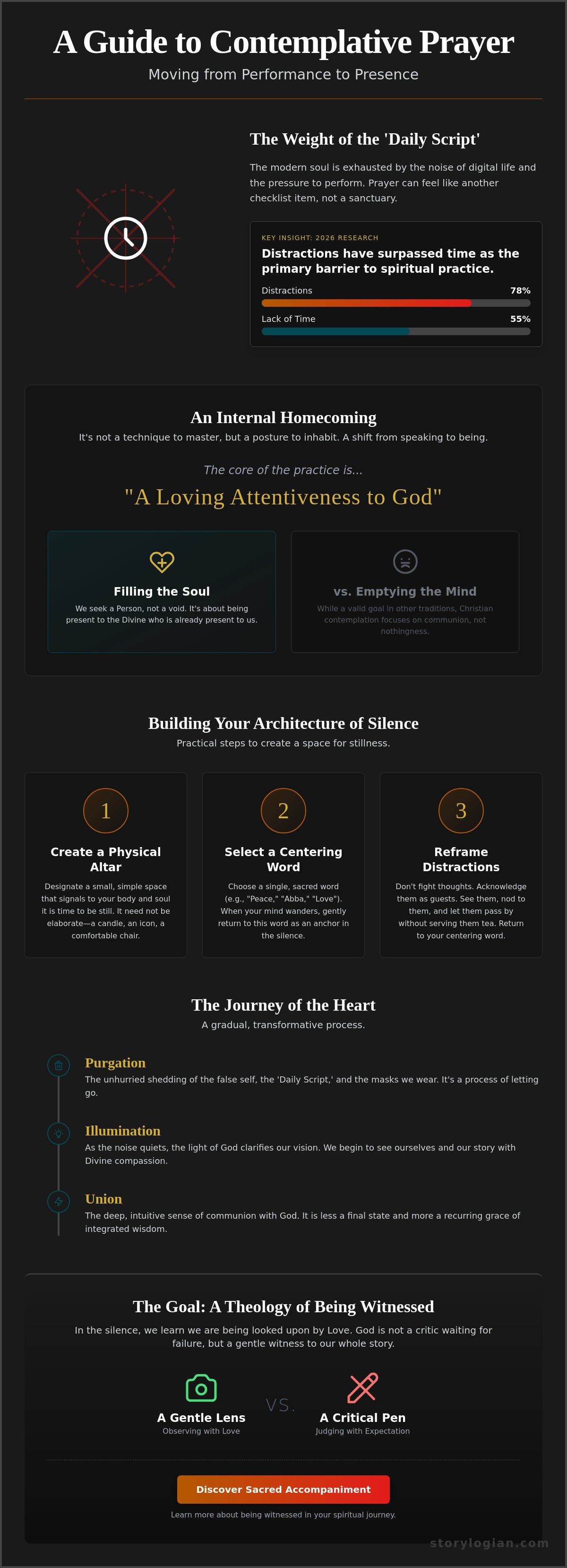
What if the silence you've been fleeing is actually the only place where you are truly seen? You sit down to pray, but the digital hum and the internal checklist refuse to quiet. It feels like you're performing a ritual rather than finding a home. You aren't alone in this. In 2026, research shows that distractions have surpassed time as the primary obstacle to spiritual practice. This contemplative prayer guide is designed to help you move beyond the mechanics of "doing" and into a sacred space of deep, narrative-driven communion.
You don't have to worry about doing it correctly. There is no performance here; only presence. We'll explore how to build an architecture of stillness that honors your personal story while inviting a sense of being witnessed by the Divine. We'll walk through practical tools for stillness and look at how your personal history can be integrated into your faith. It's time to move from a state of quiet unrest toward a sense of integrated wisdom.
Key Takeaways
Discover how contemplative prayer is less about emptying the mind and more about a loving attentiveness that fills the heart with Divine Presence.
Learn to reframe your internal distractions as guests at the table of your story, transforming noise into a pathway for deeper self-reflection.
This contemplative prayer guide offers practical steps to create a physical altar and select a centering word that anchors your soul in the stillness.
Explore how the silence of prayer integrates with Sacred Accompaniment to help you interpret the quiet movements of God within your personal history.
Table of Contents
The Sacred Invitation: Moving Beyond the Noise of the Daily Script
The exhaustion you feel isn't a lack of faith. It's the weight of the "Daily Script." This script is the collection of roles you play, the expectations you meet, and the performance you maintain to keep your world spinning. It's the mask of the capable professional, the tireless mother, or the dependable friend. When prayer becomes just another item on that checklist, it loses its breath. It feels transactional. You give God your requests; you wait for a result. But your soul was made for more than spiritual commerce.
This contemplative prayer guide is an invitation to step off the stage. Beyond the roles you inhabit, there lies an internal landscape that requires a different kind of attention. It's a place of quiet hills and deep valleys, often obscured by the fog of digital and internal noise. Our goal here isn't to achieve a specific psychological state or a sense of "zen." Instead, we're learning to be present to a Person. We're moving from a script that demands performance to a space that welcomes being.
The Hunger for Depth in a Shallow Age
We live in an era of unprecedented noise. According to a Spring 2026 survey, distractions have officially surpassed time as the primary barrier to spiritual practice. For the feminine soul, this digital hum is more than an annoyance; it's an assault on discernment. Contemplation is a rebellious act in such a shallow age. It's the decision to stop and acknowledge the unrest. Take a breath. Let the air fill your lungs and notice the tension in your shoulders. You're allowed to be tired. You're allowed to need more than a quick-fix devotion.
From Performance to Presence
Most of us were taught to talk at God. We present our lists and our apologies as if he were a distant official. But contemplative prayer shifts the focus from talking to being. It's a movement from the head to the heart. Sometimes, the journey into this silence feels daunting, and that's where the practice of sacred accompaniment becomes a vital foundation. Having a witness to your process provides a sense of safety as you descend into the quiet. The transition is subtle but profound. The noise begins to fade, replaced by a rhythmic waitfulness, like a tide pulling back to reveal the hidden treasures of the shore. You aren't just practicing a technique; you're coming home to a Presence that has been waiting for you all along.
What is Contemplative Prayer? An Internal Homecoming
Contemplative prayer is not a technique to be mastered. It is a posture to be inhabited. At its most fundamental level, it is a "loving attentiveness to God." This definition, echoed by mystics throughout the centuries, suggests that prayer is less about the words we speak and more about the gaze we maintain. It is an internal homecoming. We stop wandering through the corridors of our anxieties and sit down at the hearth of the Divine Presence. This contemplative prayer guide invites you to see this practice as the art of spiritual listening, a way to hear the whisper that the noise of the world so often drowns out.
It is helpful to distinguish this practice from other forms of meditation. While some traditions focus on the emptying of the mind, Christian contemplation is about the filling of the soul. We don't seek a void; we seek a Person. We aren't looking for nothingness. We are looking for the Someone who has been present in our story since the beginning. This tradition is anchored in the wisdom of the Desert Fathers and Mothers, those early seekers who fled the clamor of the empire to find the weight of God in the stillness of the sand. They knew that the soul requires silence to breathe.
A Theology of Being Witnessed
In the quiet, something profound happens: we realize we are being looked upon by Love. Imagine a filmmaker's lens. It doesn't judge the scene or demand it be different; it simply witnesses the light and the shadow as they are. God is that gentle observer of our lives. He is not a critic waiting for us to fail, but a Witness who honors the complexity of our journey. When we sit in silence, we allow ourselves to be seen without the need for a script. This process is deeply connected to the sacred art of storytelling, where we begin to see the Divine thread woven through our personal history.
The Three Movements of the Heart
The contemplative journey is often described through three movements. First is Purgation, the unhurried shedding of the false self and the Daily Script. Next is Illumination, where the light of God clarifies our vision and we begin to see our life through the eyes of grace. Finally, there is Union, a state of resting in oneness with Love. Most of us find ourselves in the "middle space" of illumination, where we are still learning to trust the light. The primary vessel for this work is the unhurried soul. If you feel the need for a guide on this journey, engaging in Spiritual Direction can offer the steady presence needed to navigate these internal waters. We move slowly. We breathe deeply. We allow the silence to do its work.
The Myth of the Empty Mind: Honoring the Shadows in the Silence
"I can't stop my thoughts." This is the most frequent objection whispered to any guide of the inner life. We often approach the silence with a hidden expectation of immediate tranquility, as if the mind were a room that could be emptied with a single sweep of the broom. But the mind is not a void; it is a narrative. This contemplative prayer guide suggests a different path: don't try to evict your thoughts. Instead, treat them as guests at the table of your story.
Distractions are rarely random. They are often messengers from the parts of ourselves that feel neglected or unheard. When a worry about a deadline or a memory of a sharp word enters the quiet, don't view it as a failure of discipline. View it as an invitation to notice where you are still carrying weight. By honoring these shadows, we allow the silence to become a place of integration rather than exclusion. We notice the thought, acknowledge its presence with a gentle nod, and release it back into the hands of the One who watches over us. This simple framework of noticing and releasing allows the soul to stay soft rather than becoming rigid with effort.
When the Silence is Loud
For many, the first few minutes of stillness don't feel like peace; they feel like a spike in anxiety. This is particularly true for those who have navigated trauma or the heavy weight of church hurt. Silence can feel threatening because it removes the noise we use to buffer ourselves against pain. In these moments, it's vital to establish a sense of sacred safety. Listen to your body. If the quiet feels too sharp, it's okay to open your eyes or shift your posture. Your body's response is not an obstacle. It is a vital part of the conversation you're having with the Divine.
Healing the Narrative of "Doing it Wrong"
Perfectionism is a thief that steals the joy of spiritual formation. We bring our "doing" energy into a space meant for "being," worrying about the quality of our focus or the depth of our peace. Let go of the need to perform. Grace is the floor of the contemplative room. It's the steady ground that holds you whether you're soaring in light or struggling to stay seated. Even five minutes of distracted desire is a sacred offering. It's a declaration that you want to be present, even when your mind wanders, and that desire is enough for the One who witnesses your soul.
The Architecture of Silence: A Practical Guide to Beginning
Building a practice of silence requires more than good intentions. It requires a container. This contemplative prayer guide offers a framework to help you construct that space, acting as an architecture for the soul. You aren't building a prison of rigid rules, but a sanctuary of rhythmic grace where your weary spirit can finally rest. This architecture begins with the physical and moves gently toward the internal, creating a bridge between your daily life and the Divine Presence.
Start with your environment. An external altar, even a simple one, serves as a beacon for the internal work. A single candle, a worn Bible, or a smooth stone can signal to your mind that the "Daily Script" has been set aside for a time. This physical boundary creates a sense of sacred safety. It tells your nervous system that it's okay to slow down. When your surroundings reflect your intent, the transition from noise to stillness becomes a shared journey between your body and your spirit.
Next, choose your anchor. A centering word, such as "Peace," "Mercy," or "Beloved," acts as a gentle tether. When your thoughts begin to drift toward tomorrow's tasks or yesterday's regrets, you don't fight them. You simply whisper your word. It's the silent invitation to return to the Present. Your posture also speaks. Sitting with feet grounded and hands open is an act of theological surrender. You're physically declaring your readiness to receive rather than to achieve. This is the body's prayer, a quiet bowing before the One who witnesses every breath.
Step-by-Step: Your First Twenty Minutes
Research from 2026 indicates that 36.2% of practitioners find 10 to 20 minutes to be the most effective session length for contemplative work. To begin your own 20-minute practice, follow this sequence:
Settle into your designated space and take three deep breaths, noticing the rhythm of the Spirit in your lungs.
Silently introduce your centering word as a symbol of your intent to be with God.
Sit in the stillness, allowing the silence to be the primary language of your heart.
When you notice you've wandered into the noise, use the "Gentle Return" to bring your focus back to the Presence.
Close the circle by slowly reciting a short phrase from Scripture, allowing the words to settle into your heart before you return to the world.
Tools for the Journey: Journals and Sacred Objects
Writing can be a profound form of contemplation with a pen. After your time of silence, take a few moments to record what you noticed in your internal landscape. This isn't a diary entry; it's a way of honoring the narrative God is writing in you. For those in leadership, these practices are essential components of soul care for ministry leaders. Using icons or candles can also serve as anchors for the eyes, helping to steady a restless gaze. If you find the solitary path difficult to navigate, you might find a Spiritual Formation Retreat to be a helpful next step in deepening this architecture.
From Stillness to Story: The Role of Sacred Accompaniment
The architecture of silence is not a bunker to hide in. It is a window to look through. While the previous steps in this contemplative prayer guide focused on the internal movement toward stillness, the journey doesn't end at the edge of the prayer mat. True contemplation is an integration. It's the process of bringing the fragments of your history into the light of the Divine Presence. When we move from the quiet back into the clamor of our lives, we begin the transition into contemplative living, where every moment becomes an opportunity for communion.
This integration often requires a bridge. Silence has a way of unearthing things we've long buried, from forgotten joys to "themes of harm" that still shape our reactions today. While solitary practice is foundational, there are limits to what we can interpret alone. Sometimes, the silence reveals a landscape so complex that we need a sacred witness to help us navigate it. This is the heart of storywork sessions. In these spaces, your personal narrative is treated with the same reverence as a sacred text. You aren't just analyzing a life; you're honoring a soul.
Why We Need a Witness
Spiritual direction and sacred accompaniment offer a safety that solitary practice cannot always provide. When we sit with a guide, we're no longer the sole interpreters of our experience. A witness helps us name what's happening in the quiet, especially when the silence feels heavy with the weight of past church hurt or personal trauma. Dr. Shonda Carter serves as a patient guide for those ready to move beyond the surface of their spiritual disciplines. By inviting another into your process, you allow your story to be held in a way that honors its complexity and its holiness. It's the difference between looking at a map and walking the terrain with someone who knows the path.
Your Story is the Prayer
Your life isn't a distraction from your relationship with God. It's the very medium of His grace. Every memory, every scar, and every longing is a sentence in a larger narrative being filmed by a loving Creator. The goal of this contemplative prayer guide is to help you see that you're the protagonist in a story of redemption. You're being watched with eyes of love. You're being held in a silence that isn't empty, but full of the Someone who knows you by name. Your history is the ground where the Divine chooses to meet you.
May you find the courage to stay in the room. May the silence be a place of homecoming. May you trust that your story is worth the weight of the telling. If you're ready to reclaim the sacred narrative of your life, we invite you to explore a storywork intensive or a session of Spiritual Direction. The silence is waiting, and you don't have to walk through it alone.
Stepping Into Your Sacred Story
You've moved from the noise of the Daily Script toward the quiet hearth of your own heart. We've explored how silence isn't a void to be feared, but a sacred space where you are finally, fully witnessed. This contemplative prayer guide has served as a map for your return to the present moment, reminding you that your distractions are merely guests and your posture is an act of surrender. Your story is not separate from your faith. It is the very medium through which Love speaks.
Founded by Dr. Shonda Carter, a theologian and filmmaker, our work focuses on the spiritual formation and sacred narratives of women. We offer an integrated approach that combines deep theology with the restorative power of storywork. You don't have to carry the weight of your history or the complexity of your silence alone. We are here to hold the space with you.
Begin your journey of sacred discovery with a Storywork Session and allow the stillness to become a place of profound integration. The Light is already looking upon you with kindness. Walk forward in the steady grace of being known.
Frequently Asked Questions
Is contemplative prayer the same as New Age meditation?
No, the primary difference lies in the object of your focus. While many meditation practices aim for an emptying of the mind or a focus on the self, contemplative prayer is a relational act centered on the Presence of God. It is a process of filling the heart with Divine Love. You aren't seeking a void; you are seeking a Person who has been part of your story from the beginning.
What do I do if I fall asleep during my prayer time?
Accept your sleep as a gift of rest that your body clearly requires. There is no shame in drifting off in the presence of the Divine; it often indicates that your soul finally feels safe enough to release its vigilance. St. Thérèse of Lisieux famously suggested that God loves His children just as much when they are asleep. When you wake, simply return to your centering word with a gentle heart.
How long should I practice contemplative prayer each day?
Aim for a duration of 10 to 20 minutes once or twice a day to establish a healthy rhythm. Research from 2026 indicates that 36.2% of practitioners find this specific length of time to be the most effective for deep engagement. This contemplative prayer guide encourages you to value consistency over intensity. It is better to sit in the stillness for ten minutes daily than for an hour once a month.
Can I practice contemplation if I have experienced church hurt or spiritual trauma?
Yes, and you may find that the silence is the only place where you feel truly safe. Contemplation bypasses the performative demands of religious institutions and the "Daily Script" that can feel so heavy. In the quiet, you are not a project to be fixed or a sinner to be scolded. You are a soul being witnessed by Love. If the silence feels too sharp, the presence of Sacred Accompaniment can provide a helpful buffer.
What is a centering word, and how do I choose one?
A centering word is a brief, simple word used as a symbol of your intention to consent to God's presence. You might choose a word like "Grace," "Abide," or "Beloved." The word itself carries no magical power; it is merely a tether to bring your wandering mind back to the center. Choose a term that reflects your soul's current longing and allow it to be your anchor throughout the session.
Is it okay to use music during contemplative prayer?
Soft, instrumental music can serve as a helpful "sacred buffer" against the distractions of a noisy environment. While the tradition eventually leads toward pure silence, ambient sounds can provide a sense of safety for beginners. Ensure the music is unhurried and free of lyrics so your mind doesn't latch onto a specific message. The goal is to create an atmosphere where you can hear the deeper whisper of the Spirit.
How do I know if I am hearing God or just my own thoughts?
Discernment is a slow fruit that ripens over time through consistent practice. Thoughts from the Spirit typically carry a texture of peace, humility, and a quiet sense of rightness, even when they challenge us. Your own anxious thoughts often feel urgent, critical, or repetitive. This contemplative prayer guide helps you learn to sit with these internal movements until the voice of Love becomes more recognizable than the noise of your ego.
Do I need to be a "spiritual expert" to start this practice?
No, the beauty of contemplation is that it requires no special training or theological degree. It is a practice for the weary, the distracted, and the ordinary seeker. All that is required is your presence and a willingness to be seen. You don't have to master a technique to be loved by God. You only have to show up, breathe, and allow the silence to do its restorative work.


Comments