Spiritual Direction vs Therapy: Navigating the Sacred Landscape of the Soul

You have spent months untangling the knots of your history on a therapist's couch, yet a quiet ache remains in your chest that clinical words cannot reach. You wonder if the heaviness you feel is a shadow of depression or the weight of a God who seems suddenly, painfully silent. It's a lonely threshold to stand upon. A quiet unrest. When you find yourself at this intersection, the question of spiritual direction vs therapy becomes more than academic; it becomes a vital search for the right kind of witness for your pain.
It's natural to feel stuck even when you're making genuine psychological progress. You aren't failing; you're simply standing at a crossroads of the soul. This exploration will help you discern which form of accompaniment your heart requires in this season. One path focuses on the restoration of the self, while the other listens for the Divine movement within your narrative. This guide offers clarity on the specialized roles of each professional, giving you permission to embrace both as you seek a sense of integrated peace. We'll look at how these disciplines overlap and where they diverge, helping you choose a path that honors your history and your hope.
Key Takeaways
Define the distinct roles of clinical restoration and sacred accompaniment to identify the specific support your interior landscape requires today.
Explore the necessity of therapy for processing trauma and relational patterns, allowing you to re-author a healthier psychological self through professional tools.
Recognize the unique value of spiritual direction vs therapy when seeking to discern the Divine thread and the quiet movement of the Spirit in your daily life.
Utilize a side-by-side framework of goals and methods to determine if your soul is calling for the healing of a wound or the deepening of a sacred connection.
Discover how Storywork Sessions serve as a bridge, helping you name your story to reveal the presence of grace and the threads of harm within your history.
Table of Contents
Understanding the Interior Landscape: What is Spiritual Direction vs Therapy?
The interior life is a vast and often shadowed geography. Sometimes, you find yourself wandering through a season of quiet unrest. It's a persistent, low-humming ache that doesn't quite fit into the categories of clinical diagnosis or simple fatigue. You might wonder if you need a doctor for your mind or a witness for your soul. Understanding the nuances of spiritual direction vs therapy is the first step toward finding the specific kind of rest you need. Both paths offer healing, yet they walk along different banks of the same river.
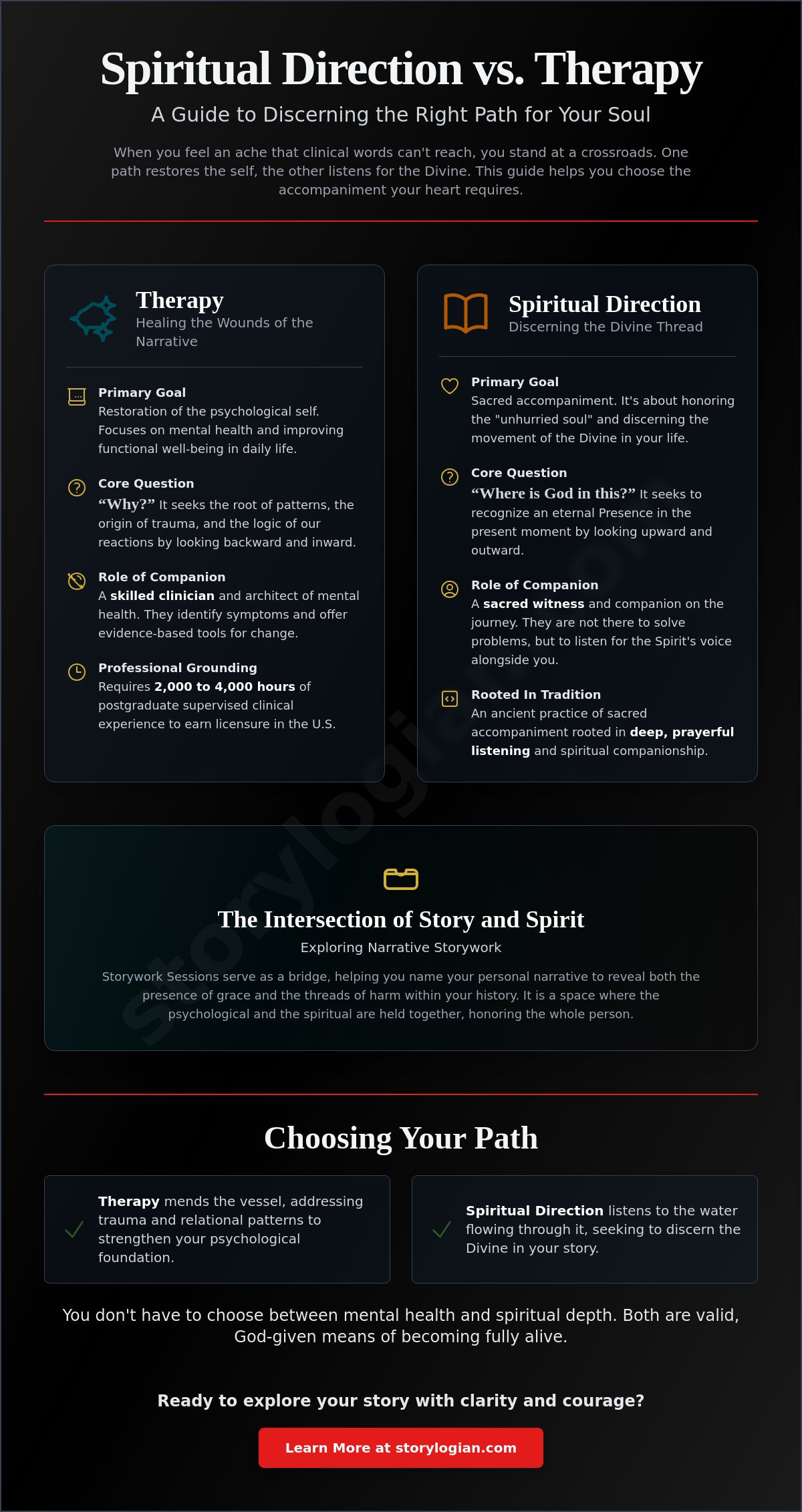
Therapy is a clinical process, a vital work of restoration designed to heal the psychological wounds that hinder your daily life. It's the sacred labor of tending to mental health and functional well-being. In contrast, spiritual direction is an ancient practice of sacred accompaniment. It's less about fixing a broken mechanism and more about honoring the "unhurried soul." If you've ever asked, What is Spiritual Direction? you'll find it's a tradition rooted in deep, prayerful listening. It seeks the movement of the Divine in the mundane details of your life.
The fundamental difference lies in the questions asked. Therapy often looks backward and inward to ask "why?" It seeks the root of patterns, the origin of trauma, and the logic of our reactions. Spiritual direction looks upward and outward from within the heart to ask "where is God in this?" It's a shift from solving a problem to discerning a Presence. One seeks to resolve the past, while the other seeks to recognize the Eternal in the present moment.
The Locus of the Work: Function vs. Presence
Therapy focuses on the intricacies of human nature. It's concerned with healthy psychological functioning, helping you navigate the world with more clarity and resilience. Spiritual direction exists in the "sacred arena." It's a space reserved for the interpersonal encounter between your soul and the Divine. Both are valid, God-given means of becoming fully alive. One mends the vessel; the other listens to the water flowing through it. You don't have to choose between mental health and spiritual depth.
The Role of the Companion
The person sitting across from you holds a different kind of space depending on their calling. A therapist is often a skilled clinician who identifies symptoms and offers tools for change. They're an architect of mental health. A spiritual director is a sacred witness. They aren't there to solve your problems or offer a clinical plan. Instead, they listen for the Spirit's voice alongside you. They're a companion on the journey. These roles are complementary threads in a single, beautiful tapestry of healing.
The Therapeutic Path: Healing the Wounds of the Narrative
Therapy is the sacred work of tending to the broken pages of our human story. It's where we look at the ink-stained chapters of trauma, grief, and the relational patterns that keep us looping through the same painful endings. While spiritual direction listens for the Divine, therapy focuses on the vessel itself. It's a vital process of restoration. Understanding the nuances of spiritual direction vs therapy means recognizing that some wounds require a clinical lens to be properly seen and held. These are the moments when our psychological infrastructure needs strengthening before we can fully engage with the silence of the soul.
One of the most persistent hurts within faith communities is the suggestion that "praying harder" can bypass the need for professional care. This is a misconception that often leads to deep shame. Faith isn't a replacement for the specialized support required to heal a nervous system trapped in the past. Therapists are skilled clinicians. In the United States, they must complete 2,000 to 4,000 hours of postgraduate supervised clinical experience to earn their license. This professional grounding allows them to offer evidence-based tools that help you re-author a healthier psychological self. You can read more about The Difference Between Spiritual Direction and Therapy to see how these paths diverge in their methods while sharing a common goal of wholeness.
When the Story is Broken: Addressing Trauma
Symptoms like chronic anxiety, crushing depression, or the intrusive echoes of PTSD are signals from your body. They aren't signs of spiritual failure. They are the body’s way of saying the narrative is "stuck" in a moment of past harm. Therapy helps unstick these moments. It allows you to move from being a character trapped in a tragedy to an author who can witness the pain without being consumed by it. Choosing this path is an act of spiritual stewardship. You're caring for the mind God gave you, ensuring your internal landscape is safe enough for deeper exploration.
The Goal of Restoration
The ultimate aim of the therapeutic path is integration and functional health. A mind that functions with clarity creates a more hospitable space for the Holy Spirit to move. It's difficult to discern the "still small voice" when the loud sirens of unhealed trauma are constant. Once this emotional infrastructure is stabilized, you might find yourself ready to explore the benefits of spiritual direction as a way to deepen your connection to the Divine. If you're feeling the pull to begin this restorative journey, you might find that Storywork Sessions offer a gentle bridge between your psychological history and your spiritual future.
Sacred Accompaniment: Discerning the Divine Thread
If therapy is the labor of re-authoring a broken story, spiritual direction is the practice of reading that story alongside the Author. It's a quiet, deliberate turning toward the Light. In this space, we move beyond the clinical to enter the realm of spiritual direction for women, a sanctuary designed for the unhurried soul. Here, the focus isn't on the efficiency of a cure, but on the depth of a connection. We aren't looking for what's wrong; we're looking for Who is present.
There's a "sacred third" in the room during these sessions. While two people sit in quiet conversation, the Holy Spirit is the true Director. The human companion simply holds the lantern. This practice honors the sacredness of the ordinary. It suggests that God isn't only found in the burning bushes of life, but also in the laundry, the boardrooms, and the heavy silences of a Tuesday afternoon. When exploring Spiritual Direction vs. Therapy: What Is the Difference?, we see that the director’s posture is one of waiting rather than doing. They're a witness to the Divine thread woven through the fabric of your daily existence.
For many women, this path offers a specific kind of healing for "church hurt." The sanctuary should be a place of refuge, yet it's often where the deepest wounds are inflicted. A spiritual director doesn't defend an institution or offer dogmatic platitudes. They offer a safe, sacred space to untangle your faith from the harm you've experienced. It's a process of reclaiming your own spiritual authority under the gentle gaze of Grace.
Listening for the Whisper
The rhythm of sacred accompaniment is built on contemplative listening. This is a far cry from the active problem-solving we encounter in most of our lives. A director listens not just to your words, but to the silence between them. They help you identify the subtle movements of God that are often drowned out by the noise of the world. You might utilize a contemplative prayer guide to help settle your heart before entering this dialogue. It's about learning to hear the whisper in the whirlwind.
Discernment Over Diagnosis
In the conversation of spiritual direction vs therapy, we must distinguish between the need for a diagnosis and the desire for discernment. Therapy identifies symptoms to provide a path toward functional health. Spiritual direction, however, makes space for mystery. It's particularly vital during seasons of spiritual dryness or major life transitions. A director doesn't try to "fix" your dark night of the soul. Instead, they sit with you in the dark, holding space until the dawn begins to break on its own time.
Choosing Your Path: A Framework for Discernment
The choice between spiritual direction vs therapy is rarely a matter of right or wrong. It's a matter of "now." Your soul has its own timing. Its own seasons of tilling and seasons of harvest. To discern the path ahead, you must first learn to listen to the quietest parts of your own life. What is the most pressing hunger you feel today? Is it a hunger for relief from a crushing weight, or a hunger for a deeper communion with the One who made you? The answer to that question reveals the map you need to follow.
Often, we find that these paths are not parallel lines that never touch. They're more like two hands holding the same fragile vessel. Therapy provides the stability; it mends the cracks in the glass so the water doesn't leak out. Spiritual direction then fills that vessel with the wine of Presence. You don't have to choose between your mental health and your spiritual longing. You're a whole person, and your healing can be as multifaceted as your story. If you're ready to begin this journey of discernment with a guide, you can explore our Sacred Accompaniment sessions to find a space held specifically for your soul's questions.
Signs You May Need Therapy
There are seasons when the internal landscape is too stormy for quiet contemplation. If you find yourself experiencing intrusive thoughts, a persistent inability to function in your daily roles, or the heavy, suffocating fog of deep-seated relational trauma, therapy is the necessary foundation. Clinical stability is the ground upon which deep spiritual work is built. It's difficult to discern the movement of the Spirit when your nervous system is in a constant state of alarm. Seeking professional counseling is not a sign of weak faith; it's an act of profound stewardship over the life you've been given.
Signs You May Need Spiritual Direction
Perhaps your life is "functional," yet you feel a persistent "God-hunger" that no amount of self-improvement can satisfy. You might be navigating a major life transition, like the emptying of a nest or the ending of a career, and you find yourself asking where God is in the change. You don't need a diagnosis; you need a "soul friend." You're looking for someone to witness your faith journey without judgment or a clinical agenda. When you feel this pull toward the deeper waters, it may be time to find a spiritual director who can sit with you in the mystery. This path is for the one who is ready to stop fixing and start listening.
The Intersection of Story and Spirit: Exploring Narrative Storywork
There is a place where the clinical and the contemplative meet. It's the ground of your own history. When we navigate the nuanced choice of spiritual direction vs therapy, we often find ourselves searching for a bridge. We need a way to connect the restoration of our psychological health with the deep longing of our spiritual discernment. This is the realm of storywork sessions. It's a practice that treats your life not as a problem to be solved, but as a sacred text to be read with trembling and hope.
Naming your story is a profound act of courage. It's the process of looking at the ink-stained pages of your past and identifying the divine threads of grace that have always been there, even in the dark. Dr. Shonda Carter’s approach offers a unique integration of theology and narrative. It moves beyond the binary of "fixing" or "listening" to offer a third way. By re-authoring your narrative through a faith-based lens, you begin to see that your history is not just a series of events. It's a living testimony of a soul being formed in the wilderness.
Reclaiming the Sacred Narrative
Storywork identifies the specific themes of harm that have muted your voice or clouded your vision. It recognizes that trauma doesn't just impact the mind; it impacts our ability to see God. Within this framework, sacred accompaniment becomes the vessel for your transformation. You're invited to consider your life as a living document, one that is being co-authored by the Divine. When you name the harm, you strip it of its power to define your future. This allows the potential for healing to take root in the very places where you once felt most abandoned. It's a methodical, gentle unrolling of the scroll of your life.
A Path Toward Wholeness
This journey toward integrated wisdom is essential for everyone, yet it holds a particular resonance for those in the trenches of service. We provide specialized soul care for ministry leaders and weary women who have spent their lives pouring out for others. The movement from a state of quiet unrest to a sense of peace requires a witness who can hold both your psychological complexity and your spiritual hunger. Whether you require the clinical tools of therapy or the discerning ear of spiritual direction, the goal remains the same: wholeness. Your story is sacred. It's the only one you have. Let us help you honor it with the reverence it deserves.
Honoring the Sacred Movement of Your Soul
The journey toward wholeness is rarely a straight line. It's a slow, deliberate turning toward the light. You now understand that the choice between spiritual direction vs therapy isn't about choosing one over the other. It's about listening to what your soul requires in this specific season. Whether you need the restorative work of clinical healing or the quiet discernment of sacred accompaniment, your path is valid. Your story is not a series of accidents. It's a living document of grace.
Dr. Shonda Carter brings a unique perspective to this landscape, blending her deep background in theology with the narrative vision of filmmaking. This specialized Christian storywork framework offers a way to see your life through a new lens, identifying the themes of harm and the threads of hope that define your history. We provide national accompaniment for women seeking spiritual freedom, offering a sanctuary for those who are ready to reclaim their sacred narrative. You don't have to carry the weight of your history alone. Begin your journey with a Storywork Session or Sacred Accompaniment today.
The silence you encounter is not empty. It's full of the One who has been with you in every chapter. Trust the unhurried process of your own becoming.
Frequently Asked Questions
Can I see a therapist and a spiritual director at the same time?
Yes, you can walk both paths simultaneously. Many find that therapy provides the emotional stability and functional health needed to engage more deeply in the work of the soul. While your therapist mends the psychological vessel, your director listens to the Spirit moving within it. These two forms of accompaniment work in tandem to support your journey toward integrated wholeness and peace.
Does insurance cover spiritual direction like it does for therapy?
Insurance does not cover spiritual direction. While therapy is a state-regulated healthcare profession with specific billing codes, spiritual direction is considered an unregulated ministry or practice. For therapy, patients often pay a copay between $15 and $50. Spiritual direction remains a self-pay service, reflecting its nature as a sacred, non-clinical accompaniment rather than a medical treatment for a diagnosed condition.
How do I know if my "spiritual problem" is actually a mental health issue?
Discernment often lies in your ability to function in daily life. If your distress prevents you from sleeping, working, or maintaining your relationships, it likely requires the clinical intervention of a licensed therapist. Spiritual dryness often feels like a quiet longing or a "God-hunger," whereas depression or anxiety involves a physiological weight that clinical tools are designed to lift. Listening to the signals of your body is the first step in this discernment.
What qualifications should I look for in a spiritual director vs a therapist?
You should look for specific credentials that match the specialized role of the companion. A therapist must hold at least a master’s degree and have completed 2,000 to 4,000 hours of supervised clinical experience to be licensed by the state. A spiritual director is not state-licensed but should be guided by ethical codes, such as those from Spiritual Directors International. They typically complete specialized training programs focused on deep listening and discernment.
Is spiritual direction only for people who are "deep" in their faith?
Spiritual direction is for anyone who feels a quiet unrest or a persistent longing for the Divine. You don't need to be "deep" in your faith or possess all the answers to begin. It's a sanctuary for the seeker, the weary, and the one standing at a lonely crossroads. This practice honors the "unhurried soul," regardless of whether you're in a season of vibrant growth or a dark night of the soul.
Will a therapist talk about God with me?
Some therapists will discuss faith if they are trained in spiritually integrated care or Christian counseling. However, their primary focus remains on your psychological and functional well-being. In the conversation of spiritual direction vs therapy, remember that a director’s entire purpose is to listen for God’s movement. A therapist may acknowledge your faith as a vital resource, but they won't typically use the session for spiritual discernment.
How much do spiritual direction sessions usually cost compared to therapy?
Spiritual direction is generally more affordable than private-pay therapy. As of 2026, therapy sessions often cost between $100 and $250 out-of-pocket in the U.S. In contrast, spiritual direction sessions are typically offered on a sliding scale between $35 and $75, though some practitioners charge up to $150. This difference reflects the distinct professional structures and regulatory requirements of each path.
What happens if my spiritual director thinks I need a therapist?
Your spiritual director will gently refer you to a licensed professional. They have an ethical responsibility to recognize the limits of their competence. If they sense that your struggle involves clinical symptoms like trauma or deep depression, they will encourage you to seek a therapist. This isn't a rejection of your spiritual journey; it's a way of ensuring your mind and heart are safe and properly supported.



Comments