The Sacred Art of Choice: A Guide to Spiritual Direction for Discernment

What if the paralyzing weight of your next big decision isn't a burden to be solved, but a sacred door waiting to be opened? You've likely spent weeks weighing every possible outcome, yet the inner chaos only grows louder while the world demands an immediate answer. It feels as though God has gone silent just when you need a map the most. You're terrified of getting it wrong. We often view choice as a high-stakes gamble rather than a slow unfolding of a larger narrative. By engaging in spiritual direction for discernment, you can begin to peel back the layers of frantic noise and listen to the quiet, persistent pulse of the divine within your own history.
You deserve a space where your story is witnessed with reverence and without judgment. This guide explores how to move beyond the mechanics of decision-making to discover the divine threads woven through the fabric of your life. Through the practice of sacred accompaniment, you'll learn to identify the subtle movements of the Spirit that often hide beneath our busyness. We'll provide tools for spiritual listening that will serve you long after this current transition settles into peace. Let's slow our pace and allow the wisdom you already carry to finally be heard.
Key Takeaways
Learn to shift from tactical problem-solving to a contemplative practice. This approach honors the quiet, internal movements of your soul.
Discover how spiritual direction for discernment invites you to move beyond simple lists of pros and cons to sense the deeper movements of the Spirit.
Identify patterns of harm and healing within your personal history. These narrative threads often illuminate the path forward through the lens of storywork.
Adopt an unhurried rhythm for decision-making. Let clarity settle in its own time through a gentle, five-step process of listening.
Explore how the integration of theology, filmmaking, and storywork creates a sacred container for interpreting your life’s next chapter.
Table of Contents
The Unquiet Heart: Why Big Decisions Require Sacred Space
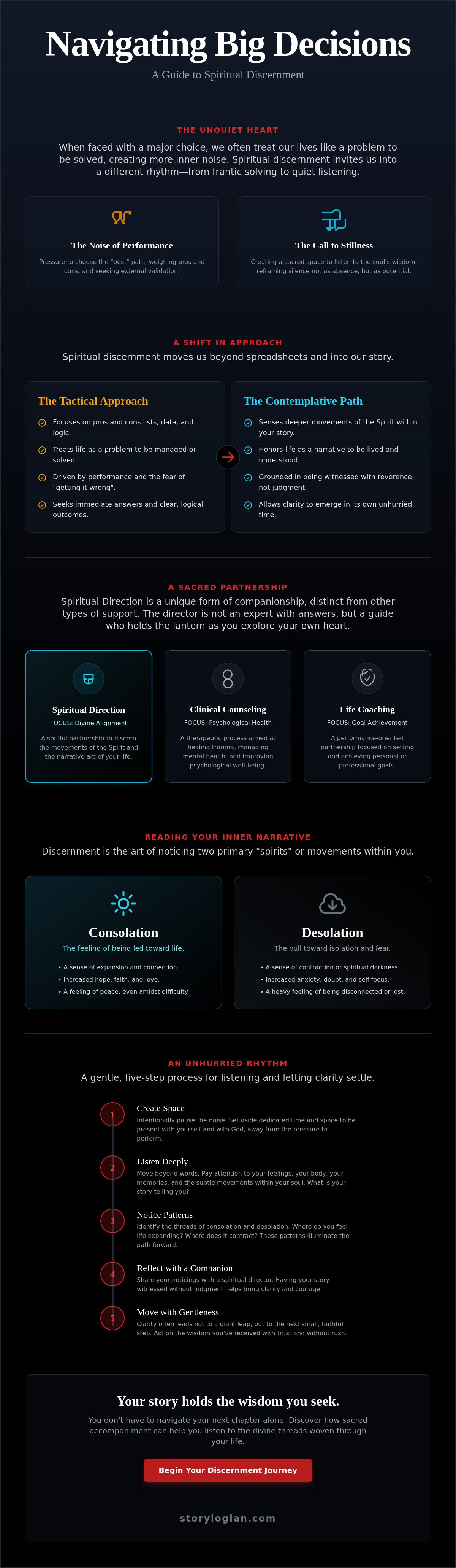
Standing at a crossroads is heavy work. It's an internal ache that doesn't easily quiet. You're looking for a sign, a clear path, or perhaps just a moment of certainty. Most of us approach these moments tactically. We build spreadsheets. We weigh pros and cons. We seek the most logical outcome. But a tactical approach often misses the heartbeat of the soul. It treats your life like a problem to be managed rather than a story to be lived. This is where Spiritual direction offers a different rhythm. It invites you into a contemplative space.
In this sacred container, we stop trying to solve the future. We begin to listen to the present. For many, the instinct is to try harder when God feels distant. We double our efforts in prayer or study. Yet, this often creates more spiritual noise. It's like trying to see the bottom of a lake while frantically splashing the water. You need stillness for the silt to settle. Practicing spiritual direction for discernment provides that stillness. It's not about finding a quick answer. It's about creating a space where the divine voice can finally be heard above the static.
The Noise of Performance-Driven Choices
We live in a culture that prizes productivity. For many women, this manifests as a crushing pressure to choose the best or most efficient path. We ask which choice will look right to others. We wonder which path yields the most fruit. This performance-oriented drivenness is a loud mask. It hides the true, quiet desires of the soul. Stop for a moment. Close your eyes. Breathe into the unrest you feel. Your worth isn't tied to the outcome of this decision. Clarity often stays hidden until we stop trying to perform our way toward it.
When Silence Feels Like Absence
There's a specific kind of fear that arrives when God feels silent during a transition. You might worry you've missed a signal. Or perhaps you feel abandoned in the dark. This experience of navigating spiritual dryness is a common part of the human journey. Silence doesn't mean absence. In the context of spiritual direction for discernment, we learn to reframe this quiet. It's not a void. It's a womb. It's a place where new wisdom is being formed, away from the glare of the world's expectations and the frantic need for results.
Defining Spiritual Direction for Discernment: Beyond Pros and Cons
When we face a significant choice, our first instinct is often to reach for a pen and a piece of paper. We draw a line down the center. We list the pros on one side and the cons on the other. This method is helpful for choosing a car or a kitchen appliance, but it rarely touches the depths of a soul seeking divine alignment. Spiritual direction for discernment is a different kind of inquiry. It's a practice that moves beyond the binary of right and wrong to explore the deeper resonance of your life. Discernment is the art of becoming aware and understanding the different movements within us. It's a slow, rhythmic process of noticing where life is expanding and where it's contracting.
It's vital to distinguish this practice from other forms of support. This isn't clinical counseling, which focuses on psychological health and healing from trauma. It isn't life coaching, which often prioritizes goal setting and external performance. Instead, it's a soulful partnership. The spiritual director doesn't arrive as a fixer or an expert with all the answers. They serve as a sacred companion. They hold the lantern while you look into the dark corners of your own heart. They help you listen to the echoes of the divine in your own story, ensuring that you remain the primary author of your choices.
Discernment of Spirits vs. Discerning God’s Will
In the quiet work of spiritual direction for discernment, we often look to the ancient wisdom of "discerning the spirits." These aren't external ghosts, but rather internal movements of consolation and desolation. Consolation is the feeling of being led toward hope, love, and a sense of connection. Desolation is the pull toward isolation, fear, and a heavy darkness. Think of these movements as chapters in a larger book. One chapter might be full of tension and shadow, while the next opens into light. By understanding which chapter you're currently living in, you begin to see the narrative arc God is drawing through your life. You're not just making a choice; you're reading the story as it unfolds.
The Role of Sacred Accompaniment
At its heart, this practice is a form of sacred accompaniment. It's a soul friendship that prioritizes the presence of the divine over the pressure of the deadline. We often struggle to see the patterns in our own lives because we're too close to the canvas. A spiritual director acts as a witness. They observe the themes of your history that you might have overlooked. This third-party perspective provides a mirror, reflecting back the wisdom you already possess. If you feel ready to explore these patterns in a safe, unhurried environment, you might find peace through Sacred Accompaniment. In this space, your autonomy is honored. You aren't told what to do; you're helped to hear what you already know.
The Narrative Lens: Discerning God’s Will Through Your Personal Story
Your past is not a graveyard of discarded choices. It is a living library. Too often, we treat our history as something to be overcome rather than something to be read. When we engage in spiritual direction for discernment, we begin to see that the divine voice rarely speaks in a vacuum. God speaks through the texture of your lived experience. Your personal history contains the very clues you need for your future. By looking back, we don't just find nostalgia; we find the "divine threads" that have always been present, waiting to be pulled into the light. This approach transforms discernment from a cold calculation into a soulful act of re-authoring your life, where every previous chapter informs the ink of the next.
Identifying Themes of Grace and Harm
Take a moment to look back at the previous crossroads of your life. What patterns emerge? Through storywork sessions, we begin to name the themes of grace and harm that have shaped your internal landscape. Naming these is the first step toward spiritual freedom. A spiritual director acts as a literary critic of the soul, helping you read the subtext of your life that you might have missed in the heat of the moment. We look for where you felt most alive and where you felt a sense of constriction. These patterns are not accidents. They are markers of where the Spirit has been moving, providing a foundation for the choices you face today.
The Sacred Art of Storytelling in Decision-Making
Viewing your life through the sacred art of storytelling changes the stakes of your decision. The paralyzing fear of making a "wrong" choice begins to dissolve. In a good story, even the difficult chapters serve the larger arc. When you adopt a reverent posture toward your history, you realize that you are a co-author with the Divine. Spiritual direction for discernment invites you to see your current transition as a pivotal scene rather than a final destination. It asks: what is the character of your soul being invited to become in this next chapter? This perspective allows you to breathe, knowing that your story is held by a hand that never wastes a single word of your experience.
A How-To Guide for Discerning with a Spiritual Companion
Engaging in spiritual direction for discernment is not a race toward a finish line. It is a slow, rhythmic walk through a forest you've only ever seen from a distance. The goal isn't just to reach the other side. The goal is to notice the life growing along the path. This process requires an unhurried pace. We often want to rush toward clarity, but clarity is a shy guest. It arrives when the environment is quiet and the heart is open. By working with a companion, you move from the isolation of your thoughts into a shared, sacred space. This collaborative framework allows you to practice the art of spiritual listening, where you begin to hear the divine whisper beneath your own anxieties.
Step 1: Cultivating the Architecture of Silence
Before you even meet with your director, the work begins in the quiet. You might use a contemplative prayer guide to help settle your weary soul. The aim is to enter the session with a posture of "holy indifference." This doesn't mean you don't care about the outcome. It means you desire God's will more than your own specific preference. Try to spend ten minutes in silence before your appointment. Let the dust of the day settle so you can see clearly.
Step 2: Naming the Movements of the Soul
In the session, you are invited to speak the unspoken. You describe the movements of consolation and desolation you've noticed. Where do you feel a sense of life and peace? Where do you feel a heavy drain or a tightening in your chest? Naming a feeling out loud often diminishes its power over us. It brings the hidden fear into the light, where it can be examined with kindness rather than judgment.
Step 3: Listening for the Divine Whisper
As you share, your director practices sacred listening. They don't offer advice or quick fixes. Instead, they reflect back the echoes they hear between your current choice and your larger faith story. They might notice a theme you've overlooked or a recurring image in your narrative. Together, you wait. You listen for the small, still voice that speaks in the pauses between your words. This is where the divine thread becomes visible.
The final steps of this journey involve testing the decision and eventually moving into action. You might "wear" a decision for a few days in your imagination to see how it sits with your spirit. Finally, you walk forward, integrated and at peace. If you are standing at a crossroads and feel the weight of the unknown, consider beginning your journey with Spiritual Direction. You don't have to listen to the silence alone.
Sacred Accompaniment: Finding Your Guide at StoryLogian
Finding a guide is about finding someone who can sit with you in the complexity of your own life. Dr. Shonda Carter offers a presence that is both professional and deeply personal. Her unique background in filmmaking and theology provides a lens that sees beyond the surface of a decision. It looks for the lighting, the subtext, and the overarching themes of your journey. This specialized form of spiritual direction for discernment isn't about being told what to do. It's about being seen as you truly are. It is an invitation to view your life not as a series of problems, but as a film still in production, where the Director is always present in the quietest scenes.
At StoryLogian, we create an atmosphere of profound safety. We understand that for a woman to truly listen to her soul, she must first feel secure. Our sessions are unhurried. They are rhythmic. We provide a contemplative container where you can set down the heavy expectations of the world and pick up the gentle threads of your own narrative. This approach honors your autonomy while providing the steady presence of a seasoned listener who is comfortable with the unspoken elements of the human experience.
Why Narrative Spiritual Direction is Different
StoryLogian focuses on the integration of your history with your future. For many women in leadership or ministry, the weight of others' expectations can lead to a profound sense of burnout. You've spent so much time holding space for others that you've lost track of your own internal compass. Our approach uses Storywork to help you reclaim your narrative. By looking at your life as a sacred text, we can identify the points where harm has silenced your intuition and where grace is inviting you forward. For a deeper look at how this specifically supports the female experience, you might explore our guide on spiritual direction for women. This process is about spiritual wholeness, not just tactical planning.
Your Invitation to Sacred Space
You've carried this decision for long enough. The silence doesn't have to be empty, and the crossroads doesn't have to be a place of fear. Spiritual direction for discernment offers you a seat at a table where your story is the guest of honor. You don't have to navigate these transitions in isolation. Whether you choose to engage through Storywork Sessions or Sacred Accompaniment, you'll find a pace designed to let your soul catch up with your body. Take the first step toward clarity by reaching out today. You're invited to stop the frantic searching and start the gentle listening.
May you find the courage to wait for the light to change. May the threads of your life begin to shimmer with the presence of the Spirit. As you move forward, may you walk into your next chapter with a heart that is integrated, peaceful, and profoundly at home.
Listening to the Unfolding Story
Your life is a sacred text. The choices you face are not obstacles to be managed, but chapters waiting to be read with reverence. We've explored how shifting from a tactical mindset to a contemplative one opens the door to lasting peace. By looking through the lens of your personal history, you discover the divine threads that have always been present. Engaging in spiritual direction for discernment allows you to stop the frantic search for a perfect answer and begin the patient work of listening to the Spirit's pulse within your own heart.
You don't have to carry the weight of your future in isolation. Dr. Shonda Carter, a theologian and filmmaker, provides a specialized narrative storywork framework that honors the complexity of your journey. This contemplative space is designed specifically for women's spiritual formation, offering a sanctuary where your story can be heard without judgment. Begin your journey of sacred accompaniment with StoryLogian today.
Peace is rarely found in a final destination. It's found in the presence of a companion who hears the music in your silence. Walk forward with the quiet confidence that your narrative is being written by a hand that treasures every word of your experience.
Frequently Asked Questions
What is the difference between spiritual direction and therapy for discernment?
Spiritual direction focuses on your relationship with the Divine and the movements of the Spirit in your daily life. While therapy often addresses psychological healing or behavioral patterns, this practice invites you to listen for God's voice within your choices. It's a soul-centered partnership rather than a clinical intervention. Both are valuable, but they serve different internal landscapes and seek different outcomes for the weary heart.
How long does the spiritual discernment process typically take with a director?
The pace of spiritual direction for discernment is deeply personal and rarely follows a rigid timeline. Most seekers meet with their director once a month, allowing ideas and prayers to settle in the weeks between. Some find clarity in a few sessions, while others dwell in the questions for a season or longer. We prioritize an unhurried rhythm that respects the soul's natural timing and the slow unfolding of your story.
Do I need to have a specific "big" decision to start spiritual direction?
You don't need a monumental crisis to begin this practice. Many women enter spiritual direction with a general sense of unrest or a desire for deeper intimacy with God. It's a space for spiritual formation as much as it is for specific decision-making. If you feel a quiet pull toward more intentional listening, that is enough of a reason to seek a companion for your journey.
What happens during a typical spiritual direction session for discernment?
A session usually begins with a moment of silence to ground the soul and invite the Divine presence. You'll share the movements of your heart, and the director will listen with a posture of sacred accompaniment. They don't offer advice; instead, they reflect back the themes and echoes they hear. It's a collaborative time of noticing where the Spirit is inviting you toward life, peace, and spiritual expansion.
Is spiritual direction for discernment only for ministry leaders or pastors?
This practice is for any woman who desires to live a more integrated and spiritually aware life. While many in ministry find it vital for avoiding burnout, it's equally transformative for those in secular careers or transitional life stages. Every story is sacred. You don't need a title or a specific vocation to deserve a companion who witnesses your spiritual journey and honors your autonomy.
Can I practice spiritual direction for discernment online or does it have to be in person?
Sacred space is not limited by physical distance or geography. Online sessions allow you to engage in spiritual direction for discernment from the comfort and safety of your own home. This digital bridge makes it possible for women across the globe to find the accompaniment they need without the stress of travel. The depth of the connection remains profound, regardless of the screen between us.
How do I know if I have found the right spiritual director for my journey?
Finding the right director is about resonance, safety, and trust. You should feel a sense of being truly heard without any pressure to perform or "get it right." Many directors offer an initial conversation to see if your spirits align and if the rhythm feels comfortable. Trust your intuition. If the space feels sacred and your personal history is treated with reverence, you've likely found a good guide.
Is there a specific "Christian" way to discern that a director will teach me?
We often utilize the Ignatian tradition of noticing internal movements of consolation and desolation. This isn't a set of rigid rules, but rather a way of reading the story God is already writing in your life. You'll learn to identify where you feel a sense of spiritual growth or where you feel a heavy contraction. This gentle framework helps you navigate choices with a heart attuned to the Divine whisper.


Comments