What is Narrative Storywork? A Sacred Path to Healing Your Personal History
- Dr. Shonda Carter
- May 29
- 13 min read

What if the most fragmented, shadowed chapters of your life weren't obstacles to your faith, but the very soil where God is waiting to meet you? Many seekers arrive here feeling exhausted by the constant pressure to "fix" what feels broken. You might feel stuck in repetitive cycles of pain, wondering what is narrative storywork and if it's a safe way to finally address the messy parts of your history. You're not looking for another clinical checklist. You're looking for a way to be truly witnessed.
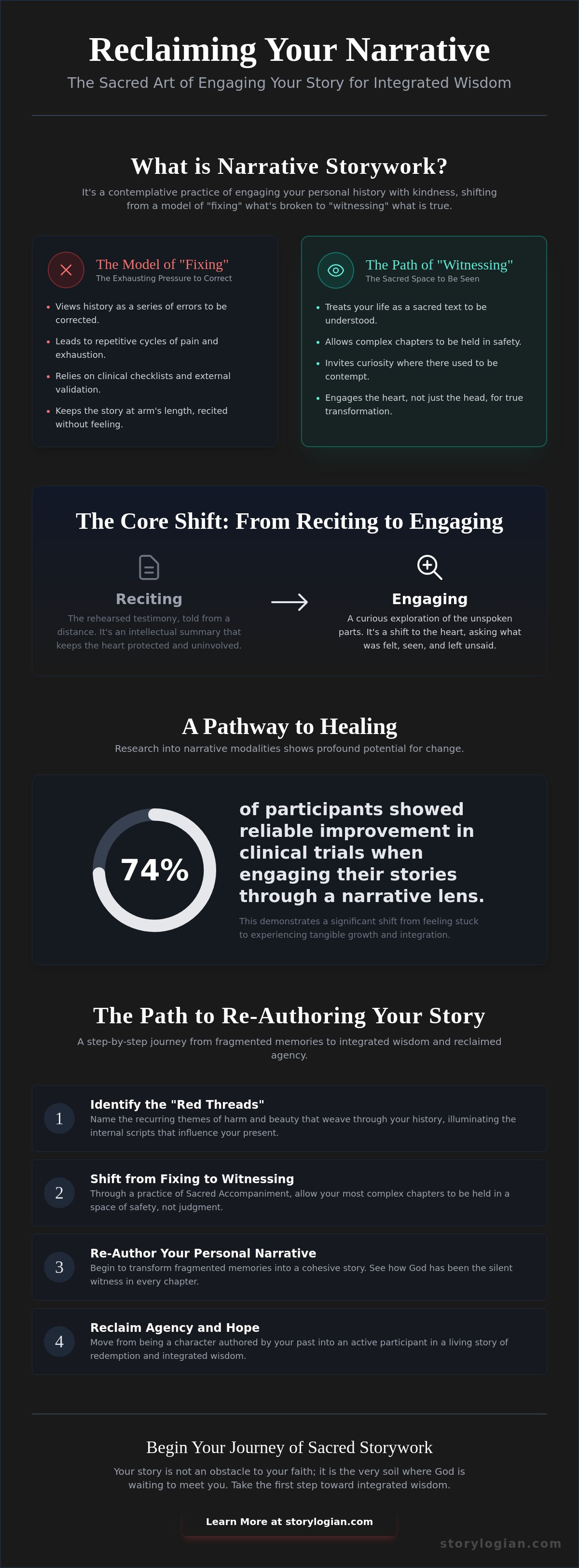
Engaging your personal narrative through a contemplative, faith-based lens can transform past harm into a future of sacred hope. Research into narrative modalities suggests profound potential for change; one clinical trial found that 74% of participants showed reliable improvement when engaging their stories through this specific lens. This article explores how you can move toward integrated wisdom, reclaiming a narrative of hope and agency. We will preview how this sacred pilgrimage allows you to honor your history while stepping into a new, restorative chapter that feels both intentional and unhurried.
Key Takeaways
Understand what is narrative storywork by exploring it as a sacred art of naming your life's themes with kindness and contemplative depth.
Identify the "red threads" of harm and beauty that weave through your history, illuminating the internal scripts that influence your present faith.
Shift from a model of "fixing" to one of "witnessing" through Sacred Accompaniment; this allows your most complex chapters to be held in a space of safety.
Learn to re-author your personal narrative, transforming fragmented memories into a cohesive story of integrated wisdom and reclaimed agency.
Discover how to begin this pilgrimage by engaging smaller, formative stories that prepare your heart for deeper reflection and healing.
Table of Contents
Defining Narrative Storywork: The Sacred Art of Listening to Your Life
The Architecture of a Narrative: How Your History Shapes Your Faith
Storywork vs. Traditional Therapy: Understanding the Contemplative Difference
The Path to Re-Authoring: Moving from Harm to Integrated Wisdom
Beginning Your Journey: How to Start Your Storywork Practice
Defining Narrative Storywork: The Sacred Art of Listening to Your Life
Listen closely. Narrative storywork is more than a technique. It's a way of being with yourself. It's the contemplative practice of engaging your personal history with a radical, quiet kindness. When we ask, what is narrative storywork, we are really asking how to stop running from our own shadows. It's the slow, methodical process of naming the recurring themes of our lives. We don't name them to judge them. We name them to find the meaning that has been there all along. It's the difference between looking at a map and actually walking the terrain of your own soul.
Why Your Story is a Sacred Text
We often treat our past like a closed book or a series of errors to be corrected. But what if your life is a living letter? This is the heart of narrative theology. Your history isn't a distraction from your faith; it's the very place where your faith is formed. Every memory, even the ones marked by harm, contains a thread of the Divine. Storywork is the hermeneutics of the soul; the art of interpreting your own life. By looking into the shadows, we find that God has never been absent. He's been the silent witness in every chapter. While it shares some foundational roots with the psychological framework of Narrative Therapy, storywork adds a layer of spiritual reverence. It treats your experiences as sacred ground rather than a clinical problem to be solved.
The Shift from Reciting to Engaging
Most of us are experts at reciting our stories. We have the rehearsed testimony. We have the "elevator pitch" of our pain that we've told so many times it has lost its pulse. But reciting is a form of distance. It's a way to keep the story at arm's length. Engaging is different. It's a shift from the head to the heart. It's about looking at the unspoken parts. What did your body feel in that moment? What was the silence saying? Storywork invites curiosity where there used to be contempt. It asks us to stay in the room with our younger selves, offering the kindness they didn't receive at the time. This is not just telling a story; it's doing the deep work of engagement that leads to true transformation. It's an invitation to look at the messy, unedited pages with a sense of wonder and hope.
The Architecture of a Narrative: How Your History Shapes Your Faith
Every life is built on a hidden framework. We are constructed of memories that act as pillars and beams, supporting the weight of who we believe ourselves to be. If we look closely, we see the "red threads" that bind these structures together. These are the recurring themes of harm, beauty, and survival that define our unique internal landscape. To truly grasp what is narrative storywork, one must become a student of this architecture. It's the practice of looking at the skeleton of your history to understand how it supports, or perhaps limits, your current reality. This structural view helps us understand the role of story in faith, revealing how our history isn't separate from our spiritual formation.
Our early stories create the internal scripts we live by today. They function as silent directors, whispering instructions on how to react, how to hide, and how to relate to the Divine. When these scripts are born of harm, they often paint a picture of a distant or demanding God. By examining these blueprints, we begin to see that our spiritual struggles are often the echoes of unexamined chapters. We are not just "messy." We are storied. And those stories have a profound logic that, once understood, can be transformed.
The Power of Naming Your Truth
Naming a moment of harm is a profound act of spiritual freedom. It's the beginning of true-telling. For many, the past is a blur of quiet unrest that feels too heavy to touch. But naming provides a boundary. It gives the pain a shape and a place. This process offers a psychological and spiritual relief that few other practices can match. When we name the truth, we stop being "authored" by our past. We move from being a character caught in a script to a participant in a living redemption. If you find yourself weary of the old scripts, engaging in Sacred Accompaniment can provide the steady presence needed to speak these truths aloud for the first time.
Identifying Themes of Harm and Hope
In this work, we define "harm" through the lens of betrayal, powerlessness, and silence. It's anything that has diminished the image of God within you. Yet, we do not look at the shadow alone. We also search for the "glimmers." These are the moments where grace was present even in the midst of pain. This rhythmic movement between acknowledging the shadow and seeking the light is essential to the methodological approach to narrative storywork. It ensures that our healing is not just a study of trauma, but a discovery of survival and the persistent beauty that refuses to be extinguished. We are looking for the evidence of a Love that never let go. By identifying these themes, we begin the slow, sacred process of re-authoring our future.
Storywork vs. Traditional Therapy: Understanding the Contemplative Difference
Traditional care often operates on a model of repair. It looks for what is broken and seeks to fix it. While clinical intervention is vital for many, there's a quiet, internal hunger that requires a different kind of attention. When we ask, what is narrative storywork, we're looking for a space that honors the soul's complexity rather than just managing its symptoms. This practice moves away from the clinical "fixing" model and toward a "witnessing" model. Here, you aren't a patient with a diagnosis. You're a person with a story that deserves to be heard in all its messy, sacred glory. While a 2025 meta-analysis of 43 empirical studies found that narrative modalities have a beneficial impact on mental health symptoms, storywork specifically focuses on the spiritual integration of those experiences.
In this space, we practice Sacred Accompaniment. It's the presence of a guide who isn't looking to categorize your pain, but to hold your story with reverence. This allows for a deep sense of healing your personal narrative that goes beyond behavioral change. We are looking for integration. We want the fragmented parts of your history to find a home within your present self. This creates a sense of wholeness that feels both grounded and holy, allowing you to move from a state of quiet unrest toward a sense of integrated wisdom.
The Role of the Witness
Healing doesn't happen in a vacuum. We cannot engage our deepest stories in total isolation because harm often occurs in the presence of another; therefore, healing must happen in the presence of another. This is the role of the witness. A guide offers "sacred listening," which is a form of prayerful attention that notices the nuances you might miss. They help you see the blind spots in your own narrative. These are the places where you've been too hard on yourself or where you've missed the presence of grace. It's a shared journey where your autonomy is always the priority. You are the expert on your life; the guide is simply a holder of space.
Moving Beyond the "Clinical" to the "Sacred"
A contemplative environment changes the way we see ourselves. In storywork, we don't just use clinical charts. We use the lenses of literature, theology, and even the narrative arc of film to understand the movement of your life. We look for the protagonist's desire, the antagonist's strategy, and the Divine's intervention in the shadows. This approach honors the "mystery" of the human experience. It acknowledges that some parts of our history cannot be fully explained. They can only be honored. This is the beauty of a soul-focused approach. It allows you to breathe, to slow down, and to trust the slow, methodical work of God in your history.
The Path to Re-Authoring: Moving from Harm to Integrated Wisdom
Re-authoring is not an act of erasure. It is an act of reclamation. When we ask, what is narrative storywork, we are essentially asking how to live a new story without pretending the old one didn't happen. It's the sacred process of integrating painful chapters into a larger narrative of resilience and grace. You cannot change the facts of your past. The betrayals happened. The silence was real. However, you can change the meaning those facts hold in your present life. This is where the quiet unrest of the past begins to settle into the integrated wisdom of the future.
As we move through this stage, we begin to see that our stories are not static. They are living, breathing entities. By engaging in this work, you move from being a passive recipient of your history to an active participant in your redemption. It's a slow, methodical movement that requires both courage and a deep, abiding kindness toward yourself. If you feel the weight of a story that no longer fits, you might find clarity by joining one of our Storywork Sessions to begin the process of discovery.
Deconstructing the False Narrative
Before we can write something new, we must look at the labels we've been carrying. Many of us live under scripts written by others; parents who were overwhelmed, teachers who didn't see us, or religious systems that used shame as a tool of control. This is particularly vital for those seeking narrative healing from spiritual abuse, where the "voice of God" was often entangled with the voice of an oppressor. Deconstruction is the spiritual discipline of letting go of these shame-based stories. It is essential to distinguish between the objective reality of what happened and the subjective burden of what I tell myself about what happened. Once we separate the event from the false interpretation, the grip of shame begins to loosen.
The Art of Re-Authoring
Re-authoring is where you find your agency. It's the moment you decide how you choose to tell the story today. This involves looking for the "Sacred Ending"—the hope that was always there, even if it was buried under layers of grief. It's not a "happily ever after" in the traditional sense. It's a "holy ever after" where the pain is honored but no longer has the final word. A practical way to begin this is by writing a "letter of hope" to your younger self. In this letter, you don't promise that the harm won't happen. Instead, you witness to that younger version of you that they survived, that they are loved, and that their story is far from over. This simple act of witnessing creates a bridge between who you were and who you are becoming.
Beginning Your Journey: How to Start Your Storywork Practice
The threshold of your own history can feel daunting. It's a place of shadows and echoes, often left unvisited for years. As you begin to explore what is narrative storywork, remember that the goal isn't to conquer your past. It's to commune with it. This pilgrimage requires a slow, deliberate pace. Start small. You don't need to begin with your most significant trauma. In fact, it's often wiser to start with a "small" story; a moment of quiet disappointment or a fleeting memory of beauty. This allows your heart to learn the rhythm of kindness before you move into deeper waters.
Preparing your heart for this work involves creating a container of safety. Deep listening cannot happen in the noise of a hurried life. It requires a sacred space, both physically and internally, where you can be honest without the fear of judgment. You are looking for a sense of integrated wisdom, not a quick fix. To help you prepare for this internal landscape, you may find it helpful to consult this reclaiming my faith story checklist, which offers a structured path for spiritual healing.
Practical Steps for the Unhurried Soul
Journaling is a powerful way to invite your narrative to the surface. It's not just about recording facts; it's about noticing resonance. Try these prompts to begin your reflection:
What is a specific memory from your childhood that still carries a physical sensation in your body today?
Where did you first learn what it meant to be "good" or "bad" in the eyes of others?
In your most difficult chapters, where can you now see a glimmer of grace that you missed at the time?
Incorporate silence and contemplative prayer into this practice. Silence is the canvas upon which your story is painted. It allows the unspoken parts of your history to finally find a voice. As you write, set boundaries for yourself. Understand the difference between what is "sacred" and what is "secret." Secrets are heavy and isolating, while the sacred is something precious that deserves to be honored and shared only in a safe, witnessed environment.
The Invitation to Accompaniment
Some stories are too heavy to be held in isolation. While personal reflection is vital, there's a transformative power in being truly seen and heard by another. Our Storywork Sessions provide a structured, sacred container for this deep engagement. These sessions are not about clinical fixing. They are about Sacred Accompaniment.
When you enter a session with Dr. Shonda Carter, you're entering a space of profound respect and unhurried grace. You can expect to be met with a patient, wise guide who is comfortable with the complexity of the human experience. Here, you're invited to move from a state of quiet unrest toward a sense of reclaimed agency. The process is organic and circular, allowing you to return to central themes of reflection until they are fully integrated. This is the heart of what is narrative storywork; the belief that when your story is witnessed with kindness, it can finally begin to heal.
Step Into Your Sacred Narrative
Your story is not a problem to be solved. It's a landscape to be explored with reverence and quiet courage. We've looked at what is narrative storywork; a sacred pilgrimage where your history becomes the ground for spiritual formation. By naming your truth and deconstructing the labels of the past, you reclaim the agency to write a future defined by hope. This is the work of integration. It's the work of finally coming home to yourself.
Dr. Shonda Carter, a theologian and filmmaker, offers a contemplative, sacred environment specifically designed for women's narratives and spiritual formation. Her approach provides the deep work and sacred listening your soul has been longing for. You don't have to carry the weight of your history alone. Begin your journey of re-authoring with a Storywork Session. The Divine thread in your life is still being woven, and your most restorative chapters are yet to be written. Trust the slow, beautiful movement of grace.
Frequently Asked Questions
Is narrative storywork the same as traditional counseling?
No, it is explicitly different from clinical mental health counseling. When people ask what is narrative storywork, they are often seeking a spiritual and narrative-based coaching process rather than a medical diagnosis. It focuses on witnessing the movement of the soul through your personal history; it offers a sacred space for integration that traditional clinical models may not prioritize.
Do I have to have experienced 'major trauma' to benefit from storywork?
No, storywork is for anyone with a history. You don't need a catastrophic event to justify this exploration. Every life is shaped by "small" stories of disappointment, silence, or formative beauty. This practice honors the quiet unrest of any life, recognizing that even subtle themes from your early years can create the internal scripts you live by today.
How can storywork help me heal from church hurt or spiritual abuse?
It provides a structured, safe container to name the harm experienced in religious settings. By looking at the specific stories where your faith was used against you, you can begin to untangle the voice of an oppressor from the voice of the Divine. This process allows you to reclaim your sacred story and move toward a faith that feels honest and restorative.
Is this practice biblically grounded?
Yes, this practice rests on the belief that our histories are revelatory and that God speaks through our lives. Scripture itself is a collection of narratives that reveal the character of God through human experience. Storywork applies this same theological lens to your personal history, treating your life as a "living letter" that contains threads of Divine presence even in the shadows.
What happens if I'm not a 'good storyteller' or writer?
Eloquence is not a prerequisite for this work; honesty is the only requirement. You don't need to be a poet or a professional writer to engage your history. A guide helps you find the words and identifies the "red threads" you might miss on your own. It's about the truth of your experience, not the performance of your prose.
How long does the storywork process typically take?
The process is designed to be unhurried and organic, matching the slow rhythm of the soul's healing. While individual sessions are typically 50 minutes, the deeper work of re-authoring your life unfolds over months or years as you return to central themes. It is a circular journey of discovery rather than a linear checklist, allowing ideas to settle before moving to the next thought.
Can storywork be done in a group setting or only one-on-one?
Both formats are valuable and available depending on your needs. You can engage in private Storywork Sessions for deep, individual focus with a guide. Alternatively, Spiritual Formation Retreats offer a communal setting where the power of being witnessed by a group can accelerate the sense of being seen and understood in a sacred, shared environment.
What is the difference between a spiritual director and a storywork guide?
A spiritual director primarily listens for God's movement in your present life and discernment. In contrast, what is narrative storywork focuses on excavating the specific stories of your past to see how they have formed your current internal scripts. While both practices utilize sacred listening, a storywork guide helps you interpret the narrative themes that influence your spiritual formation and identity.


Comments