What is Sacred Accompaniment? The Art of Soul Friendship

Have you ever sat in a crowded sanctuary, surrounded by the rhythm of familiar liturgy, yet felt entirely alone? It's a quiet, heavy isolation. You carry a story that feels too fragmented for the polished pews, a narrative you've tucked away because it doesn't seem to fit the definition of "sacred." You might find yourself wondering, what is sacred accompaniment, and could it be the space where your unspoken history finally finds a home? Perhaps you've felt the weight of high-performance ministry or the exhaustion of a life that demands constant, wearying "fixing."
It's a common ache to believe that God only resides in the tidy, resolved chapters of our lives. We strive. We perform. We burn out while searching for a Divine presence we fear we've misplaced. This article invites you to pause and breathe. Discover the restorative practice of soul friendship, a space where a prayerful, narrative-focused presence helps you find God in the very threads you thought were beyond repair. We'll explore how being witnessed, rather than solved, leads to a profound sense of peace and spiritual integration.
Key Takeaways
Understand what is sacred accompaniment by learning how a non-anxious presence focuses on witnessing your journey rather than fixing your problems.
Distinguish between psychological healing and spiritual discernment to see how accompaniment prioritizes God’s presence over symptom management.
Discover why your personal history is the primary landscape for meeting the Divine and how a companion can validate your spiritual worth.
Explore the anatomy of a session, where unhurried listening and intentional silence create space for your soul to breathe.
Learn how integrating theology with storywork helps you move from quiet unrest toward a sense of integrated wisdom and peace.
Table of Contents
Defining the Sacred Space: What is Sacred Accompaniment?
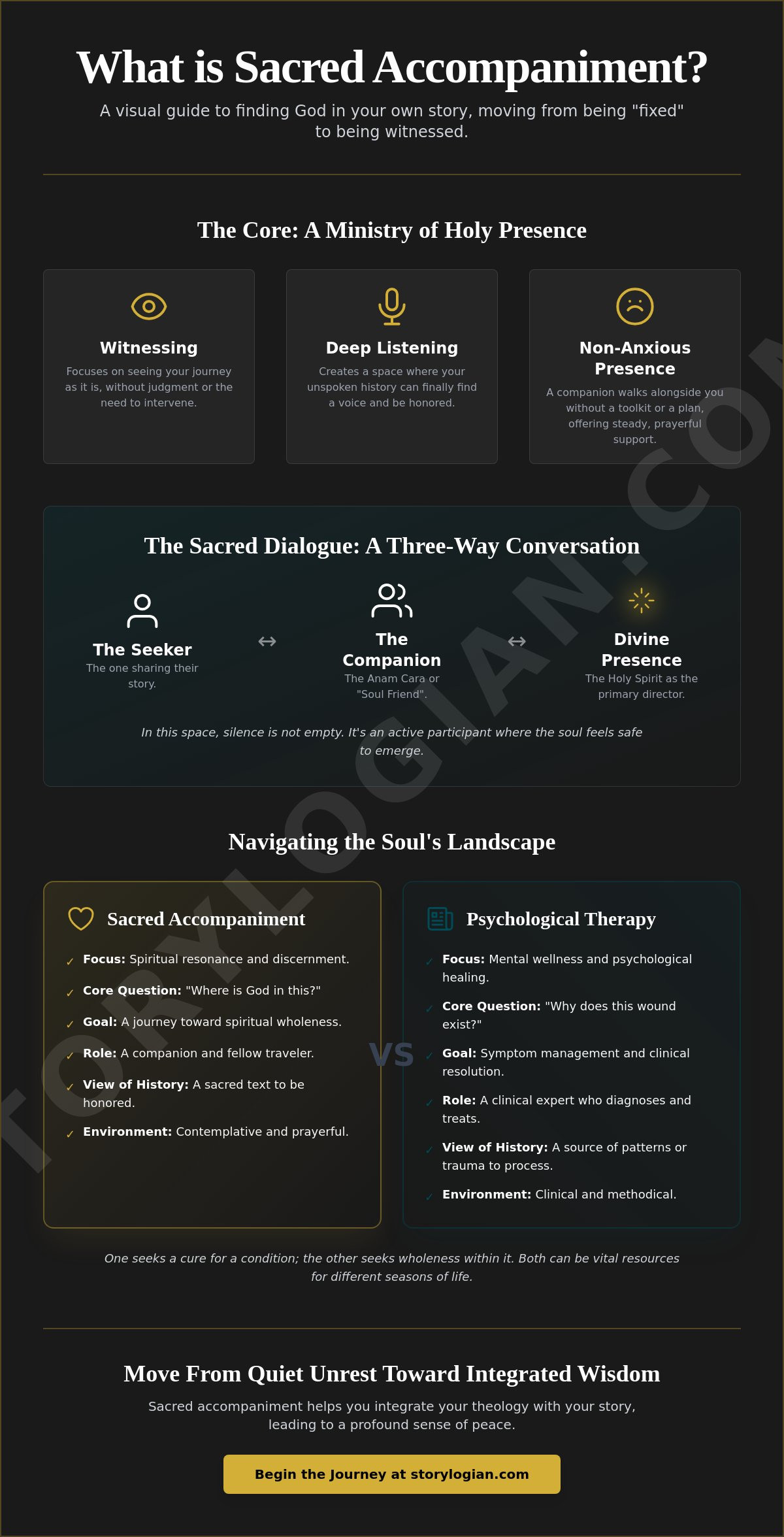
To understand what is sacred accompaniment, we must first unlearn our modern obsession with being fixed. This is not a project. It's a ministry of holy presence. At its core, it's the quiet, deliberate work of deep listening where one person walks alongside another, eyes and heart open to the movement of the Divine. In this space, the companion offers what we call a non-anxious presence. They don't arrive with a toolkit or a five-step plan for your life. They arrive to witness. This practice reaches back through centuries of spiritual direction and the ancient Celtic tradition of the Anam Cara, or soul friend. In these sessions, we acknowledge a fundamental truth: the Holy Spirit is the primary director in the room. The companion isn't there to lead you toward a specific conclusion; they're there to help you notice where God is already speaking within the messy, beautiful pages of your own story.
The Three-Way Conversation
In a typical conversation, two people exchange ideas. In this sacred space, we recognize a third participant. There's the seeker, the companion, and the Divine Presence. This creates a unique dynamic where silence is never empty. Silence becomes a vital participant. It's the breath between words where the soul finally feels safe enough to emerge. For those experiencing spiritual dryness, this three-way dialogue is essential. When God feels distant or silent, the companion holds the light, steadying the space until the seeker can perceive the subtle, subterranean shifts of Grace once more. It's an unhurried rhythm that honors the soul's timing.
Sacred vs. Secular Presence
When we ask what is sacred accompaniment, we must distinguish it from the casual, well-meaning support of a friend. A friend might offer advice or try to cheer you up. A trained spiritual companion does something different. They provide a contemplative environment rooted in prayerful intentionality. While a secular coach focuses on behavioral change or external goals, this practice looks for the sacred in the ordinary. It's the belief that the "un-sacred" details of a woman’s life, the laundry, the office tensions, the quiet grief, are the very places where God is most active. We don't escape our lives to find the holy; we look closer at the life we've already been given.
The Soul’s Landscape: How Accompaniment Differs from Therapy
It's a question often whispered in the quiet moments of a first session: is this just therapy by another name? When we ask what is sacred accompaniment, we aren't seeking a clinical diagnosis or a strategy for symptom management. While therapy is a vital, life-giving resource for psychological healing and mental health, accompaniment operates on a different plane of the soul. It moves beyond the "why" of our wounds and into the "where" of the Divine. It's about discerning the Spirituality of Accompaniment, recognizing that our lives are not problems to be solved, but mysteries to be witnessed. A woman may find herself in a season where she needs both. She might seek a therapist to process the trauma of her past while simultaneously inviting a spiritual companion to help her find God's hand in that very same history.
A Comparison of Purpose
Therapy often focuses on the architecture of the mind, examining the past to build a healthier present. Sacred accompaniment, however, looks for the Weaver behind the tapestry. It asks where God has been hiding in the shadows and where He is inviting you now. One seeks mental wellness; the other seeks spiritual resonance. Therapy looks for clinical resolution, but spiritual direction is a journey toward wholeness rather than a cure for a condition. It's an invitation to see your story not as a list of symptoms, but as a sacred text still being written by a loving Creator.
The Narrative Shift
Understanding the nuance between spiritual direction vs therapy helps you choose the right path for your current season. Therapy provides a clinical expert who treats trauma or behavioral patterns through proven psychological methods. In contrast, the spiritual companion sits with you as a fellow traveler. We don't diagnose your history. We honor it. This shift in posture allows for a deeper discernment of the soul's landscape, moving from the clinical to the contemplative. It's a space where you are seen, not as a patient, but as a beloved child of God. If you feel a tug toward this deeper exploration of your story, exploring sacred accompaniment can provide the unhurried space your soul craves.
The Power of the Witness: Why Your Story Needs a Companion
We often carry our histories like heavy, closed books. We assume the messy parts are footnotes or, worse, redacted sections that have no place in a life of faith. But what is sacred accompaniment if not the act of opening that book together? It's the profound belief that your personal history is the primary place you meet the Living God. When another person sits with you, holding a non-anxious space, a transformation occurs. You aren't just reciting facts; you're being witnessed. This witnessing validates your spiritual worth. It says, "Your life matters to God, and therefore, it matters to me."
In seeking to understand what is sacred accompaniment, we discover it is more than just listening; it is a holy validation of your existence. Within the narrative of our lives, we often encounter "themes of harm," those repeated patterns of pain or rejection that seem to echo across the years. Left alone, these themes can define us. However, a spiritual companion helps you spot the "threads of grace" that are often woven right alongside the hurt. These are the subtle, shimmering ways God has been sustaining you, even when you didn't feel His presence. By identifying these threads, you can begin to re-author your narrative, moving from a story of survival to one of sacred becoming.
Uncovering the Divine Thread
We engage in the sacred art of storytelling to find meaning in the shadows of our past. A companion listens for the unspoken, the pauses, the sighs, and the parts of the story you've been taught to hide. It's a gentle unearthing. You move from a shame-based story, where you feel like the problem, to a grace-based narrative, where you are the beloved character in a larger, divine epic. This process doesn't change the facts of your past, but it changes the light in which you see them.
Healing from Church Hurt
For many women, the very places meant to offer sanctuary have caused the deepest wounds. Religious systems can sometimes demand performance over presence, leaving you feeling seen only for what you do, not who you are. Sacred accompaniment is vital here. It offers a safe, non-judgmental harbor to rebuild a fractured spiritual core. Your companion acts as a sacred mirror. They don't reflect your failures or the expectations of a rigid system; they reflect your true identity in Christ. This slow, patient witnessing helps you untangle God from the people who may have misrepresented Him, allowing for a quiet, steady restoration of trust.
Entering the Quiet: What Happens During Sacred Accompaniment?
Stepping into a session of soul friendship feels like exhaling a breath you didn't know you were holding. It's a departure from the frantic noise of a world that demands immediate answers. When we examine what is sacred accompaniment in practice, we find a sanctuary built of time and silence. The primary tool isn't a curriculum or a diagnostic chart. It's deep, unhurried listening. The companion doesn't listen to respond; they listen to receive. They hold a space where your words can land softly, without the fear of being judged or immediately "fixed." This posture creates a fertile ground where the soul feels safe enough to speak its truth.
Within this container, the companion uses evocative questions. These aren't interrogations. They're gentle invitations to look closer at the internal landscape. A question like, "Where did you feel a sense of 'shimmer' this week?" acts as a key to a locked room. It nudges you toward reflection rather than performance. Along with these questions, contemplative prayer and spiritual exercises are woven into the hour, acting as anchors that keep the conversation grounded in the Divine presence rather than drifting into mere social chatter.
The Rhythm of a Session
Step 1: Arriving and Centering. We begin by shedding the frantic energy of the day. Through contemplative prayer, we invite the Holy Spirit to be the primary guide in the room.
Step 2: Sharing the Movements. You are invited to share the "movements of the soul" since we last met. This isn't a report of activities, but a narrative of where you felt God’s presence or absence.
Step 3: Prayerful Discernment. Together, we lean into prayerful discernment. We look for the nudges of Grace and the areas where the soul is being invited into deeper healing or rest.
The Benefits of the Unhurried Pace
Modern life is addicted to the quick fix. Transformation, however, is a slow drip. The benefits of spiritual direction include a measurable reduction in spiritual anxiety and an increase in clarity. You aren't rushing toward a finish line. You're learning to walk at the pace of Grace. In the hallowed pauses between our words, the seeker finally finds the stillness required to hear the quietest whispers of their own soul. This unhurried rhythm allows for a sense of peace that lingers long after the session ends. If you're ready to trade performance for presence, you can book a session for sacred accompaniment today.
Beginning the Journey: How StoryLogian Practices Sacred Accompaniment
Dr. Shonda Carter understands that your story is not a problem to be solved. It's a sacred text. At StoryLogian, the practice of sacred accompaniment is an intentional weaving of deep theology and the lived reality of your narrative. It is a space designed specifically for women who are weary of performing and hungry for a soul care that honors the quiet, internal shifts of the Spirit. Here, the focus is not on high-performance ministry or meeting external demands. Instead, we create a contemplative space. We slow down. We listen for the Divine echo in the mundane and the magnificent alike. If you've been asking what is sacred accompaniment, the answer lies in the experience of being truly seen without the pressure to produce or perform.
Personalized Storywork Sessions
While traditional accompaniment provides a steady presence, our storywork sessions offer a deeper dive into the specific architecture of your life. We use narrative frameworks to identify where harm has silenced your voice and where Grace is inviting you to speak again. It's a process of reclaiming the sacred narrative of your life. You aren't just looking at what happened; you are looking at who you are becoming in the light of God’s love. To re-author your story with a sacred companion is to move from being a passive observer of your past to an active participant in your spiritual future. It's a journey of integration, where the "un-sacred" parts of your history are brought into the warmth of Divine light.
Finding Your Companion
The relationship between a seeker and a companion is a delicate, holy thing. Alignment matters. It's essential to find a spiritual director who understands your specific background, your unique wounds, and your deepest longings. At StoryLogian, we prioritize this "fit," ensuring that the space between us is one of profound safety and mutual respect. We recognize that the soul cannot be forced; it can only be invited. If you feel a sacred nudge toward this practice, we invite you to reach out. Whether through a discovery call or an initial session, the journey toward spiritual integration begins with a single, unhurried step. Your story is waiting to be heard. It's time to find God in the threads of your own history.
Walking Toward Spiritual Wholeness
Your history is not a collection of errors or a list of symptoms to be managed. It is a sacred text, still being written by a Divine hand. We have journeyed through the quiet landscape of the soul to understand what is sacred accompaniment, discovering a restorative practice where being witnessed is more vital than being fixed. By distinguishing this path from therapy and embracing the unhurried rhythm of deep listening, you allow the threads of grace in your story to finally shimmer in the light.
At StoryLogian, Dr. Shonda Carter, a theologian and filmmaker, offers a deeply personalized, narrative-focused approach designed specifically for women and ministry leaders. This is a sanctuary where your unspoken experiences are held with reverence and wisdom. If you feel the nudge of the Spirit calling you into a deeper integration of your past and present, we invite you to take that first step. Begin your journey with a Storywork Session at StoryLogian. Peace is not found in the absence of your story, but in the presence of the One who has been with you through every chapter.
Frequently Asked Questions
What is the main goal of sacred accompaniment?
The primary goal is to help you identify and respond to the presence of God within the unique narrative of your life. It is less about solving problems and more about holy witnessing. By looking at your history through a prayerful lens, you can begin to see the Divine threads that have been woven through your story all along. This practice fosters a sense of spiritual integration and peace.
Is sacred accompaniment only for people in crisis?
No, this practice is beneficial for anyone seeking a deeper, more reflective connection with the Divine. While it provides a safe harbor during seasons of grief or transition, it is also a vital rhythm for the ordinary, quiet stretches of life. It is for the woman who feels a "sacred nudge" to move beyond performance and into a more authentic, unhurried spiritual formation.
How often do sacred accompaniment sessions usually happen?
Most seekers meet with their companion once every month. This deliberate pace honors the soul’s natural timing and allows for the "slow-drip" of transformation to settle between sessions. It provides enough space to live out the nudges of the Spirit while maintaining a consistent, supportive presence. The focus is always on quality of presence rather than frequency of meetings.
Can I do sacred accompaniment if I am not a member of a specific church?
Yes, your soul’s journey with God is not confined by institutional membership or specific denominational ties. This practice is open to any woman seeking to explore her internal landscape and find the Divine in her personal story. It is a shared journey of discovery that welcomes the complexity and unspoken elements of your individual history, regardless of your current church standing.
How much does a session of sacred accompaniment typically cost?
Rates for these sessions vary based on the practitioner and the specific nature of the support required. Some practitioners offer individual arrangements to ensure the service remains accessible to those who need it. It’s best to contact the practitioner directly to discuss their current fee structure and find an arrangement that honors both the service and your circumstances.
What is the difference between a spiritual director and a sacred companion?
These terms are often used interchangeably to describe a ministry of presence and deep listening. While "spiritual direction" is the traditional term, "sacred companion" often emphasizes the collaborative, "soul friendship" aspect of the relationship. Both roles serve as a non-anxious presence, helping you interpret the process of your own spiritual becoming without looking to fix or diagnose.
Is sacred accompaniment a form of clinical counseling?
No, it is important to understand that what is sacred accompaniment is a spiritual practice, not a clinical or psychological one. While it can be deeply healing, it does not involve clinical diagnosis, symptom management, or treatment for mental health conditions. It focuses on your relationship with God and the movement of the Spirit rather than behavioral modification or psychological interventions.
How do I know if I am ready for sacred accompaniment?
You are likely ready if you feel an internal longing to be heard in a way that goes deeper than casual conversation. Many women seek this path when they feel burnt out by high-performance ministry or lonely in their spiritual journey. If you are ready to trade the "quick-fix" for a more methodical, prayerful exploration of your story, the time is right to reach out.


Comments