Finding God in My Story: The Sacred Art of Spiritual Remembering

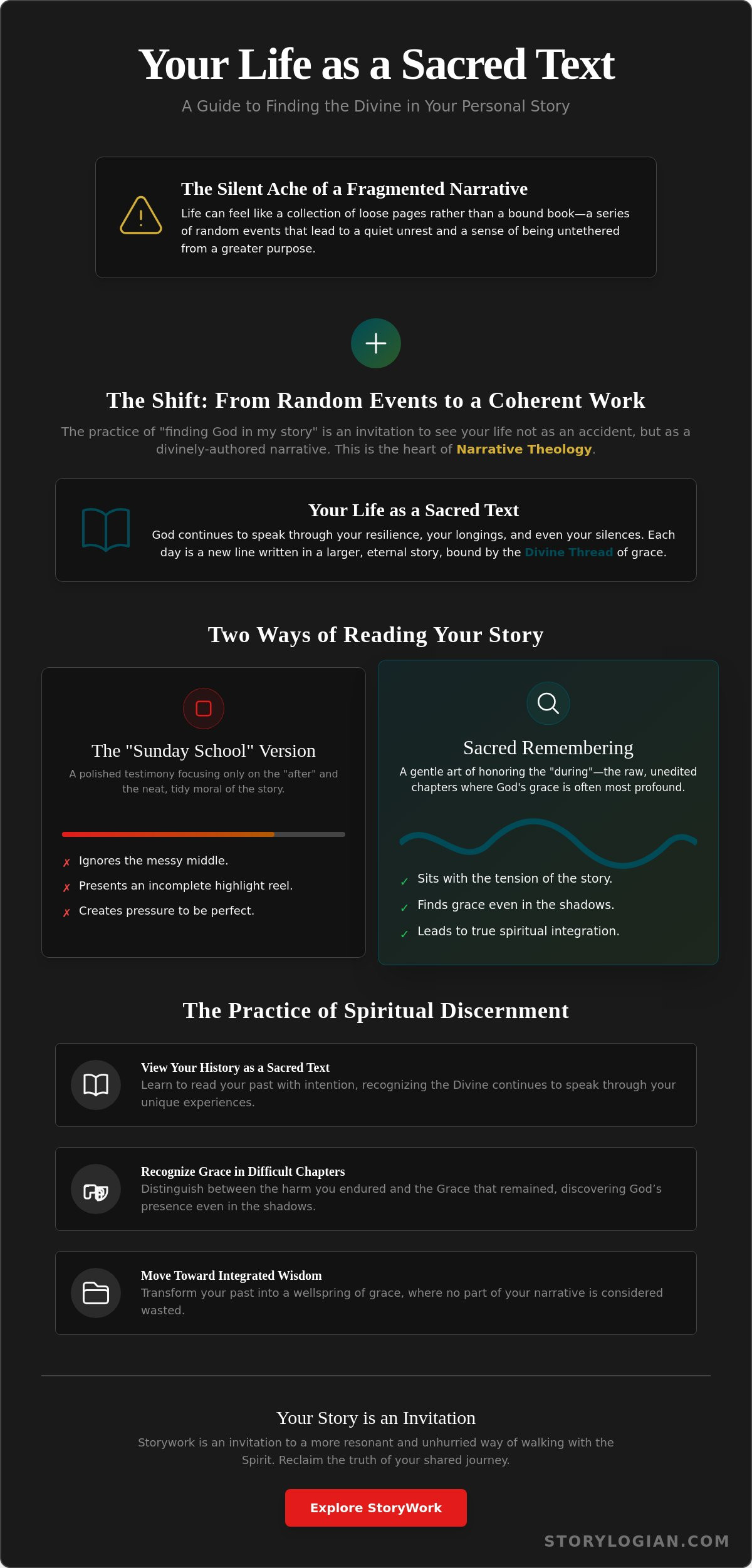
What if the chapters you've tried to edit out are actually the places where the Author is most present? It's easy to feel like your life is just a sequence of random events, a chaotic collection of "and thens" that don't seem to add up to much. You might struggle to see the divine in the middle of past harm or the heavy silence of the mundane. The practice of finding god in my story isn't about rewriting the facts. It's about learning to see the sacredness already woven into the fabric of your days.
You deserve to know that no part of your journey is wasted. We'll explore how to trace the divine thread through your history, even in the shadows you'd rather forget. This guide offers practical tools for spiritual discernment to help you move from quiet unrest toward a sense of integrated wisdom. Together, we'll look at how to recognize God's presence in every line of your narrative, transforming your past into a wellspring of grace and reclaiming the truth of your shared journey with the Spirit.
Key Takeaways
Learn to view your personal history as a sacred text where the Divine continues to speak through your unique experiences.
Master the gentle art of finding god in my story through a structured practice of contemplative spiritual remembering.
Discover how to recognize God’s presence within your most difficult chapters, distinguishing between the harm you endured and the Grace that remained.
Move from a state of quiet unrest toward a sense of integrated wisdom where no part of your narrative is considered wasted.
Understand how the practice of storywork serves as an invitation to a more resonant and unhurried way of walking with the Spirit.
Table of Contents
The Silent Ache: Why We Seek the Divine in Our Personal History
There's a quiet unrest that often settles in the heart during the middle years of a life. It's a feeling that our days have been a collection of loose pages rather than a bound book. We look back and see fragments. We see a career change here, a season of grief there, and long stretches of the mundane in between. This sense of narrative fragmentation can leave us feeling untethered. We begin to wonder if there's a design at all. The practice of finding god in my story is the intentional process of spiritual narrative integration. It's an invitation to stop viewing your life as a series of accidents and start seeing it as a coherent, divinely-authored work.
This isn't just about looking for small sparks of joy. It's a deeper, more rigorous discipline called sacred remembering. Unlike a polished testimony, which often focuses only on the "after" and the resolution, sacred remembering honors the "during." It sits with the tension of the middle of the story where things are still messy and unresolved. This approach finds its roots in Narrative theology, which suggests that the Divine isn't just a set of abstract doctrines to be studied. Instead, God is a character who is actively speaking through the unfolding events of our personal and communal histories.
The Longing for Meaning Beyond the Mundane
Many women experience a specific hush in their souls as they navigate major transitions. It's a sacred unrest that asks: "What was the point of it all?" This isn't a crisis of faith but a call to deeper discovery. Your personal history is not a graveyard of dead moments. It's an altar. When we look backward with intention, we begin to see the subtle, persistent ink of a Co-Author who was present in the rooms we thought we occupied alone. In the quiet work of finding god in my story, we discover that no chapter was ever truly written in isolation.
Moving Beyond the 'Sunday School' Version of Your Life
We've often been taught to present a resolved version of our lives. We feel a subtle pressure to make our stories sound like a perfect Sunday School lesson, complete with a tidy moral at the end. But God is not interested in your highlight reel. He's drawn to your honesty. Honoring the raw, unedited chapters, including the parts where you felt abandoned or hurt, is the only way to find true integration. It's in the shadows, not just the light, where the most profound grace is often hidden. Your story doesn't need to be perfect to be sacred.
Understanding Narrative Theology: Your Life as a Sacred Text
To understand the weight of your history, you must first change the way you read it. We often treat our past like a ledger of gains and losses. We see a sequence of events, some fortunate and others regrettable. But what if your life is actually a living document? This is the core of narrative theology explained. It's the belief that God is a master storyteller who uses the specific events of our lives to reveal His character. When you begin the work of finding god in my story, you're looking for the Divine Thread. This thread is the subtle, persistent presence of grace that runs through every page, binding the disparate moments into a single, sacred text.
Reading your life as a text changes how you encounter the present. You're no longer just a passive observer of your own existence. You become a student of the Spirit. This perspective allows you to see that God didn't stop speaking when the canon of Scripture was closed. He continues to speak through your resilience, your longings, and even your silences. Every day is a new line being written in a larger, eternal work. It's a slow, methodical process of discovery that requires us to linger over the sentences we previously rushed past.
The Interplay Between the Great Story and Your Story
Scripture provides the essential grammar for our personal narratives. It gives us the vocabulary for the seasons that feel like "exile" or the years spent wandering in a "wilderness." By recognizing these biblical themes in your own timeline, you realize your experience isn't an anomaly. You're part of a lineage. The Holy Spirit acts as the Interpreter, helping you translate the confusing syntax of your past into a language of hope. Research on The Power of Personal Narrative suggests that when we frame our experiences within a larger meaning, we find greater psychological and spiritual resilience.
Honoring the Author: Autonomy and Sovereignty
We often struggle with the tension between our choices and God's providence. It's vital to avoid the trap of spiritual bypass, where we might blame God for harm or ignore the reality of human agency. Instead, we see a God who honors our autonomy while remaining sovereign over the outcome. We aren't puppets. We are co-authors. We don't control every plot twist, but we do choose how we respond to the Call. If you're ready to look closer at these chapters, a Storywork Session can provide the space to witness these complexities with a patient guide. Finding god in my story means trusting that the Author is still holding the pen, even when the ink seems to smudge.
Tracing the Divine Thread: A Practice of Spiritual Remembering
To begin the work of finding god in my story, we must first agree to slow down. This isn't a task for the hurried mind. It's a sacred art that requires a contemplative environment, perhaps a quiet room, a candle, and the willingness to look backward without flinching. We often rush to judge our past. We label years as "bad" or "wasted." In this practice, we simply name what happened. We name the events, the people, and the feelings without the immediate need to fix or justify them. By naming, we create space for the Spirit to show us what we might have missed in the heat of the moment.
This process uses spiritual markers to identify significant turning points. These are the hinges upon which your life swung in a new direction. When we look at these markers through the lens of faith, they stop being random occurrences. They become invitations. They are the places where the Divine Thread was pulled tight, guiding you through the labyrinth of your own history. It's a methodical way of honoring the weight of your lived experience.
Step 1: Creating a Narrative Timeline
Begin by mapping out the peaks and valleys of your life across the decades. Don't just list dates. Instead, use sensory details to unlock buried memories. What was the smell of the air during that difficult season? What song was playing when you felt that sudden surge of hope? You might use a simple "Litany of Remembering" to open your heart, a prayer that asks the Spirit to bring to mind the things you need to see. This isn't about nostalgia. It's about presence.
Step 2: Looking for the 'Redemptive Echoes'
Once your timeline is visible, look for recurring themes of grace. These are your "Burning Bushes," moments that demanded your attention and signaled a divine encounter. You might notice a specific way God provides for you or a particular way you are comforted in grief. A Redemptive Echo is a recurring manifestation of God's specific character in your life. Identifying these echoes helps you see finding god in my story as an ongoing conversation rather than a series of one-off events.
Step 3: Sitting with the Unresolved
The most difficult part of storywork is leaving some chapters open. Not every story has a neat conclusion or a "lesson learned" just yet. We must practice the discipline of waiting in the "not yet." Finding God in the unresolved parts of our narrative requires a deep trust in the Author's timing. This process is often deepened through the sacred art of storytelling, where we share our unfolding journeys in a community of deep listening and shared reverence.
The Sacred in the Shadows: Finding Grace in Our Places of Harm
How could God be in this painful chapter? It is the question that haunts the edges of our memory. When we look back at seasons of trauma, betrayal, or deep loss, the Divine often feels absent, or worse, indifferent. We must begin by making a vital distinction. God is not the author of your harm. He did not script the betrayal or orchestrate the abuse. There is a profound difference between God causing harm and God being present within it. Finding god in my story requires us to look for the One who sat in the dust with us, weeping over the wreckage that He never intended for His children.
We often speak of God in the light, but there is a sacredness in the shadows too. These are the places where God’s presence is often most intimate but least visible, like a seed germinating in the dark of the earth. To find Him here, we must embrace the practice of lament. Lament is not a lack of faith; it is a holy insistence that things are not as they should be. It is the language we use when the story feels broken. By bringing our raw, unedited grief to the Spirit, we allow the shadows to become a place of meeting rather than a place of hiding.
Healing from Church Hurt and Spiritual Trauma
For many, the deepest shadows are cast by the very institutions meant to represent the Divine. If you have experienced spiritual trauma, you may feel that God Himself is the one who failed you. Yet, finding god in my story often involves discovering the "hidden God" who stood with you when religious systems collapsed. He grieves the ways His name has been misused. For those who have carried the weight of leadership, soul care for ministry leaders often begins with this honest acknowledgment of the shadows. It is a process of untangling the character of the Creator from the failures of His representatives.
The Theology of the Cross in Your Personal History
The broken parts of your narrative are often the very sites where resurrection begins. Think of the Japanese art of Kintsugi, where broken pottery is repaired with gold. The vessel is not returned to its original state; it is made more beautiful and stronger for having been broken. The gold does not hide the cracks; it honors them. We can reframe what we once called "wasted years" as seasons of unseen growth. These were not gaps in your story; they were the deep winter where the roots were stretching out. If you are ready to begin the gentle work of witnessing these chapters, you might find peace through Sacred Accompaniment, allowing a patient guide to hold space for your healing.
From Reflection to Integration: The Invitation of Storywork
The act of looking back is only the first movement in a larger symphony. Integration is the second. While reflection allows us to see the patterns, integration is the process of weaving those patterns into your present identity. The practice of finding god in my story is not an end in itself. It's the beginning of a new way of walking through the world. It's the moment when the "then" informs the "now," giving you the agency to step into your future with a grounded sense of hope. You're no longer a victim of a random timeline. You're a participant in an ongoing, sacred dialogue.
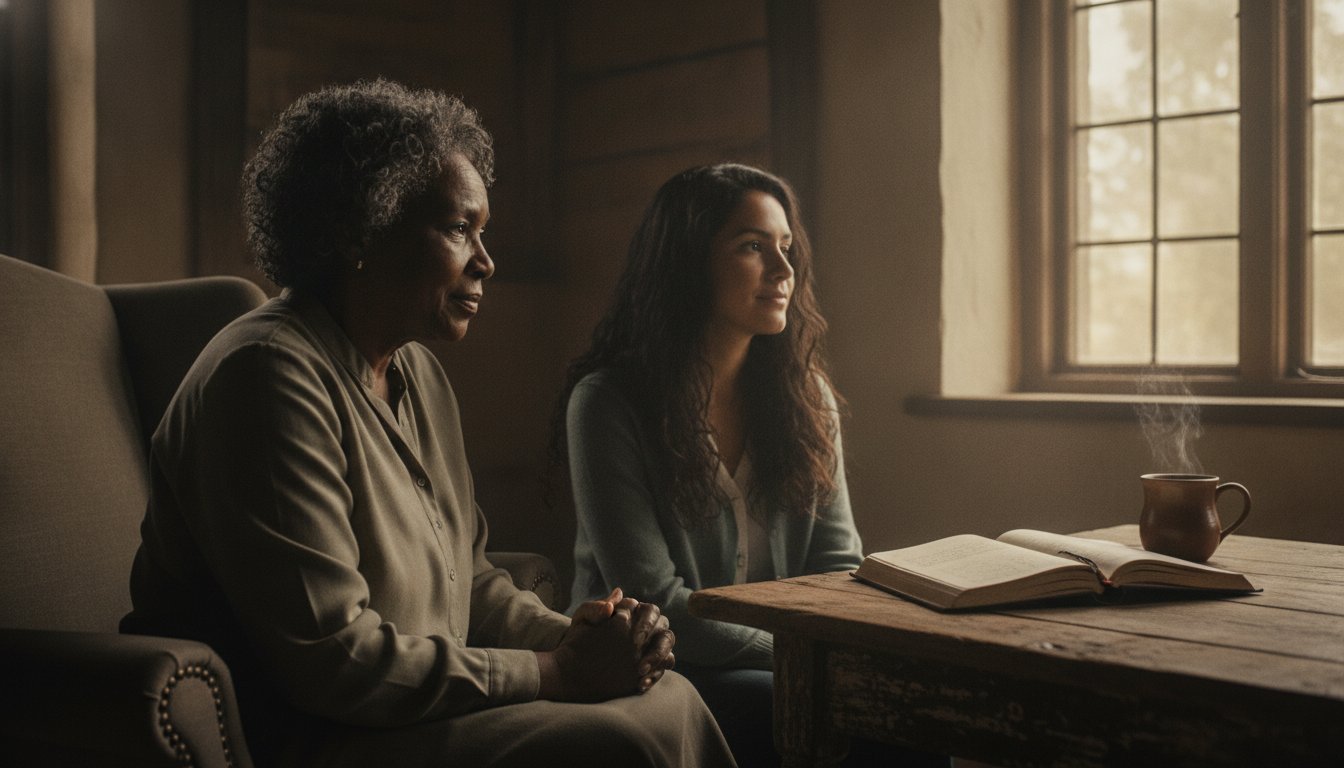
This movement toward wholeness often requires a dedicated space to process the complexities of the past. Engaging in Storywork Sessions offers a path to this deeper integration. Here, the story is not just told; it is witnessed. A Sacred Guide or Spiritual Director acts as a co-listener, helping you interpret the nuances that are often invisible when you're too close to the text of your own life. They help you re-author the narrative, moving from a place of quiet unrest toward a state of integrated wisdom. This isn't about fixing the past. It's about honoring it.
Why You Shouldn't Journey Alone
Self-reflection has its limits. We all have blind spots where our own pain or bias obscures the divine whisper. This is the beauty of Sacred Accompaniment. A trained listener can hear the subtle themes of grace that you might have dismissed as coincidence. There's a profound power in being witnessed in your full, sacred complexity. When another person honors your history with reverence, it validates the truth that finding god in my story is a shared, holy endeavor. You don't have to carry the weight of interpretation by yourself.
Living as a 'StoryLogian'
To live as a StoryLogian is to adopt a habitual posture of curiosity toward the Divine. It's a shift in perspective. You stop asking, "What is happening to me?" and begin to ask, "What is God inviting me into through this?" This doesn't erase the difficulty of life, but it provides a framework of meaning. Trust the Author of your days. The pen is still moving. Your story is not finished, and the chapters yet to come are being written by the same Grace that held you in the beginning. Breathe. The narrative is still unfolding.
Reclaiming Your Sacred Narrative
Your history is not a series of random accidents. It's a living text. We've explored how narrative theology invites you to read your past with new eyes, identifying the divine thread even in the shadows of harm. This process of finding god in my story transforms the way you inhabit the present. It moves you from a state of quiet unrest toward a sense of integrated wisdom where no chapter is considered wasted. Your life is a coherent work of grace.
You don't have to witness these chapters alone. Guided by Dr. Shonda Carter, a theologian and filmmaker, we provide a safe space for processing spiritual trauma and narrative harm. This work is deeply rooted in the contemplative tradition of sacred accompaniment. Begin your journey of sacred remembering with a Storywork Session today. Trust that the Author is still at work. Your story is sacred, and it's being held with infinite care.
Frequently Asked Questions
How can I tell the difference between my imagination and God's presence in my story?
Discernment is a slow process of noticing the fruit of a memory rather than seeking immediate, clinical certainty. Divine presence often carries a quality of "otherness" that brings a persistent peace, a gentle conviction, or a sense of resonance that you didn't manufacture on your own. It's helpful to ask if the insight aligns with the character of God revealed in the larger Story of Scripture. Over time, you'll recognize the specific "voice" of the Spirit in your history.
Is it possible that God was absent during the most traumatic parts of my life?
While God may feel absent, the contemplative tradition suggests He is often most present in the "hiddenness" and the shared grief of our darkest moments. He doesn't cause the harm, but He remains the Witness who weeps with us in the wreckage. Finding god in my story during trauma involves looking for the quiet, subtle ways you were sustained even when the light went out and the path forward seemed entirely lost.
What if my story doesn't have a 'happy ending' yet?
Sacred remembering doesn't require a tidy resolution or a "happy ending" to be valid or holy. Many of the most profound chapters in our lives are still in the "middle," where the ink is still wet and the ultimate meaning is still unfolding. We honor the story by staying present in the tension of the unresolved. We trust that the Author is still holding the pen, even when the current page feels heavy.
Do I need to be a writer or a theologian to find God in my story?
You don't need formal credentials, literary skill, or academic training to recognize the Divine in your history. Spiritual remembering is an act of the heart and a posture of the soul, not an exercise in intellectual mastery. It requires only a willingness to slow down, breathe, and pay attention to the patterns of grace that have already been woven into the fabric of your ordinary days.
How do I start 're-authoring' a narrative that feels defined by failure?
Re-authoring begins by changing the lens through which you view your mistakes and regrets. Instead of seeing failure as the final period at the end of a sentence, we look for how those moments served as soil for future growth or deep humility. We look for the grace that met us in the wreckage. We acknowledge the resilience that allowed us to continue the journey despite the weight of our errors.
Can finding God in my story help me with church hurt or spiritual abuse?
Storywork provides a safe, sacred container to untangle the character of God from the failures of religious institutions. By finding god in my story apart from the systems that caused harm, you can begin to reclaim your personal relationship with the Divine. It's a process of identifying the "hidden God" who stood with you in your pain, even when those who claimed to represent Him failed you.
What is the difference between spiritual direction and traditional therapy for my story?
Traditional therapy often focuses on psychological healing and behavioral shifts, while spiritual direction or sacred accompaniment focuses on your relationship with the Divine. We look specifically for the movement of the Spirit within your narrative. It is a contemplative practice that treats your life as a sacred text rather than a problem to be solved. We witness the process of your spiritual formation as it unfolds.
How long does the process of 'sacred remembering' typically take?
Sacred remembering is a lifelong rhythm rather than a one-time event with a fixed deadline. Some insights may arrive in a sudden flash of clarity, while others require years of patient lingering and reflection. It is a slow, methodical journey that moves at the pace of the soul. This allows truth to settle and integrate into your life over time, matching the unhurried nature of the Spirit's work.


Comments