Healing the Unspoken: A Guide to Christian Storywork Retreats in 2026

What if the chapters of your life you've tried hardest to erase are actually the places where God is speaking most clearly? It's a heavy thing to carry a story that feels fragmented. You might feel stuck in old patterns of harm, fearing that if you truly spoke your truth, you'd find judgment instead of grace. This sense of being unheard often leads us to seek a christian storywork retreat, a space where the silence of the past is met with profound empathy. You've likely wondered why God seemed silent during the seasons that hurt the most. It's a common ache. Many of us feel that our past is a series of closed doors we're afraid to reopen.
We agree that your history deserves more than just to be survived; it deserves to be honored. This guide will show you how engaging your personal narrative provides a gentle path toward deep spiritual healing and transformation. We'll explore the process of naming your life's themes and feeling truly witnessed in your most vulnerable moments. Together, we'll look at how these sacred spaces offer a clearer vision of how God has been present in your entire narrative, helping you move from quiet unrest toward a sense of integrated wisdom.
Key Takeaways
Learn how a christian storywork retreat integrates narrative theology and communal witnessing to help you engage the painful chapters of your life with grace.
Understand the vital role of naming the harm in your history, a process that creates the necessary space for true spiritual freedom and transformation.
Discover the Gentle Threshold approach, which ensures the pace of your narrative journey respects your soul's timing and internal landscape.
Explore the daily rhythms of morning contemplation and narrative teaching that help you move from a state of unrest toward integrated wisdom.
Gain a clearer vision of how to carry your story forward through Sacred Accompaniment, allowing your healing to become a lasting part of your spiritual formation.
Table of Contents
What is a Christian Storywork Retreat?
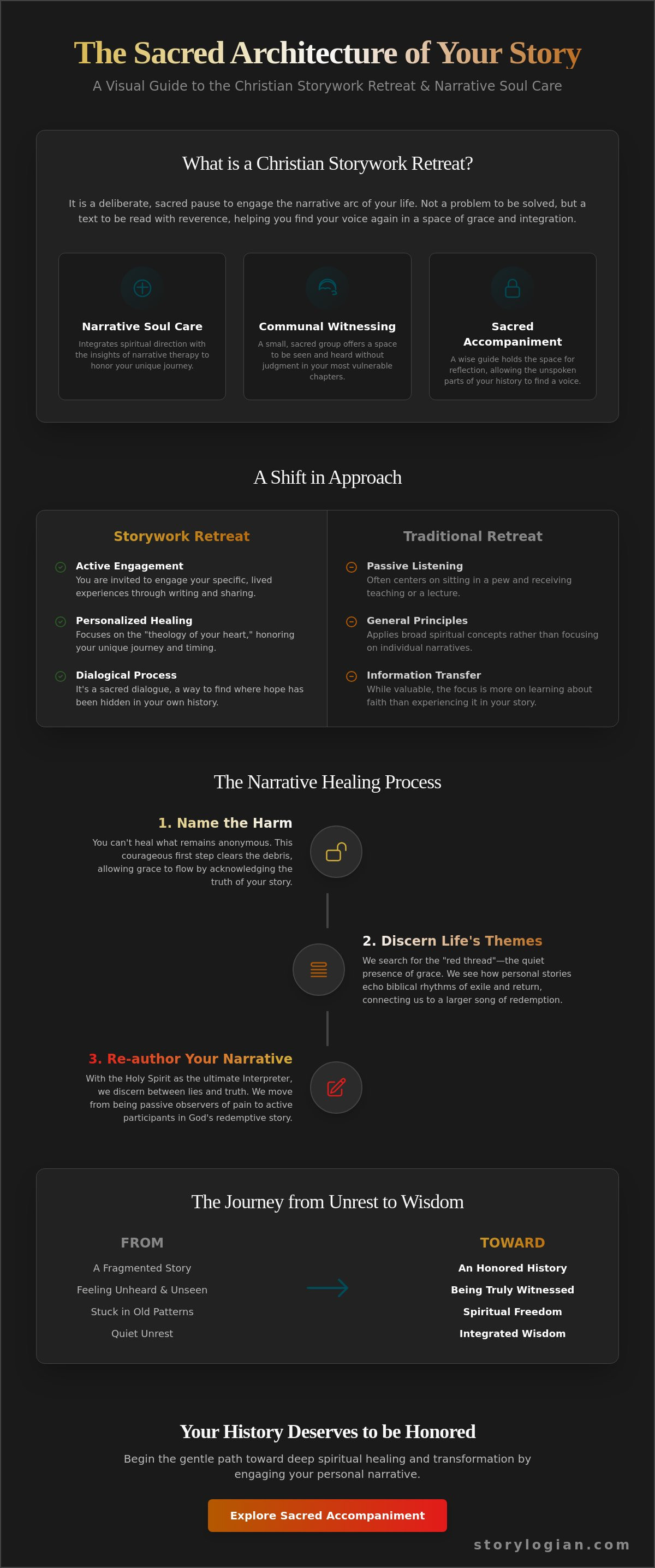
A christian storywork retreat is a deliberate, sacred pause in the middle of a noisy world. It's not a luxury vacation or a clinical intensive designed to fix a broken mechanism. Instead, it's an invitation to sit with the narrative arc of your life. You aren't just looking at what happened; you're looking at how you've been shaped by the telling. This process integrates the wisdom of spiritual direction with the structural insights of Narrative therapy, all while held in the safety of communal witnessing.
In this space, we don't treat your life as a problem to be solved. We treat it as a text to be read with reverence. The facilitator serves as a wise guide or a deep listener, rather than a clinical therapist. They hold the space for you to breathe and reflect, allowing the unspoken parts of your history to finally find a voice. It's a journey from isolation toward integration. It's a way to find your voice again.
The Core Elements of Narrative Soul Care
At the heart of this work lies the practice of narrative soul care. This isn't a passive exercise. It involves several rhythmic layers that help you engage your story with kindness and clarity:
Writing as Discernment: We use the pen to name truths that have long remained silent. Writing becomes a mirror, reflecting the internal landscapes we often ignore in the rush of daily life.
Communal Witnessing: A small, sacred group offers a space to be seen without judgment. These circles ensure that you are loved in your most vulnerable chapters.
The Red Thread: We search for the quiet presence of grace in every chapter. We seek to find where God has been present even in the shadows of your narrative.
Storywork vs. Traditional Christian Retreats
Many traditional retreats focus on passive listening. You sit in a pew and receive teaching. While there is value in that, a christian storywork retreat asks for active engagement. It moves beyond general spiritual principles to the "theology of the heart." This requires looking at your specific, lived experiences. We believe that God speaks through the particularity of your life. Instead of just learning about hope, you are invited to find where hope has been hidden in your own history. The shift is profound. It moves from a lecture to a personalized narrative healing that honors your unique journey and respects the soul's timing.
The Sacred Architecture of Narrative Healing
Every life possesses an architecture. It's a structure built by time, choice, and the quiet weight of circumstance. Within the container of a christian storywork retreat, we begin to recognize that this structure isn't accidental. It's narrative theology in motion. This perspective invites you to see your life as a story God is actively writing. It's a sacred dialogue rather than a series of random events. When we view our history through this lens, we stop being passive observers of our own pain and start seeing the Hand that has been moving even in the shadows.
True spiritual freedom requires a courageous first step: naming the harm. You can't heal what remains anonymous. In our narratives, harm often acts like a blockage in a natural spring. It stops the flow of grace and keeps us tethered to old patterns of survival. By naming these specific moments, we clear the debris. This isn't about dwelling on the past. It's about acknowledging reality so the Holy Spirit, the ultimate Interpreter of our personal histories, can bring light to the dark corners. He is the one who helps us discern the difference between the lies we've been told and the truth of who we are.
The themes of our lives often echo the larger biblical rhythms of exile and return. We find ourselves in seasons of wandering, feeling far from the "home" of God's presence. Yet, these themes of exile always point toward a promised return. In the stillness of reflection, we discover that our stories aren't just personal. They are part of a much older, much larger song of redemption.
The Imago Dei in Your Personal History
Your specific story is a unique reflection of God’s character. No one else carries the particular blend of beauty and struggle that you do. This means that your history is a site of potential epiphany. Even the unspoken, quieter chapters hold the possibility of meeting the Divine in a new way. Sacred Narrative is the intersection of human experience and divine presence. If you feel called to explore these intersections more deeply, engaging in Sacred Accompaniment can provide the steady, patient witness your story deserves.
Redemption as Re-Authoring
Redemption isn't a return to innocence. It's a movement toward integration. It's the process of moving from being a victim of your past to becoming a co-author of your future. When we name our themes of harm, we finally gain the vocabulary to name our themes of glory. This shift happens most powerfully when we are witnessed by a community of faith. To be seen and loved in your most vulnerable chapters is a theological act. It mirrors the way God sees us, fully known and yet profoundly loved, as we move from a state of quiet unrest toward a sense of integrated wisdom.
Addressing the Fear: Is a Storywork Retreat Too Intensive?
It's natural to feel a tremor of hesitation when considering a christian storywork retreat. Opening the pages of a personal history can feel like stepping into a storm. You might worry that looking back will leave you overwhelmed or re-traumatized. This anxiety is actually a sign of your soul's wisdom. It's a signal that your story is precious and deserves to be handled with immense care. We acknowledge that the quiet chapters of your life carry weight. They shouldn't be rushed into the light before they are ready.
At StoryLogian, we lean into what we call the "Gentle Threshold." This approach respects the soul's timing above all else. Unlike high-intensity workshops that demand immediate depth, we prioritize a pace that allows for breathing. There is a fundamental difference between "exposure" and "reverent engagement." Exposure can feel like a clinical interrogation, cold and invasive. Reverent engagement, however, is like holding a fragile artifact in the light. We don't force the story out. We create an environment where the story feels safe enough to emerge on its own. It's a sacred pause, not a forced interrogation.
The Role of Safety and Sacred Space
Safety is not a static condition; it is a shared practice. We establish "covenants of presence" within our groups, ensuring that every participant is committed to holding space for others without the urge to fix or judge. This protective boundary allows for deep listening. Between sessions, we emphasize the importance of silence and contemplative rest. These moments of stillness are just as vital as the dialogue itself. They allow the insights to settle and the nervous system to remain calm. A facilitator acts as a guardian of this space, ensuring that the process remains protective rather than intrusive.
Storywork as a Slow Journey, Not a Quick Fix
We must dispel the myth that a single weekend can heal every wound from a lifetime. That expectation is a burden no soul should carry. Storywork is a slow, methodical journey. Sometimes, the most significant progress is found in "partial naming," simply acknowledging a small fragment of truth and letting the soul breathe. There is no rush to reach a finish line. The goal is integration, the quiet coming together of your fragmented parts, rather than a singular moment of explosive catharsis. This unhurried movement allows for a sense of steady, guided growth that feels both intentional and sustainable.
What to Expect: A Journey Through a Narrative Retreat
Entering a christian storywork retreat is much like entering a living liturgy. It's an unhurried sequence of moments designed to help you settle into your own skin and breathe. The day doesn't begin with a frantic rush or a packed agenda. It begins with Morning Contemplation. This is a dedicated time of prayer and silence where we set the heart's intention. We ask for the courage to see what needs to be seen and the grace to hold it with kindness. It's a moment to center yourself before the work of the day begins.
From this quiet foundation, we move into Narrative Teaching. Here, we explore the frameworks of story, harm, and hope. We learn to identify the plot points that have shaped our internal landscapes. The rhythm then shifts to Small Group Engagement. In these intimate circles, you're invited to share a specific "story of impact" with a facilitator. This isn't a performance or a lecture. It's an act of Sacred Witnessing. We practice "holy curiosity" toward one another's lives, listening for the themes that hum beneath the surface of the words. We conclude with Integration Time. This provides solitary space for journaling, walking among the trees, or simply sitting in prayerful reflection to let the day's insights settle into the soul.
The Practice of Writing Your Story
We don't ask you to write a full autobiography. That would be a daunting task that often leads to exhaustion rather than insight. Instead, we focus on a single "story of impact." This is a specific, contained moment in time that carries significant weight in your narrative. We use tools for accessing memory through a contemplative lens, allowing the sensory details to surface gently. If you don't consider yourself a "writer," please know that this isn't about literary merit. It's about naming truth. We provide guidance to help you find the words that match your internal experience, honoring the story exactly as it is.
The Communal Table: Food and Fellowship
Shared meals are essential to the healing process. There is something profoundly grounding about breaking bread together after a day of deep reflection. At the communal table, food and fellowship become a container for the work we're doing. Community helps carry the weight of individual stories, reminding us that we aren't alone in our seasons of exile. We create a rhythm of work and rest that honors the body, acknowledging that the soul needs physical nourishment and laughter to sustain the journey of transformation. If you're ready to experience this restorative rhythm, we invite you to explore our Spiritual Formation Retreats and find a place at our table.
Beginning Your Narrative Journey with StoryLogian
Healing is unhurried. It requires a witness. The StoryLogian approach, pioneered by Dr. Shonda Carter, draws from the worlds of theology and filmmaking to help you see your life through a more intentional lens. In film, the way a scene is framed and lit changes its entire meaning. Similarly, a christian storywork retreat allows you to re-examine the scenes of your life under the light of grace. We don't just look at what happened. We look at how those moments have been directed and where the Author of all things is inviting a new perspective. This unique blend of disciplines ensures that your narrative is treated with the dignity of a masterpiece.
Deciding to attend a retreat is an act of profound courage. You might wonder if you are ready to step across this threshold. Readiness often looks less like certainty and more like a quiet hunger for truth. If you feel a persistent tug toward the unspoken chapters of your history, it may be time to listen. We invite you to join our upcoming contemplative gatherings where the weight of your story is met with the lightness of communal hope. This is a space where you can finally stop running from your past and begin to walk through it with a wise guide at your side.
Sacred Accompaniment: The Post-Retreat Path
The work of a narrative journey doesn't end when the retreat concludes. In fact, the most significant integration often happens in the weeks and months that follow. This is where many people feel the most vulnerable. To address this, we offer Sacred Accompaniment as a way to continue the rhythm of soul care. These one-on-one sessions provide a steady, patient presence as you learn to live into your new narrative. Having a spiritual director to walk with you ensures that the seeds planted during the retreat find deep, nourishing soil. It's about building a sustainable practice that honors your history while looking toward your future.
A Threshold of Hope
There is transformative power in seeing your story as a sacred text. Your life is not a series of errors or a collection of random pains. It's a living testimony of a God who pursues us into the furthest reaches of our exile. To the weary soul seeking a place to land, know that your narrative has a home here. You are invited to move from a state of quiet unrest toward a sense of integrated wisdom. This is your invitation to be seen, heard, and profoundly loved in every chapter of your existence. View our upcoming retreats and begin your storywork journey.
Step Across the Threshold of Your Sacred Story
Your history is not a collection of accidents. It is a sacred text awaiting a reverent reader. We've explored how a christian storywork retreat provides the gentle architecture needed to name the harm and discover the hidden threads of grace. You've seen that healing doesn't require a forced interrogation. It invites a slow, methodical engagement with the soul's timing. This journey moves you from a state of quiet unrest toward a sense of integrated wisdom.
Led by Dr. Shonda Carter, a theologian and spiritual director, StoryLogian offers contemplative, small-group environments where safety is the highest priority. Our approach integrates narrative theology with film-inspired reflection to help you reframe your life with dignity and depth. This is your invitation to find a place where your unspoken chapters can finally land. You don't have to carry the weight of an unexamined narrative alone.
Explore Upcoming StoryLogian Retreats & Intensives and begin the process of honoring your personal history. There is hope waiting in the chapters you've yet to read with God. You are seen, you are known, and you are invited into the light.
Frequently Asked Questions
What is the difference between storywork and traditional therapy?
Storywork is a form of spiritual formation rather than clinical mental health counseling. While therapy often focuses on symptom reduction, a christian storywork retreat invites you to read your life as a sacred text. We look for themes of grace and exile within your narrative. It's a journey of spiritual discernment facilitated by a guide who witnesses your process without seeking to diagnose or treat a clinical condition.
Do I have to share my most painful secrets at a storywork retreat?
You are the sole steward of your story and are never forced to share anything beyond your comfort level. We focus on a single story of impact that you choose to bring into the light. This specific focus allows you to engage with depth without feeling the need to expose every hidden chapter. Our facilitators create a gentle threshold where your autonomy is respected and your silence is honored as much as your speech.
How do I know if I am "ready" for a Christian storywork retreat?
Readiness is often felt as a quiet, persistent tug toward the unspoken parts of your history. It's less about being "healed enough" and more about having a hunger for integration and truth. If you feel a desire to see how God has been present in your painful chapters, you are likely ready. It's a movement from quiet unrest toward a sense of wanting to be witnessed in your most vulnerable moments.
Is storywork only for people who have experienced severe trauma?
Engaging with your narrative is for anyone who desires to understand the arc of their life, regardless of the severity of their past. While it's a powerful tool for those who have known harm, it's equally valuable for anyone feeling stuck in old patterns. Every life contains themes of exile and return. A christian storywork retreat provides the space to name those themes so you can move forward with a clearer vision of your divine calling.
What should I bring to a narrative healing retreat?
We suggest bringing a physical journal, comfortable clothing for walking, and an object that represents a significant part of your journey. The most important thing to bring is a spirit of holy curiosity. Since we provide the framework and the sacred space, your primary task is to arrive with a willingness to listen. We handle the logistical details so you can focus entirely on the internal landscape of your narrative.
Will there be time for rest and silence, or is it all group work?
Our retreats follow a deliberate rhythm that prioritizes contemplative rest and solitary silence. You won't be in group sessions all day. We build in significant integration time for journaling, prayerful reflection, or walking among the trees. These pauses allow the soul to breathe and the insights from the communal table to settle. We believe that silence is just as transformative as the spoken word in the healing process.
How does storywork integrate with my existing faith and church life?
Storywork deepens your faith by helping you recognize the theology of the heart in your lived experience. It doesn't replace church life; instead, it provides a richer vocabulary for understanding how God interacts with your specific history. By seeing your life as a sacred narrative, you gain a clearer sense of how the Holy Spirit acts as the ultimate Interpreter of your past. This often leads to a more vibrant, integrated spiritual life.
Can I attend a storywork retreat if I don’t consider myself a writer?
You don't need to be a literary expert to participate in narrative healing. The focus is on naming truth rather than crafting perfect prose. We use writing as a tool for spiritual discernment, helping you access memories through a contemplative lens. Our guides provide simple prompts to help you find the words that match your internal state. Your story is valid and powerful regardless of your experience with the written word.

Comments