Reclaiming My Faith Story: A Contemplative Checklist for Spiritual Healing
- Dr. Shonda Carter
- May 28
- 13 min read

What if the most painful chapters of your spiritual history weren't meant to be erased, but were actually the very places where your truest voice is waiting to be found? For many, the pen was taken away long ago. You've felt your story being overwritten by rigid systems or silenced by the noise of spiritual burnout. It's a heavy, quiet ache. You're left wondering where the divine truth ends and human harm begins, struggling to find your place in a landscape that feels increasingly unfamiliar.
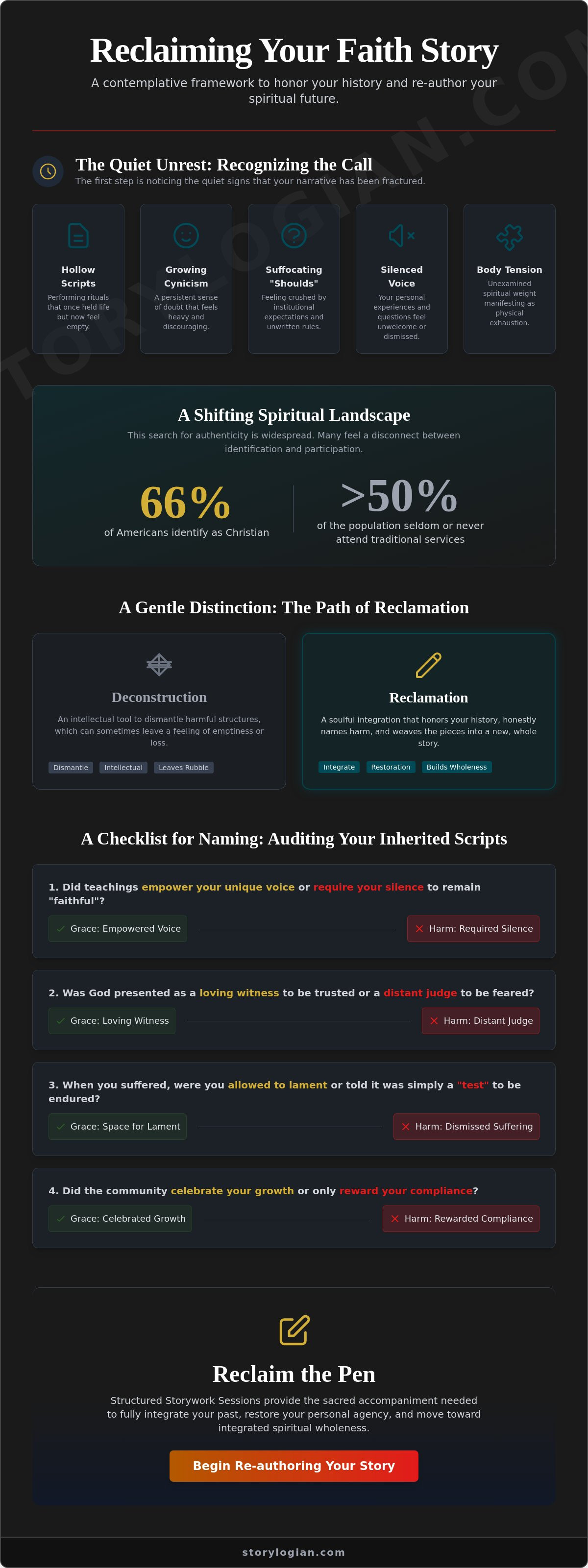
You aren't alone in this search for clarity. As of 2025, 66% of Americans identify as Christian, yet more than half of the population reports they seldom or never attend traditional services. This shift often reflects a deep desire for something more authentic. Reclaiming my faith story isn't about tearing everything down; it's about picking up the pen again with intention. This article provides a gentle, narrative-driven framework to honor your history and re-author your spiritual future. We'll walk through a contemplative checklist that invites you to witness your past with kindness, identify the threads of grace, and move toward a sense of integrated spiritual wholeness.
Key Takeaways
Recognize the quiet signs of spiritual exhaustion and cynicism as a sacred invitation to begin the process of reclaiming my faith story.
Use a guided checklist to audit the religious scripts you've inherited, helping you separate human-inflicted harm from the presence of grace.
Implement a narrative discernment framework to identify the different voices in your internal spiritual life and understand the roots of your reactions.
Create a contemplative environment that supports deep, non-judgmental listening to your own history as you move toward re-authoring your future.
Explore how structured Storywork Sessions can provide the sacred accompaniment needed to fully integrate your past and restore your personal agency.
Table of Contents
The Quiet Unrest: Recognizing the Call to Reclaim Your Faith Story
The ache is quiet. It is heavy. There's a specific kind of exhaustion that doesn't resolve with rest; it's the weight of a story you no longer recognize as your own. When we speak of reclaiming my faith story, we aren't describing a simple edit or a change of perspective. We are naming the courageous act of uncovering truths buried under layers of shame, institutional expectation, or systemic silence. It's about finding the "I" again. It's about realizing that while others may have held the pen for a season, the ink always belonged to you. Your history isn't a series of accidents; it is the primary location of God's current work in your life.
Identifying the Symptoms of a Fractured Narrative
How do you know the narrative has fractured? The signs are often muffled. You might feel a growing cynicism that tastes like ash in your mouth. Perhaps you find yourself "acting" in faith, performing rituals that once held life but now feel like hollow scripts. In spiritual spaces, the "shoulds" become suffocating. Your personal voice is lost. This unexamined weight often manifests in the body as a persistent tension or a quiet desire to walk away from everything you once held sacred. You notice the places where your history feels thin; it's as if someone else wrote the chapters while you were merely a background character in their play.
Reclamation vs. Deconstruction: A Gentle Distinction
It's helpful to distinguish this work from the broader concept of deconstruction. While deconstruction often acts as an intellectual tool to dismantle harmful structures, reclamation is a soulful integration. It's less about the sledgehammer. It's more about the restoration artist's brush. While deconstruction might leave you standing in a field of rubble, reclaiming my faith story seeks to build something sacred from the pieces. This approach shares deep roots with Narrative therapy, positioning you as the protagonist who can re-author their history with agency. This process honors the moments of genuine light while honestly naming the harm. It doesn't ask you to choose between your history and your future; it asks you to weave them into a single, honest thread of integrated wisdom.
Your personal history is not a distraction from your spiritual life. It's the soil where healing begins. By looking back with a gentle gaze, you discover that the divine wasn't absent from the difficult chapters. Instead, the Spirit was the one holding the space for you to eventually tell the truth. This is the first step toward wholeness: recognizing that your story is worth the work of reclamation.
A Checklist for Naming: Identifying Themes of Harm and Grace
To begin the work of reclaiming my faith story, we must first look at the pages already written. We often carry "religious scripts," the unwritten rules and inherited expectations that govern our spiritual self-perception. These scripts tell us who we are allowed to be in the eyes of the Divine. If we don't name them, they continue to direct our lives from the shadows. This audit isn't an act of betrayal. It's an act of stewardship over the life you've been given.
Uncovering the Scripts You Were Handed
Auditing your history requires a gentle, honest gaze. It's a slow process. Consider these questions as you look back at the institutions and teachings that shaped your early spiritual landscape:
Did this specific teaching empower my unique voice, or did it require my silence to remain "faithful"?
Was God presented as a distant judge to be feared and managed, or as a loving witness to be trusted?
When I experienced suffering, was I told it was a "test," or was I allowed to lament?
Did the community celebrate my growth, or did they only reward my compliance?
These moments where your dignity was diminished or your humanity was sidelined are "themes of harm." They are real. They carry weight. Acknowledging them is the first step toward moving beyond them. You are not just a collection of these moments, but you cannot ignore them if you wish to find your way home.
Finding the Sacred Threads in the Shadows
The process of reclaiming my faith story involves more than just memory; it involves a deep, narrative discernment. Reclamation is not only about identifying what went wrong. It's also about finding the "sacred threads" that survived. These are the glimmers of the Divine that appeared even during seasons of spiritual dryness or institutional betrayal. You might recall a specific person who offered sacred accompaniment when you felt most alone. These individuals didn't try to fix you. They simply sat with you in the complexity of your experience.
Naming these moments of grace is just as vital as naming the harm. Research into Re-constructing a Life-Giving Spirituality suggests that re-authoring our experiences requires us to integrate both the pain and the presence of the sacred. If we only focus on the harm, we risk losing our connection to the Divine entirely. If we only focus on the positive, we live in denial. Wholeness lives in the tension between the two.
Through intentional Storywork Sessions, you can begin to see these events as individual chapters rather than the entire book. You are more than what was done to you. You're the one invited to hold the pen now. By identifying where God was present, even in the silence, you begin the sacred work of re-authoring your future.
Evaluating Your Spiritual Landscape: A Narrative Discernment Framework
Once you have begun the work of auditing your past, the focus naturally shifts to the present. The inner landscape is often crowded. Many voices compete for the pulpit of your soul, making it difficult to hear the quiet resonance of your own spirit. To move toward wholeness, we must learn the art of narrative discernment. This isn't just about sorting thoughts; it's about listening to the body’s reaction to spiritual ideas. We look for the "why" behind our reactions. Why does a certain hymn cause your chest to tighten? Why does the word "surrender" feel like a threat? This process of reclaiming my faith story requires us to sit with these questions without the need for immediate answers.
You might wonder if this deep focus on your own history is a form of spiritual narcissism. It's a common fear. But looking inward isn't about self-obsession; it's about stewardship. If you don't know the story you're living, you can't offer your true self to God or your community. You're merely offering a mask. By healing your personal narrative, you're clearing the debris that prevents a genuine connection with the Divine. You're recovering the image of God that was obscured by the scripts of others.
Discerning Voice: Systemic Pressure vs. Divine Invitation
How do we distinguish between holy conviction and institutional shame? Systemic pressure often feels like a whip. It's frantic, loud, and demands immediate compliance. It uses "should" as its primary currency. In contrast, a Divine invitation feels like a breath. It's spacious. It respects your autonomy. When a spiritual practice feels like a heavy burden rather than a lifeline, it's often because that practice was designed to serve a system rather than your soul. Quietness is the only environment where these voices can be untangled. In the silence, the echo of shame eventually fades, leaving room for the gentle whisper of truth.
Assessing Your Current Spiritual Rhythms
Speed is a thief in the work of restoration. If your spiritual life is a series of tasks to be completed, there's no room for the narrative to breathe. A checklist for "soul care" must include the necessity of the pause. Ask yourself:
Does my current rhythm allow for periods of unhurried silence?
Am I allowed to disagree with a teaching without fear of losing community?
Is there space in my life for "Deep Listening" to my own history?
For those who carry the weight of religious responsibility, this assessment is even more critical. We invite you to explore soul care for ministry leaders to find ways to protect your own story while serving others. Reclamation cannot happen in a rush. It's a methodical, circular journey that returns again and again to the central theme of your belovedness.
The Path Forward: Steps to Re-Authoring Your Sacred History
The journey of reclaiming my faith story is not a linear sprint. It's a slow, circular return to the center of your own experience. Once you've identified the scripts and the shadows, the work of re-authoring begins. This is where you move from being a passive reader of your life to being its primary narrator. It requires a specific kind of environment and a specific kind of courage. You aren't just remembering the past; you're deciding how that past will be permitted to speak into your future.
Creating a Contemplative Space for Truth-Telling
Truth requires a hospitable climate. You cannot force the soul to speak in a crowded, noisy room. Creating a contemplative space is about setting a sacred stage where your reflections can finally land. This might look like lighting a single candle to represent the Divine presence, choosing a journal that feels like an invitation, or simply sitting in twenty minutes of unhurried silence. The pace is vital. Narrative recovery happens in the pauses. At StoryLogian, we provide Sacred Accompaniment to help you hold this space when the silence feels too heavy to carry alone. In this unhurried environment, the fragmented pieces of your history begin to find their way back into a coherent whole.
The Role of the Witness in Your Journey
We were never meant to carry the full weight of our histories in isolation. There is a limit to what we can see when we're the only ones looking. A witness acts as a mirror, reflecting back the dignity you might've forgotten. However, this witness must not be a "fixer." A "fixer" wants to resolve your tension to ease their own discomfort. A spiritual director or storyworker wants to witness your process. They hold the space while you untangle the threads, offering a presence that is both authoritative and profoundly gentle. This communal aspect of storytelling is ancient. It reminds us that our personal narratives are part of a larger, sacred tapestry. You can explore the role of story in faith to understand how sharing these sacred threads leads to a deeper sense of spiritual wholeness.
Practicing "Deep Listening" means attending to your history without the immediate urge to judge or categorize it. You listen to the younger version of yourself with the same kindness you'd offer a friend. Finally, you move to the act of re-authoring. This is the moment you write the ending you desire from a place of agency. The act of reclaiming my faith story culminates in this reclamation of authority. You decide which themes will define your future. You choose whether the story ends in the valley or on the horizon. Reclaiming the pen allows you to honor what was while intentionally choosing what will be.
Reclaiming the Pen: How Storywork Sessions Restore Your Voice
The ink is wet. The page is open. The long journey of reclaiming my faith story eventually moves from the solitary quiet of the journal to the transformative strength of a shared witness. While the internal work of discernment is foundational, there is a specific, profound restoration that only happens when our narrative is held by another in a sacred space. This is the essence of Storywork Sessions. It's a professional path for those ready to move beyond the fragments and into a cohesive, lived truth. Dr. Shonda Carter brings a singular perspective to this process, blending the contemplative depth of theology with the narrative precision of filmmaking. She understands that how we "frame" our past determines the light that reaches our future.
This work is often conducted in an Intensive format. It's a deliberate, unhurried pause. It's a season set apart to dive deep into the architecture of your life without the distractions of the daily grind. You aren't just recounting events; you're examining the very themes that have governed your spiritual identity. This is where the "why" of your reactions meets the "who" of your truest self. By the end of this process, the story is no longer something that happened to you. It is something you carry with integrated wisdom and a resilient sense of hope.
What to Expect in a Storywork Intensive
Entering an Intensive is an act of profound courage. You'll use a specific framework to re-author your personal history through a faith lens, one that honors your autonomy and your experience. The focus remains on identifying themes of harm that have previously gone unnamed, allowing their power to dissipate in the light of truth. You'll experience a significant shift in posture. You move from feeling like a victim of a story written by rigid systems to being the empowered author of your own sacred future. It's a methodical transition from fragmented memory to integrated narrative.
Moving from Survivor to Sacred Storyteller
When you finish the work of reclaiming my faith story, you don't just walk away with a better memory. You walk away with a new way of being in the world. This reclamation changes how you show up in your community, your family, and your own skin. There's a newfound freedom in no longer having to hide the "complicated" parts of your spiritual journey. You become a sacred storyteller, someone whose life speaks of a Divine presence that isn't afraid of the dark chapters.
The weight of the silenced story is gone. In its place is the steady, calm breath of a soul that has been seen and heard. If you've spent years feeling like your voice was overwritten or lost, we invite you to step into a space of sacred accompaniment. Your story is not a problem to be solved; it is a sacred text waiting to be read with honor. The pen is back in your hand. It's time to write the next chapter.
Re-Authoring Your Future with Intention
The work of naming the themes of harm and grace in your history is the first step toward a lived wholeness. It requires a slow, unhurried pace that honors the complexity of your experience. You've explored how to audit inherited scripts and discern the gentle voice of the Divine from the loud echoes of systemic pressure. These fragments of your past don't define you; they are the soil where your new narrative begins to take root. Every chapter you've lived holds a seed of wisdom that's ready to be integrated into your present life.
Reclaiming my faith story is a sacred act of taking back the pen from those who sought to write it for you. This journey of integration is most profound when held in a space of sacred accompaniment. Facilitated by Dr. Shonda Carter, a theologian and filmmaker, our sessions utilize a specialized narrative framework designed for deep, faith-based healing. This contemplative approach ensures your soul has the room it needs to breathe and speak. Begin your journey of reclamation with a Storywork Session. Your history is a sacred text, and its most beautiful chapters are still being written.
Frequently Asked Questions
What does it mean to reclaim your faith story?
Reclaiming your faith story is the sacred process of naming the truths that were once hidden by external expectations or institutional shame. It involves looking back at your history with a gentle gaze to identify where your voice was silenced. By doing so, you move from being a passive recipient of a narrative to the active narrator of your own spiritual journey. It's about finding the "I" within the "we" of religious systems.
How is storywork different from traditional therapy?
Storywork focuses on the narrative and spiritual integration of your life rather than clinical mental health diagnosis. While traditional therapy often addresses psychological symptoms, storywork sessions provide sacred accompaniment for those seeking to re-author their spiritual history. It's a contemplative process that uses the lens of story to find meaning and agency. We don't offer clinical mental health counseling; instead, we offer a dedicated space for spiritual formation and narrative healing.
Can I reclaim my story if I still want to stay in my current church?
You can absolutely engage in the work of reclaiming my faith story while remaining within your current church community. Reclamation is an internal shift of agency and authority, not necessarily a physical departure. It allows you to participate in your community from a place of honesty rather than performance. By knowing your own story, you can set healthier boundaries and engage with your faith from a position of integrated truth.
What if my faith story includes significant spiritual abuse?
Acknowledging significant harm or spiritual abuse is a central part of the reclamation process. These chapters require a witness who can hold the weight of your experience without rushing to "fix" or minimize it. In storywork, we name these moments as themes of harm to strip them of their silent power. This isn't about dwelling on the pain; it's about witnessing it so you can finally integrate it into a story of survival and strength.
How do I know if I am ready for a Storywork Intensive?
You are likely ready for a Storywork Intensive when you feel a persistent "quiet unrest" or a sense that you're merely performing your faith. If you find yourself wondering where God was during your most difficult chapters, the intensive format offers the unhurried space needed to find those answers. It's for those who are tired of the scripts they've been handed and are ready to pick up the pen themselves. It requires a willingness to sit in the silence and listen.
Is it possible to find God in a story that feels entirely broken?
Finding God in a broken story is often the most profound outcome of reclaiming my faith story. We often discover that the Divine wasn't absent during the dark chapters, but was instead the silent witness holding the space for our eventual truth-telling. By looking back with a contemplative gaze, we can identify the sacred threads that remained unbroken even when the systems around us failed. Brokenness doesn't end the story; it often becomes the place where the most honest chapters begin.
What is the role of a spiritual director in reclaiming my story?
A spiritual director serves as a sacred witness who helps you listen for the movement of the Spirit within your own history. They don't provide answers or directives; instead, they offer a presence that is both authoritative and profoundly gentle. Their role is to hold the space for your autonomy, helping you discern the difference between external pressure and internal truth. They walk beside you as you untangle the threads of your past, ensuring you don't have to carry the weight alone.


Comments