Spiritual Wholeness for Women: The Shift from Performance to Narrative Integration

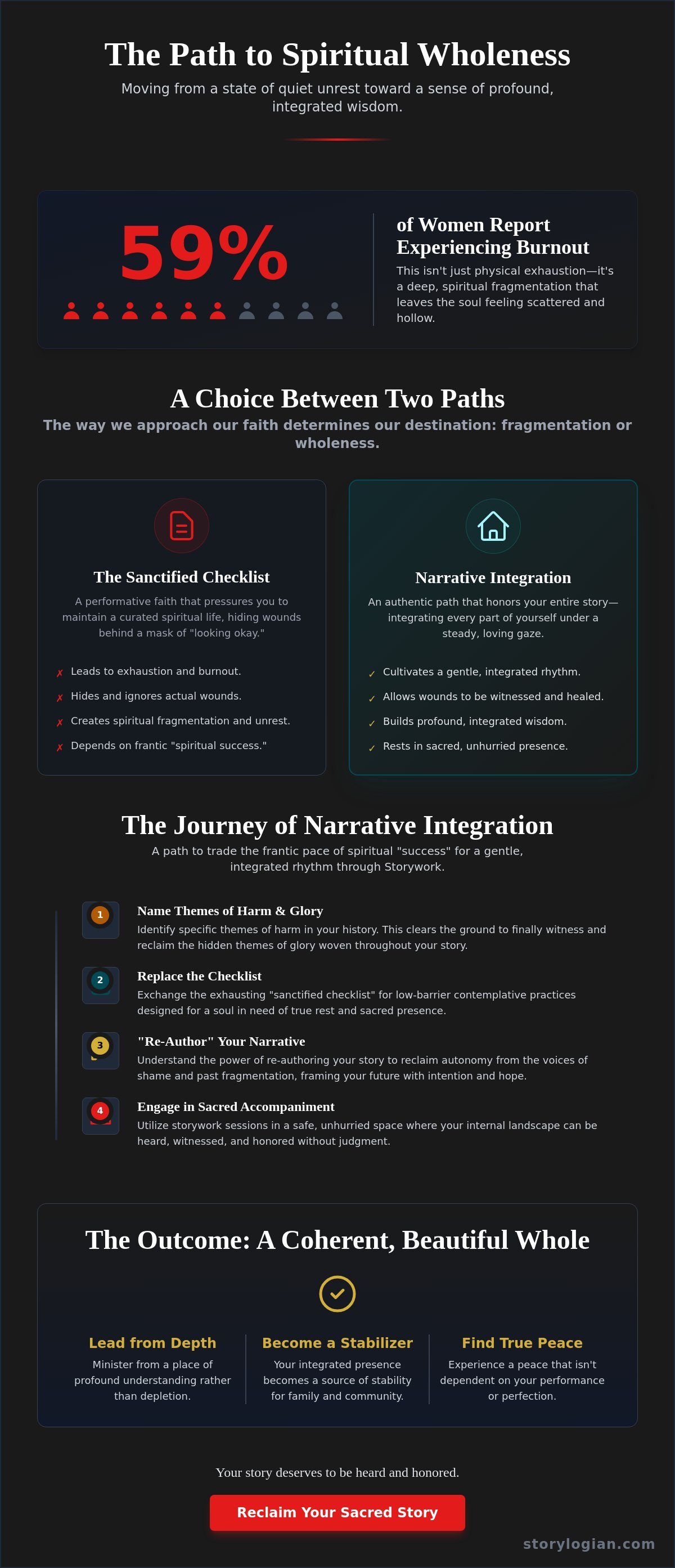
Current research shows that 59% of women now report experiencing the heavy, hollow ache of burnout. It is a staggering reality. For many, this exhaustion isn't just physical; it's a deep, spiritual fragmentation that leaves the soul feeling scattered. You likely know the weight of the "sanctified checklist." You've felt the pressure to perform a version of faith that ignores your actual wounds. The search for true spiritual wholeness for women often feels like another chore on an already crowded calendar. But what if the path to peace isn't found in doing more, but in finally gathering the pieces of who you've always been?
We agree that your story deserves better than to be hidden or hurried. You don't have to choose between your history and your healing. This article will show you how to move beyond performative expectations and reclaim your sacred story through the lens of narrative integration. You'll learn to trade the frantic pace of spiritual "success" for a gentle, integrated rhythm. Together, we will explore how to weave your unresolved narratives into a coherent, beautiful whole, moving from a state of quiet unrest toward a sense of profound, integrated wisdom.
Key Takeaways
Contrast performative masks with narrative integration to find a deeper, more authentic spiritual wholeness for women.
Identify how naming specific themes of harm in your history allows the hidden themes of glory to be witnessed and finally reclaimed.
Replace the exhausting "sanctified checklist" with low-barrier contemplative practices designed specifically for a soul in need of rest.
Understand the power of "re-authoring" your narrative to reclaim your autonomy from the voices of shame and past fragmentation.
Discover how sacred accompaniment and storywork sessions provide a safe, unhurried space for your internal landscape to be heard and honored.
Table of Contents
Defining Spiritual Wholeness for Women in a Fragmented Age
In a world that demands a polished exterior, the internal landscape often feels like a collection of glass shards. We've been taught to sweep the pieces under the rug. We've been told that faith is a matter of keeping it all together, a constant effort to maintain a curated spiritual life that looks beautiful from the outside. This pressure creates a deep, quiet unrest. For many, spiritual wholeness for women has become synonymous with "looking okay." It's a performative wholeness. It's a mask that hides the fragmented soul. But true wholeness isn't the absence of brokenness. It's the sacred integration of every part of your self under the steady, loving gaze of God. It's the shift from trying to be "unbroken" to becoming truly integrated.
When we explore the concept of narrative identity, we acknowledge that our lives aren't just a series of random events. They're a story. Wholeness happens when we stop trying to edit out the difficult chapters. Instead of performative perfection, we move toward narrative wholeness. This means being okay with your story, even the parts that haven't been resolved yet. The fragmented soul is the primary barrier to peace because it lives in a state of internal war, constantly trying to hide its wounds. Integration ends that war. It allows you to breathe again. It lets you be present to your own life without the exhausting need to perform a version of yourself that doesn't exist.
The Shift from Sanctified Perfection to Sacred Presence
There's a growing trend among women to reject the "fixing" model of spirituality. We're tired of being projects to be completed. The unhurried soul realizes that spiritual wholeness for women is found in witnessing our lives rather than constantly repairing them. Contemplative prayer plays a vital role here. It reduces the internal noise of the sanctified checklist. In the silence, we move from the frantic need for perfection to the quiet beauty of sacred presence. We learn to be with God as we are, not as we think we should be. This shift allows us to experience a peace that isn't dependent on our performance.
Wholeness as a Communal and Individual Journey
Your individual story is sacred ground. It's a theological foundation. When a woman pursues her own healing, that work doesn't stay contained within her. It spills over. A whole woman leads differently. She ministers from a place of depth rather than depletion. Her presence becomes a source of stability for her family and her community. Personal integration is a prerequisite for healthy leadership. You can only lead others as far as you've been willing to go into your own story. By honoring your history, you create space for others to do the same.
The Rise of Narrative Spirituality: Why Your Story is the Key
Your life is not a collection of random accidents. It is a manuscript. For too long, the path toward spiritual wholeness for women has been paved with "to-do" lists and behavioral modifications that only touch the surface of our being. This is changing. In 2026, we are witnessing a profound shift toward Storywork, a process that treats your personal history as sacred text. Narrative Theology invites us to see God as the Great Author, the one who holds the pen even in the chapters we would rather skip or erase. This isn't about ignoring the pain; it's about integrating it into a larger story of redemption.
Science is beginning to echo what the soul has always known. Research from the Harvard T.H. Chan School of Public Health demonstrates the vital link between spirituality and overall health, confirming that a deep sense of sacred meaning is essential for our physical and emotional flourishing. When we name our "themes of harm," we aren't just revisiting trauma. We're clearing the ground for "themes of glory" to emerge. Women, in particular, are finding liberation in this movement, reclaiming histories that were once silenced by shame or performative expectations. True spiritual wholeness for women requires us to look back with kindness, acknowledging that our history is the very place where God meets us.
Seeing the Divine Thread in Your Personal History
Narrative Recovery is the act of seeing God in the shadows of the past, trusting that no chapter is outside the reach of grace. This process involves identifying "turning points," those moments where the plot of your life shifted in ways you didn't expect. There's a significant difference between "telling your testimony," which often feels like a polished performance for an audience, and "engaging your story," which is a raw and honest encounter with your own soul. By engaging the story, you move from a two-dimensional faith into a three-dimensional reality where God is present in every memory.
How Storywork Sessions Facilitate Integration
This is the heart of storywork sessions, where the fragmented pieces of a life are gathered with care. Having a "sacred witness" to hear and hold your narrative changes the way you see yourself. You're no longer alone in the dark corners of your history. As you are heard, the narrative begins to shift. You move from a "victim" narrative, where things only happen to you, to a "hope-bearer" narrative, where you participate in the unfolding grace of your own life. To sit with your story is to honor the one who wrote it. You might find that spiritual direction offers the unhurried space your soul has been craving.
Dismantling the "Sanctified Checklist": Addressing the Burnout Objection
"I don't have the energy for one more thing." It is the most common whisper we hear. When life feels like a series of heavy obligations, the idea of pursuing spiritual wholeness for women can feel like an invitation to more labor. We've been conditioned to believe that growth requires a sanctified checklist of study, service, and constant improvement. This is the primary barrier to peace. What if the path to wholeness isn't a mountain to climb, but a valley to rest in? The current movement of deconstruction and reconstruction isn't a loss of faith. It's often a desperate search for an integrated life that doesn't require us to perform. We're moving from a model of fixing to a model of being.
Research increasingly supports this shift from performance to presence. The National Institutes of Health has explored the role of spirituality in health care, noting how it provides a framework for coping and finding meaning during profound stress. Wholeness isn't about adding tasks. It's about removing the barriers that keep us from our own souls. We move from striving for wholeness to resting into it. It's a surrender to the reality that you're already loved. This realization is the antidote to spiritual burnout.
Healing from Church Hurt and Spiritual Fragmentation
Fragmentation often begins in environments where we are forced to choose between our belonging and our truth. This is the root of church hurt. Toxic religious cultures often split the "spiritual self" from the "authentic self," demanding a version of us that is always "fine." To find spiritual wholeness for women, we must first engage in healing from church hurt. This process requires naming the harm with courage. We can't heal what we refuse to acknowledge. By looking at the wounds caused by rigid expectations, we begin the work of narrative integration, inviting our whole selves back into the light.
The Unhurried Soul: Moving from Doing to Being
Slowing down is a radical act. For women who have spent years in the hustle culture of ministry or family life, choosing silence is a form of spiritual warfare. We offer a guide to soul care for ministry leaders that prioritizes being over doing. Sacred Presence is not a list of activities. It is a state of being. It is the quiet confidence that you're already held. When you stop the frantic pace, you allow the fragments of your story to settle. You allow the Great Author to speak into the silence, replacing the noise of the checklist with the rhythm of grace.
Practices for Cultivating Spiritual Integration
Integration is a slow knitting of the soul. It's not a forceful act of will, but a gentle gathering of the parts of yourself that have been scattered by the demands of a performative life. For the 59% of women reporting burnout in 2026, the answer is rarely more effort. Instead, spiritual wholeness for women is found in practices that prioritize being over doing. These are low-barrier entries to soul care. They are invitations to breathe. They're designed to honor your internal landscape rather than to fix it. We trade the heavy yoke of religious rigor for the light rhythm of grace.
These practices function as a way to gather the fragments we've ignored. When we slow down, we allow the narrative of our lives to settle. We stop running from the shadows and begin to see how they define the light. This is the work of integration. It's the process of becoming a whole person again, one who doesn't need to hide behind a curated spiritual mask. It's a return to the original design of the soul, where rest is the foundation and presence is the goal.
A Contemplative Checklist for the Weary
We begin with the simplest of movements. Silence and solitude are not luxuries; they're the soil in which the integrated self grows. By engaging in intentional soul care practices, you create a container for Sacred Listening. This is the art of discerning God's voice within your own story. Journaling, too, becomes more than a record of events. It becomes a tool for narrative discovery, a way to see the ink of the Great Author on the pages of your daily life. A 2025 survey found that 83.6% of women who meditate do so to prioritize emotional balance. These contemplative acts are the pathway to that equilibrium.
The Art of Sacred Accompaniment
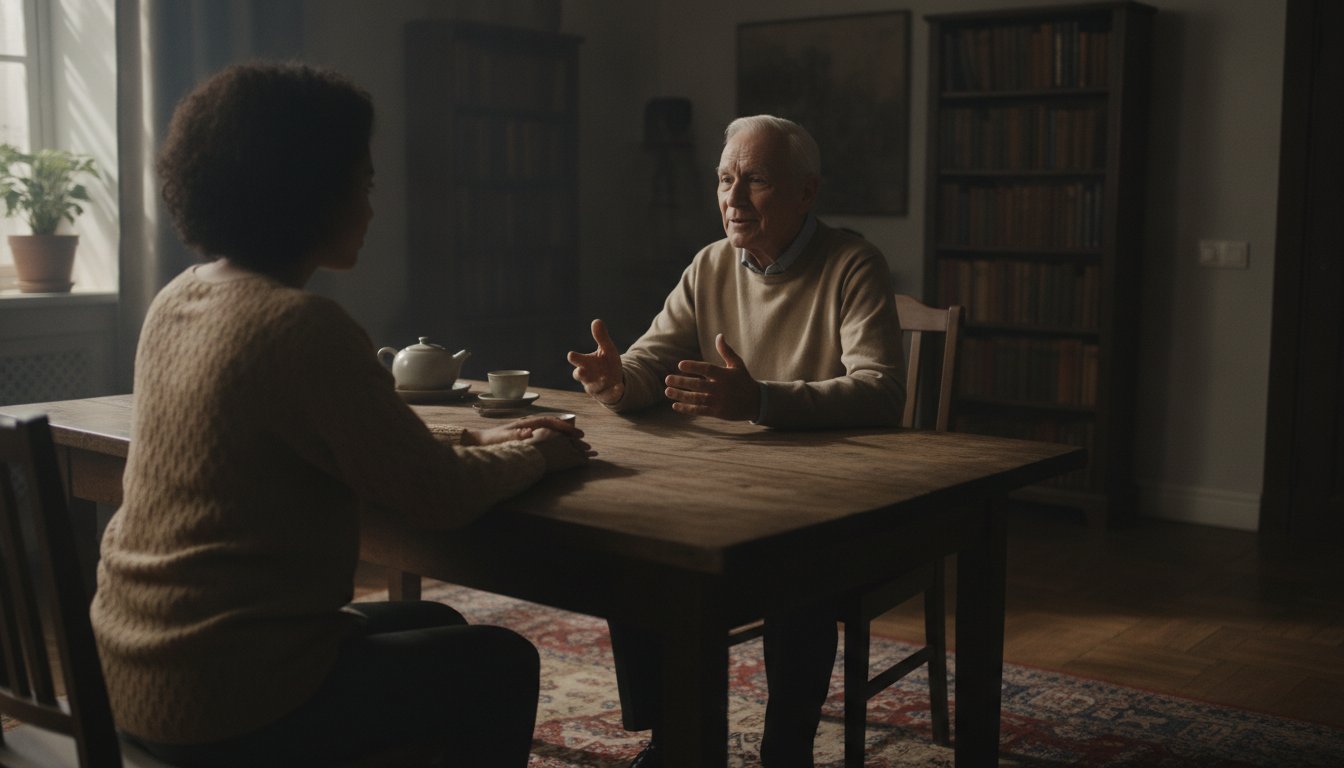
You weren't meant to carry the weight of your history in isolation. While the journey of spiritual wholeness for women is deeply personal, it's not solitary. There is a profound difference between a coach, who often focuses on future goals and performance, and a spiritual director or sacred companion. A companion is a witness. They hold space for your narrative without the need to solve you. Shared storytelling creates a sacred container where healing can settle. It's in the presence of another that we often find the courage to look at the chapters we've avoided. If you feel the call toward this integrated way of living, we invite you to explore Spiritual Direction to begin your journey of unhurried discovery.
Re-Authoring Your Future: The Path of Sacred Accompaniment
The journey doesn't end with a checklist. It begins with a pen. We've explored how fragmentation occurs and how rest invites us back to ourselves. Now, we consider the long, beautiful work of re-authoring. This is the heart of spiritual wholeness for women. It is the moment you decide that shame no longer gets to write your ending. You take the pen back. You look at the chapters of harm and you begin to see how grace has been weaving a different subtext all along. This isn't a solitary effort. It's a shared journey. We weren't meant to interpret our lives in the dark.
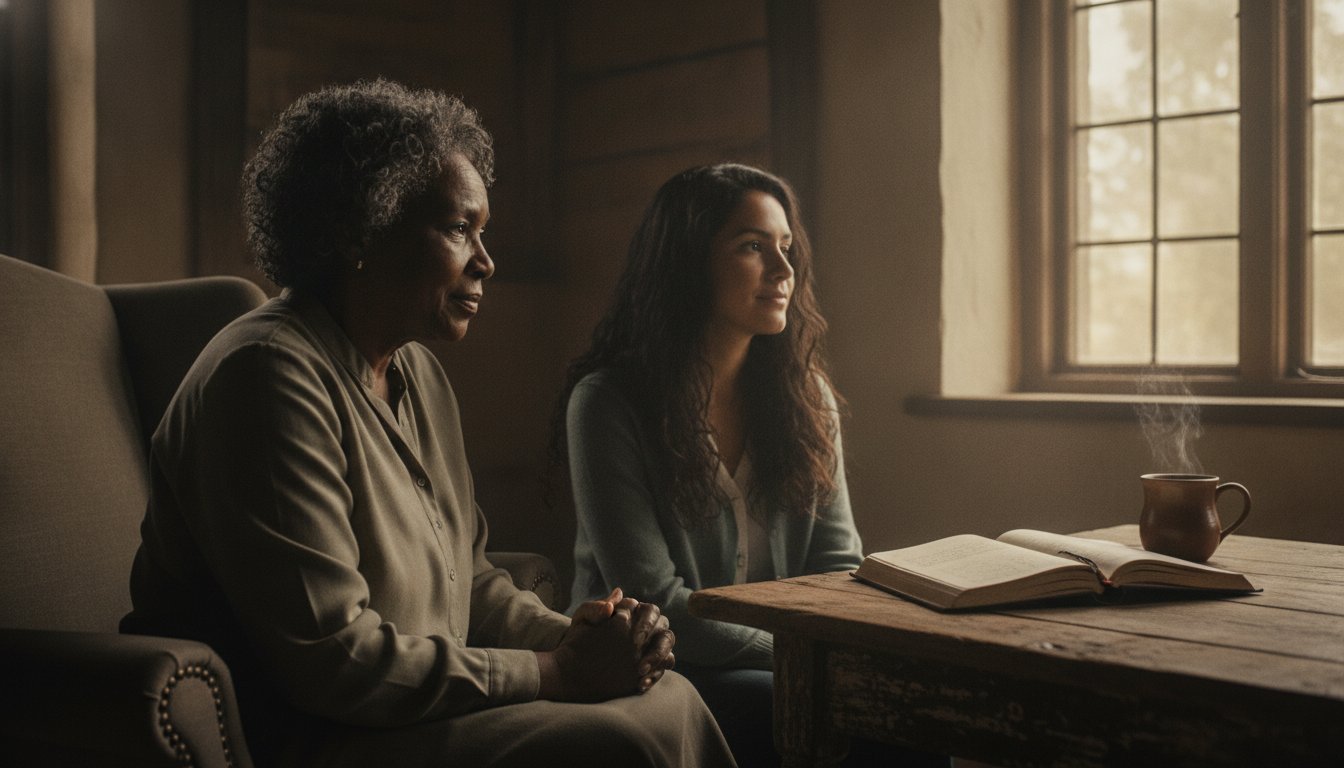
Sacred accompaniment provides the container for this shift. In the presence of a witness, the stories that once felt like heavy weights begin to feel like holy ground. You move from being a character who things happen to, into a woman who participates in her own unfolding. This is the transition from performance to integration. It's the movement from a scattered life to a centered one. By gathering the fragments of your past, you allow the Great Author to show you the beauty of the whole manuscript. You finally stop performing your faith and start living your story.
Honoring the Divine Thread
There is a profound beauty in the sacred art of storytelling. It requires a quiet, steady bravery to look at your history without flinching. You're not just looking for facts; you're looking for the Divine thread that has never been cut. This process honors the complexity of your experience. It doesn't ask you to simplify your pain or rush your healing. Instead, it invites you to see every chapter as part of a larger, redemptive arc. True spiritual wholeness for women is living as a beloved, integrated daughter of God.
Beginning Your Journey with StoryLogian
Dr. Shonda Carter offers a path of sacred accompaniment that honors the unhurried nature of the soul. Through Storywork Sessions and Spiritual Direction, she creates a space where your internal landscape is treated with the reverence it deserves. These aren't clinical appointments. They're soulful encounters. Whether you join a Spiritual Formation Retreat or engage in one-on-one sessions, the goal is the same: to help you stop running and start listening. Your story is still being written. The Great Author is inviting you to sit at the table, pick up the pen, and witness the beauty of your integrated life. It's time to come home to yourself.
Reclaiming the Pen of Your Sacred Story
The path to integration is rarely a straight line. It's a slow, rhythmic return to the truth of your belovedness. You've discovered that wholeness isn't found in the frantic completion of a sanctified checklist. Instead, it emerges when you choose to honor the divine thread woven through your most difficult chapters. By moving from performance to narrative integration, you allow the fragmented parts of your soul to finally breathe and settle under the gaze of a loving Author. This is the shift from a life of quiet unrest to a state of integrated wisdom.
True spiritual wholeness for women is an invitation to stop running and start listening. StoryLogian, founded by Dr. Shonda Carter, a theologian and filmmaker, provides a sacred, contemplative space for this very work. Through a specialized focus on Christian Storywork and Sacred Accompaniment, we offer a gentle, faith-based framework for your healing. You don't have to interpret the shadows of your history alone. Begin your journey toward narrative wholeness with a Storywork Session today. Your story is sacred. Every chapter belongs. Rest in the knowledge that you're being gathered into a whole and holy narrative.
Frequently Asked Questions
Is spiritual wholeness for women different from emotional health?
They are distinct yet deeply intertwined. Emotional health focuses on the regulation and understanding of feelings, while spiritual wholeness involves integrating the soul's narrative with the Divine presence. It's the movement toward being a whole person whose history and faith are no longer at war. Wholeness addresses the deep, quiet ache of the soul that longs for sacred meaning and narrative coherence.
How do I know if I need spiritual direction or therapy for my wholeness journey?
The choice depends on whether you seek clinical intervention or sacred accompaniment. Therapy often addresses psychological patterns or mental health challenges, whereas spiritual direction focuses on discerning God's presence within your life story. If your primary longing is to explore your relationship with the Divine and integrate your faith narrative, spiritual direction or a Storywork session is a fitting path for your soul.
Can I achieve spiritual wholeness if I have experienced church hurt?
Healing from fragmentation often begins precisely at the site of our deepest wounds. Church hurt can split our authentic selves from our spiritual lives, but spiritual wholeness for women involves naming that harm and reclaiming your sacred value. Wholeness isn't the absence of scars. It is the integration of those scars into a story of redemption, where you finally feel safe to be known.
What is the first step in re-authoring my personal story?
The first step is to become a witness to your own history without the need to edit or judge it. This involves slowing down enough to notice the recurring themes in your life manuscript. By simply acknowledging the chapters you've tried to hide, you begin the process of taking the pen back from shame. You move from being a character who is acted upon to a participant in your own unfolding grace.
How much time do I need to dedicate to spiritual wholeness practices each day?
Wholeness is more about the quality of your presence than the quantity of your time. Even ten minutes of silence or intentional listening can create the space needed for the soul to settle. The goal is to move away from the sanctified checklist and toward a gentle rhythm that fits your actual life. Consistency in small, unhurried moments is more transformative than occasional, forced rigor.
Is focusing on my own spiritual wholeness biblical?
The scriptures frequently invite us into deep reflection and the gathering of our whole selves before God. Jesus often withdrew to lonely places for silence and communion, modeling a life that prioritizes internal integration over external performance. Caring for the soul is an act of stewardship. It honors the Creator by valuing the life and story He has uniquely authored in you as a beloved daughter.
How does storywork differ from traditional Bible study for women?
Storywork focuses on the intersection of your personal manuscript and the Great Author's narrative. While Bible study centers on the interpretation of sacred text, storywork treats your own life as a text where God is actively speaking. It's a process of spiritual wholeness for women that moves beyond cognitive learning into the lived experience of integration. You learn to see your history as holy ground where the Divine is present.
Can I practice these contemplative rhythms if I have a very busy schedule?
You don't need a perfectly quiet life to cultivate a quiet heart. Contemplative rhythms are designed to be woven into the cracks of a full day, such as a moment of deep breathing during a commute or sacred listening before bed. These practices aren't meant to be another chore. They're a way of being that carries you through the noise, allowing you to remain centered even when the world is loud.
Comments