The Sacred Art of Storytelling: Honoring the Divine Thread in Your Personal Narrative

What if the chapters of your life you feel most tempted to edit out are actually the very places where the Divine is whispering most clearly? You might feel as though your history is a collection of fragmented scenes, perhaps marred by the weight of spiritual trauma or the exhaustion of trying to perform a perfect faith. It's common to look back and see only the broken threads. But there is a deeper way to look. By engaging in the sacred art of storytelling, we begin to see that our lives are not random sequences of events. They are living, breathing texts co-authored by a Grace that never lets go.
In this space, we invite you to move from performance to presence. You'll discover how to view your personal history as a sacred text, learning the contemplative practices that turn even the most painful memories into a path for spiritual healing. We'll explore a framework for integration and peace, offering you the tools to identify the sacred threads woven through your days. This journey is not about fixing what's broken. It's about honoring the whole story, allowing your narrative to become a sanctuary of quiet wisdom and deep, integrated peace.
Key Takeaways
Learn to trade the performance of a perfect narrative for the quiet, honest presence of witnessing grace in your history.
Discover how the sacred art of storytelling reveals a redemptive arc within your most fragmented and difficult chapters.
Gain contemplative tools, such as Sacred Journaling, to help you identify the subtle threads of the Divine woven through your past.
Realize why no part of your history is too broken to be sacred, allowing for a sense of integration and peace.
Explore the value of Sacred Accompaniment and Storywork in helping you interpret the deep, often unspoken elements of your journey.
Table of Contents
What is the Sacred Art of Storytelling?
The sacred art of storytelling is the intentional practice of witnessing God’s presence within the arc of your own history. It's not a performance for an audience. It's an invitation to a deeper kind of seeing. While secular storytelling often focuses on entertainment or the suspension of disbelief, the sacred approach focuses on spiritual formation. It's about deepening our belief that we are held by a hand we cannot always see. In this space, we don't look for a plot twist to distract us; we look for the Divine Thread that has been there all along.
Many of us carry a heavy misconception. We believe a story must be heroic or "perfect" to be considered holy. We wait for the "happily ever after" before we dare to call it sacred. But your life is a Living Text. It's an ongoing revelation, written in the ink of your daily choices, your quiet sorrows, and your unexpected joys. Understanding the role of myth in storytelling helps us see how narrative has always shaped the human condition; yet, your personal history is more than a universal symbol. It's a specific, breathing documentary of grace that requires a patient eye to read.
The Difference Between Telling and Witnessing
There's a profound shift that happens when we move from merely telling a story to witnessing it. Witnessing is a passive-active state of holy observation. It's the difference between a reporter and a mystic. When we tell a story to "fix" it, we're often trying to manage the pain or tidy the loose ends. When we witness it, we're simply honoring what is. This is where the role of the Sacred Listener becomes vital. They don't offer critiques or edits. They offer a steady, reverent presence that allows the truth of your experience to breathe without the pressure of performance. In the sacred art of storytelling, we find the freedom to let the story be exactly what it is.
Why Your Narrative is a Site of Revelation
Your personal history is your primary source for spiritual discernment. God doesn't only speak through ancient prophets; the Divine speaks through the ordinary moments of your Tuesday afternoon. This is the "sacredness of the ordinary." Every interaction and every season of waiting is a site of revelation. Dr. Shonda Carter often describes these narratives as documentaries of grace. They are the evidence of a Love that is constantly pursuing us, even when the screen of our lives feels dark or the plot feels stagnant. Your story isn't a distraction from your faith; it is the very place where your faith is formed.
Theology of Personal Story: Where History Meets Grace
At the heart of our exploration lies the concept of Narrative Theology. It's the quiet backbone that supports the weight of our lived experiences. This isn't just an academic framework. It's a way of recognizing that God is not a distant observer but a presence woven into the very fabric of our chronologies. When we engage in the sacred art of storytelling, we're practicing a form of worship that honors the "Imago Dei" within us. We're creators because we're made in the image of the Creator. This divine imprint gives us the capacity to name our pain and frame our joys, transforming raw data into a meaningful testimony of grace.
Even amidst the seasons of quiet unrest or profound trauma, a Redemptive Arc is unfolding. This arc doesn't always lead to a tidy, successful ending. Instead, it leads toward integration. It's the movement of a soul toward wholeness. To dive deeper into this framework, you might find it helpful to read Narrative Theology Explained: Finding the Sacred Thread in Your Story. Understanding this theology allows us to see our history as a fertile ground for future hope rather than a prison of past mistakes.
Finding the Sacred Thread
We define the Sacred Thread as the consistent, often subtle, presence of the Divine across the span of time. Grace rarely arrives with a trumpet blast. It appears in the "minor characters" who offered a cup of water when we were parched. It's found in the "unimportant" scenes where a sudden sense of peace settled over a chaotic room. Narrative Theology is the study of God through the unfolding of our lives. It's the belief that our personal history is a site where the Holy continues to speak. If you find it difficult to see these threads alone, engaging in Storywork Sessions can provide a mirror for the grace you might have missed.
The Co-Authorship of the Divine
There is a beautiful, holy tension between our human agency and divine providence. We aren't merely characters being moved across a board. We're co-authors. When we begin "re-authoring" a story with God, we find spiritual freedom. This doesn't mean we change the facts of what happened. It means we change the power those facts have over us. We move from being victims of a sequence to being witnesses of a process. Our past is no longer a locked room. It's a landscape of discovery where every memory, no matter how heavy, can be held with reverence and curiosity.
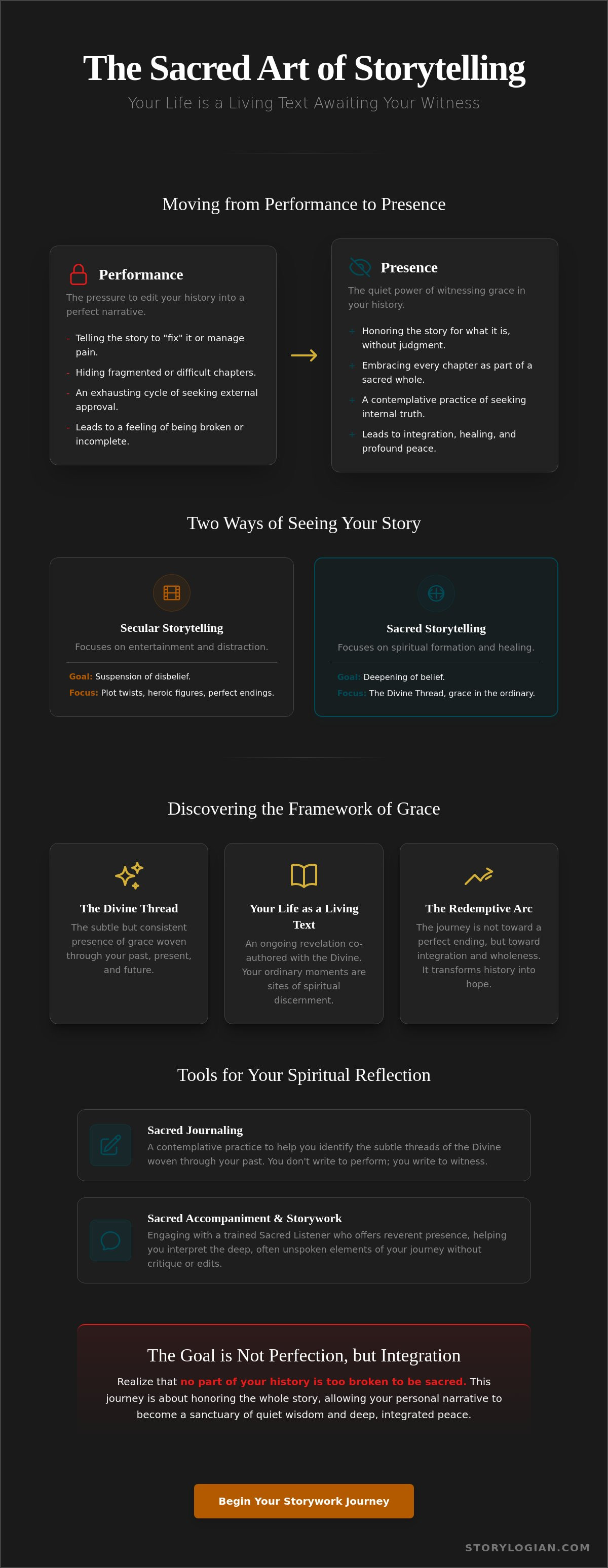
Moving from Performance to Presence: Storytelling as Healing
Many of us carry a quiet, persistent fear. We worry that our stories are too jagged or too broken to be considered sacred. We wait for the edges to soften before we dare to speak them. This is the "Performance Trap." It's the heavy pressure to make our lives sound like a linear success story or a tidy testimony of constant victory. But the sacred art of storytelling isn't interested in a polished edit. It's interested in the truth. When we move from performing a "perfect" faith to being present with our actual history, we find the first seeds of genuine healing.
It's important to understand how this process differs from other modalities. While clinical mental health counseling focuses on diagnostic resolution or symptom management, Storywork focuses on spiritual integration. It's a soulful inquiry into how the Divine has been moving through your specific narrative. We don't look for a cure; we look for a connection. We seek to understand how the soul has survived, where it has hidden, and how it's being called back into the light of Grace. This focus on the internal landscape allows for a deep, rhythmic peace that transcends simple problem-solving.
Healing the Fragmented Self
Naming a story of harm is often the first step toward reclaiming your spiritual autonomy. When we leave our history unexamined, it remains fragmented. We carry parts of ourselves that feel "wrong" or "shameful." This is the "Shadow" in our storytelling. Healing requires us to honor these hidden chapters rather than erasing them. Through Sacred Accompaniment, you have a witness who holds space for these difficult narratives. They don't look away from the darkness. Instead, they help you hold a candle to it, recognizing that even the shadows are part of the sacred whole.
Reclaiming the Narrative After Church Hurt
For those who have experienced "church hurt," the personal narrative often feels buried under institutional weights. You may have been told a story about yourself that wasn't true. To heal, we must gently identify where these external narratives overshadowed your own internal experience of God. We begin to "re-read" painful seasons. We look for divine presence where we were once told there was only divine punishment. This shift in perspective is transformative. It allows you to breathe again. Your worth is not defined by the "edit" others have made of your life. It is rooted in the original, unchangeable love of the One who began the story.
Practicing the Sacred Art: Tools for Spiritual Reflection
The path to integration begins with a pen and a pause. Engaging in the sacred art of storytelling is not a one-time event; it is a daily posture of the heart. It requires a willingness to be surprised by your own history. One of the most accessible ways to enter this work is through Sacred Journaling. This isn't about recording a list of tasks. It's about witnessing the day's movements. Similarly, the Examen of the Past invites you to look at broader seasons of your life, asking where the Divine was present in the long winters of the soul.
When you revisit these moments, you're invited to use your Sacred Imagination. This is the belief that the Holy Spirit can meet you within your memory, offering a new perspective on old wounds. It's not about changing what happened. It's about seeing who was there with you. If you find that your story feels too heavy to carry or interpret alone, you may find peace in Sacred Accompaniment, where a gentle witness can help you hold the weight of these revelations.
Step-by-Step: The Daily Witness
To begin witnessing your story today, follow this simple, five-step rhythm:
Create a Sacred Space. Find a corner that feels unhurried and quiet. Let the silence settle before you begin.
Practice Deep Listening. Don't rush to write. Listen to the quiet unrest or the steady peace within your internal landscape.
Name the Primary Emotion. What does a specific memory actually feel like? Be honest. Is it grief, relief, or perhaps a lingering anger?
Ask the Sacred Question. "Where was Grace in this moment?" Look for the subtle thread that kept you whole.
Seal the Insight. Write down one sentence that honors what you discovered. This acts as a marker of your journey.
Writing Your Spiritual Autobiography
Think of your life as a series of shifting landscapes. Was your early faith a lush forest, a high mountain, or perhaps a barren desert? Identify the turning points where the plot of your life shifted irrevocably. Use metaphors like films or seasons to describe these spiritual states. This helps bypass the analytical mind and speaks directly to the soul. Finally, write a "letter of honor" to a past version of yourself. Acknowledge their survival. Thank them for the courage they had to keep moving forward, even when the path was dark. You're the fruit of their endurance.
Inviting Sacred Accompaniment: The Next Step in Your Journey
We aren't meant to interpret our lives in isolation. The human heart is a vast and complex landscape. Sometimes, we need a guide to help us map the terrain. While the tools of personal reflection are powerful, they are often most transformative when shared with a witness. A story told in the silence of one's own mind can sometimes circle back into old patterns of shame or confusion. By engaging in the sacred art of storytelling with another, you allow your narrative to be held with a reverence that is difficult to maintain on your own. You move from a solitary internal monologue to a holy dialogue.
This is the essential role of a Spiritual Director or a Storywork practitioner. They do not arrive with a map to tell you where to go. Instead, they offer a steady lamp to help you see where you already are. Dr. Shonda Carter offers Storywork Sessions as a dedicated path for this deep, interpretive work. It's an invitation to go deeper than the surface of your days. For those who feel the need for a more intensive narrative experience, a Soul Care Retreat provides a sanctuary where the noise of the world fades, allowing the divine thread in your history to become finally, beautifully clear.
What to Expect in a Storywork Session
In a session, you will find a contemplative environment designed for safety and stillness. It's a place defined by deep listening. There's no pressure to arrive with a polished testimony. This is a space for sacred accompaniment, not clinical fixing. We aren't looking for a diagnosis. We're looking for the soul. The process focuses on identifying themes of harm that have fragmented your narrative, while simultaneously uncovering the profound potential for healing. It's a methodical, gentle uncovering of the grace that has been co-authoring your life from the beginning.
A Blessing for Your Story
May you find the courage to look back with kindness. May the jagged edges of your past be met with the softness of a new understanding. Your story is not a closed book. It's a living text. Every breath is a new line. Every season is a fresh page. The Divine is still writing with you, and the end has not yet been told. You are more than the sum of your wounds. You are a documentary of grace in motion. If you're ready to begin this deeper exploration, we invite you to Book a Storywork Session with Dr. Shonda Carter and begin the work of reclaiming your sacred narrative.
Reclaiming the Pages of Your Life
Your history is not a collection of errors or a series of random, painful events. It's a living document of grace. By embracing the sacred art of storytelling, you've begun to see that even the most fragmented chapters hold a divine thread. You've learned that moving from performance to presence allows for deep spiritual integration. This shift doesn't just change how you see your past. It changes how you walk into your future. We aren't meant to carry these narratives in isolation. We're meant to be witnessed.
If you're ready to go deeper, Dr. Shonda Carter, a theologian and filmmaker, provides a deeply contemplative space for your healing. Her faith based approach specializes in the gentle restoration of those who've carried the weight of spiritual trauma or church hurt. You can begin your journey with a Sacred Storywork Session today. Allow yourself the gift of a patient listener. Your story is still unfolding. It's held by a Love that never lets go of the pen.
Frequently Asked Questions
What is the difference between storytelling and storywork?
Storywork is the intentional, contemplative process of witnessing the Divine within your history, while storytelling is often the external act of sharing a narrative. In storywork, we don't just recount events. We examine them with a posture of holy curiosity to see how grace was moving beneath the surface. It's a shift from merely reciting the past to actively interpreting it as a site of revelation and spiritual formation.
Is sacred storytelling a form of therapy or clinical counseling?
Sacred storytelling is a spiritual practice focused on integration and formation, not a clinical mental health treatment. While the process is often deeply healing, it doesn't involve psychological diagnosis or clinical intervention. It's a soulful journey of sacred accompaniment. The focus remains on your relationship with the Divine and the movement of the Spirit within your personal narrative rather than a clinical resolution of symptoms.
How do I start telling my story if I feel like nothing important has happened?
You begin by honoring the "sacredness of the ordinary," recognizing that God often speaks in the quiet, unremarkable moments of your life. There is no such thing as an unimportant history. Your story is found in the way you've navigated a Tuesday afternoon, the quiet persistence of your presence, and the subtle ways you've experienced peace. These small threads are the very places where the Divine is most often woven.
Can I practice the sacred art of storytelling if I have experienced church hurt?
Yes, the sacred art of storytelling is a vital path for those who have experienced church hurt or spiritual trauma. It provides a safe space to reclaim your narrative from institutional voices that may have misnamed your experience. By re-reading your history through the lens of individual grace, you can begin to untangle your worth from the "edits" others have made, finding a direct connection to the Spirit.
What is narrative theology and how does it relate to my personal life?
Narrative theology is the belief that our lives are living texts where God's nature is revealed through our unfolding history. It suggests that we understand the Divine best not through abstract doctrines, but through the specific stories of human experience. In your personal life, this means viewing your timeline as a primary source of spiritual discernment. Every chapter offers a unique insight into the character of Grace.
How long does it take to see healing through storywork?
Healing through storywork is an organic, non-linear process that unfolds at the pace of your own soul's readiness. There is no fixed timeline for integration. Some find a sense of peace in a single session of sacred accompaniment, while others experience a slow, steady settling over several months. It's a circular journey of returning to central themes, allowing each layer of your history to be honored in its own time.
Do I need to be a writer to practice the sacred art of storytelling?
You don't need to be a writer or have any literary skill to practice the sacred art of storytelling. This work is about the quality of your witnessing, not the polish of your prose. Whether you share your story through spoken word, quiet reflection, or simple journaling, the value lies in the honesty of your presence. The soul speaks in truths, not in perfect grammar or sophisticated metaphors.
How can a spiritual director help me with my personal narrative?
A spiritual director serves as a "Sacred Listener," offering a steady and reverent presence that allows you to see what you might have missed. They provide a mirror for the grace in your life, helping you identify the Divine Threads that are often invisible when viewed in isolation. Their role is to hold a safe space for your questions and silences, facilitating a deeper, unhurried dialogue between you and the Spirit.


Comments